Myakka’s Wonders

In central Florida there is a very special state park called Myakka River. While it’s known by visitors as a place to see alligators, it holds so many more wonders of nature. Its beauty is breathtaking. It’s the type of place that holds you entranced even without the multitude of birds and other creatures that call it home.

The wide array of greens and blues in the scenery are magnificent to behold on this late January day. Dried grasses rustle softly in the wind. The waters are calm, with mirror reflections of the sky.

The slow-moving waters of Myakka River meander between narrow banks. Shorebirds hunt peacefully nearby. Like this Great Egret with its recent catch. I was told it may be an armored catfish, which are considered invasive in Florida, and sometimes challenging for a bird to swallow (depending on the size of the fish).

Quite often you will see birds of different species hunting or abiding peacefully together in the waters. Like these Roseate Spoonbills and Wood Storks. Roseate Spoonbills are interesting to watch when feeding. They swing their wide bill back and forth beneath the water, literally mining for food.

On this late afternoon/early evening the Wood Stork decided it was time to bathe (or was it just playing?). He was pretty interesting to watch him splash about, totally ignorant of its audience.

One shorebird which is usually quite reticent to have its photo taken is the Green Heron. But when they’re on the hunt, their single-minded focus is second to none.

There is one bird I think is rather peculiar looking with its red legs, large curved bill and pale blue eyes. The White Ibis are all white except for their black wingtips seen when flying. They roost in trees and shrubs and are native to coastal states from North Carolina to Texas and even further south.

This year, we were fortunate to see a multitude of Glossy Ibis. You would definitely not mistake it with the white one! The Glossy Ibis has dark bills and legs, and the most miraculous looking wing feather colors when the light strikes it just right.

Herons of numerous species abound in Myakka River state park. There never seems to be a shortage of Little Blue Herons. Like this one. It’s coloring is blue-gray with maroon around the neck. It’s a quiet bird you see frequently by itself, wading in and amongst the greenery near shore.

The juvenile Little Blues are not blue at all, but are white. Their legs and feet are a greenish yellow. I’ve read their coloring will change to a mottled white/blue in a sort of “molt” before they become adults and develop their blue/gray/maroon coloring.

And then, of course, there’s the Tricolored Heron which is white and blue/gray, although there appears to be some maroon coloring around the neck as well. Their behavior is comical to watch, with their quick movements, sharp stops and starts as they run after prey. This one is in a more relaxed pose with its neck tucked in.

We would be remiss if we didn’t include a photo of a Great Blue Heron. It’s a much larger bird. This one we see in Ohio quite often along shallow streams. The Great Blue emits a loud, almost prehistoric cry when disturbed. It’s something you won’t forget when you hear it.

The Black Crowned Night Heron is a much stockier heron than the ones preciously shown. As the name implies, it is active at night and roosts during the day. Usually you might get a photo of one sleeping in a shrub, although the one in the photo below was awake and watchful.

This year I also managed to get a photo of a Yellow-Crowned Night Heron – a first for me! It’s smaller than its cousin the Black-Crowned Night Heron. This photo was not taken at Myakka, but I couldn’t resist showing a photo of my “new” find.

And we mustn’t forget Sandhill Cranes. You hear their melodious calls early in the morning and in the early evening as they fly high overhead to or from their roosting areas. They’re beautiful creatures. If you ever get a chance to see their mating dance, it’s something you won’t forget. They jump and spin. Sometimes toss up a clod of dirt into the air while they perform.

But birds were not the only winged wonders at Myakka River state park. One of the most beautiful butterflies I found was this White Peacock, with it’s exquisite brown/tan/white coloring. It’s native to Florida, southern states and central America. It’s landed on a Spanish Needle flower in search of nectar.

Some of the equally beautiful creatures at Myakka are small. Very small. Like this Great Pondhawk dragonfly which landed amongst the dried Live Oak leaves. Again, another “first” for me. According to iNaturalist, it is prevalent through South America and is primarily found in the southern regions of the U.S. although there have been a few sightings further north. Its vivid green coloring is spectacular.

This is the second time I have seen a Bobcat at Myakka River state park. I apologize for the poor photo but it caught me unaware. This photo was taken early one morning along the main roadway through the park. We must have been walking very quietly because the cat didn’t seem to realize we were there.

And to end this very long blog, I have to include a photo of what most visitors seek when visiting the park. Alligators. Some are just babies, like this one on the log. It was perhaps a foot and a half long.

While some gators are pretty large. This big boy could easily be 8 feet in length, or more. I was very content to guess its length from a distance…a great distance.

If you find yourself in the Sarasota FL area, consider visiting Myakka River state park. Explore more than just the 7-mile drive through the park. Take some hikes. It’s well worth it. You will discover so much more than you expected. The natural wonders at Myakka are varied and plentiful. It can enrich your life as it has done mine.

Until next time, keep exploring nature up close.

A Winter Hike

I admit it…my favorite time of year is Spring. But the contrasts winter brings can also be mesmerizing. Hiking in winter isn’t for everyone, I know that. It’s cold. It’s sometimes snowy, icy, muddy or wet. And my fingers never seem to get warm when I hike in the winter, no matter what combination of gloves I wear.

But winter hikes can also bring a fresh perspective and a new view of your world.

Some friends recently shared a couple of their favorite winter hikes with me. Hiking these trails in southeastern Ohio in winter brings not only wonderful views, but few (if any) people on the trail. You virtually have the entire preserve to yourself. A cell phone had to suffice for photography on these adventures. (It’s hard to be gloved up with hiking poles in hand and manipulate a camera too.)

Near Logan there is a short hike of just over a mile that is in Rock Stalls Preserve. While privately owned, it is open to the public from 9 a.m. to 5 p.m. The trail starts out rather mildly with a level, fairly wide grass trail through woods, then steps take you down into the “rock stall.” I’ve been told that Indians used to winter their horses in this area due to the nature of the rock formations and water source. I’m not positive as to the accuracy of this, but once you view the area, you will understand its plausibility.

You drop down into fantastic rock formations that surround you on three sides with heights of roughly 20 to 30 feet or more.

A small meandering creek winds through the bottom ground. You cross this several times when hiking through the area. It’s peaceful there and quiet except for the sound of water. Waterproof hiking boots are highly recommended if you want dry feet.

Rock formations rise impressively on both sides. It’s very easy to understand how horses could have been “corralled” within these structures. It’s natural fencing of sorts.

And at the very end is a waterfall that is approximately 20 feet tall, although at this time of year it was only a trickle over the rocks. But mineral stains easily show the normal width of the falls in times of increased rainfall. A tree had, at some point, lost the battle of balance along the top edge of rock and tumbled down.

Extricating oneself from this area (without backtracking) means climbing up a rock surface that thankfully had small foot indentions for boots but does require a bit of skill to scale. It’s a beautiful area that captures the imagination of not only today but days gone by as well. You can almost hear the whinny of horses in the distance echoing off the rock walls (or so I imagine).

* * *

Another hike close to Conkle’s Hollow State Nature Preserve is Airplane Rock and Chapel Cave. While I’ve hiked at Conkle’s Hollow, I’d never been to the other two trails. I was in for an amazing experience.

Rock formations in this area also astound the mind with their intricacies and grandeur. It makes one stand in awe thinking how these rock formations came to be…how water, wind and weather helped shape their very existence.

The views continue to amaze, with towering formations of moss-covered rock and cave-like crevices. Small trees cling tenaciously to rocky surfaces, sometimes defying gravity in their exuberance to thrive. I always find this aspect of nature thought-provoking. That is, when living things survive best when left to their own devices without human intervention. I think there just might be an underlying lesson there for us all in this.

Some of the rock formations (see photo below) appear to defy gravity, like Table Rock. Not sure if that is this formation’s actual name, but it seems to fit quite well, don’t you think?

This one made me stop and fathom how this particular formation could have possibly developed. How does the effect of water, wind and ice over an untold number (millions?) of years create such an amazing grouping of stone that balances so precariously? I believe it’s the very essence of art created by nature, which somehow makes me feel small and rather insignificant in the grand scheme of things. And perhaps that’s the way it should be.

Further along the trail, one encounters a magnificent waterfall. Another of nature’s gems to behold and experience. The sound of water encompasses the entire area, making one halt and admire its dramatic effect.

And just in case you haven’t seen enough waterfalls yet, here’s another view of one I found amazing.

Did I mention that it was cold on this hike? Yep. In the mid-20s, which made for more solid footing and also for some interesting ice formations. At the base of the waterfall, ice had formed on logs and twigs where water splattered off the rocks. The ice on the twig (in the photo below) was more than an inch thick.

Earlier I mentioned the name of one hiking trail was Airplane Rock. And why you ask is it called Airplane Rock? Here’s the answer for those inquisitive folks who want to know…

Okay, now look at the above photo and squint your eyes a bit. See the point of the rock in the top center of the photo? Well, that’s the airplane “cockpit.” And the rock ledge I was standing on to take this photo is the right wing. Hence, airplane rock.

And now, on to the next portion of the hike. Chapel Cave is probably one of the most amazing caves I have experienced in this area. Its shape and size are astounding. From a distance, it beacons you to come explore.

It takes a while for the eyes to become accustomed to the darkness, and I have to admit, I did have images of bats flying around. But fortunately (for me) those were only in my head.

This is one cave you really need to experience personally to fully appreciate its beauty. You need to stand in its cool interior and see the height of the ceiling, the walls that encompass you and the embracing smell of earth.

The hiking I have shared with you in this blog wasn’t long by hiking standards; it was just short of 8 miles or so. But I can’t remember a hike in which I have felt more in awe and wonder of the natural beauty around me. It’s the kind of hike that leaves you feeling energetic and alive. And very happy to add this experience to your treasured memories.

My sincere thanks to our hiking friends, Chris and Eva, who shared these wonders with us, along with the stories behind them. You made this day very special!

Until next time, keep exploring nature up close.

Awe and Wonder

I guess it’s natural towards the end of the year to take time for reflection. Some quiet time to think. Perhaps to assess where you are in life or simply reevaluate what’s important. And perhaps even more importantly, what’s not important. To get rid of the “clutter” in your mind. To find the place inside that is just “you.”

Nature is where I unerringly find the real me. It’s where I stop and take the time to really see what is around me. Not just look at it. But to experience it. To feel it. To breathe.

Most times I have a camera in hand, or at least a cell phone. Oh, the photos aren’t necessarily good but they’re enough for me to slow down and remember not only what was in front of me, but also how it made me feel. The awe and wonder of nature’s beauty, like this collage of colorful leaves that floated to this particular arrangement through no human intervention.

Perhaps it’s how the light filters through the trees in a woods, like a spotlight illuminating your path and brightening your day.

Or the wonder of two different tree species growing together, sharing nutrients and helping each other to thrive. Like this black walnut and maple. Sharing resources to grow stronger. Perhaps it’s a lesson we could all learn from. If we could only slow down enough to see it.

Beauty in nature captures the eye and the mind if we only let it. Nature’s harmony is all around us. Like this Great Spangled Fritillary with a small bee sharing nectar from a thistle.

I too need to be reminded to slow down and really see what’s in front of me. I almost walked right on by this innocuous little thing in the pasture field till a friend pointed it out and told me what it was.

It’s a praying mantis (mantid) egg sac. The first I’ve ever seen (or rather, the first I’ve ever fully recognized as such). The little sac (called ootheca) is about one inch long and the outside looks like foam but is hard. I’ve read the eggs overwinter and emerge in spring as 1/2 inch nymphs that look like a praying mantis but don’t have wings yet. And there can be from 50 to 200 of them in a single egg sac. Amazing.

Beauty in nature comes in many forms. This tree had me stopping in my tracks to wonder how this growth happened.

And stand in awe and wonder how the tree survived whatever had caused it to be shaped like this. Yet it continued to grow. Perhaps rather like we survive tough times and have the resilience to “soldier” on through it all. Just another reflection of nature in its many forms and the lessons it has to provide.

I hope you are fortunate enough to take a few moments to stop and really see whatever view of nature may be around you, wherever you live. To marvel at its magnificence. And stand in awe and wonder of its beauty. Whether it’s an close up view of the intricacies of an insect, such as this Gold-marked Thread-waisted wasp…

or experiencing the cold quiet hush of a partially frozen wetland on a morning walk.

May your Holiday and New Year be filled with awe and wonder of the nature that abounds around us all.

Until next time, keep exploring nature up close.

Migrating Sandhill Cranes

If you’ve never experienced seeing (and hearing) sandhill cranes, I’d highly recommend seeking opportunities to do so. They’re truly amazing birds. Standing 3 feet tall with a wing span of 6 feet, I guarantee they’re something you will not easily forget.

SANDHILL CRANE PAIR

They have long bills, necks and legs, and have gray bodies, red on the head area above the eye and white cheeks. They weigh somewhere between 7 to 11 pounds. There are only two species of cranes in North America, sandhills and whooping cranes (which are even larger).

This October, I drove up to the Jasper-Pulaski Wildlife Area in northwestern Indiana to see sandhill cranes that were beginning to migrate through the area. Their flight takes them from some eastern areas in Canada and funnels them through this wildlife area. And with good reason. Sandhill cranes seek flat, wet, marshy land that provides good overall vision of the area. And add the appeal of recently combined agricultural fields and you have a good source of grain foraging which helps feed them on their routes south.

Not all sandhill cranes migrate through this area. The majority of sandhills migrate through the Sand Hills region of Nebraska. Hence the source of the “sandhill” name.

SANDHILL CRANES IN EARLY MORNING FLIGHT

Sandhill cranes migrating through Indiana do so from about mid-October through early to mid-December. When migrating, they can average 150 to 400 miles per day and fly predominantly during the daytime. When they fly, their necks are outstretched with legs extended straight behind them. It’s a graceful and striking pose.

SANDHILL CRANE IN FLIGHT

If you want to see Sandhills in flight, plan to arrive in the early morning after sunrise or in the evening before sunset, as this is the time they’re on the move. During the day you will usually find them foraging in fields.

Sandhill cranes can live 20 years or more and they mate for life. The females will lay one to three eggs (usually 2 eggs), with often only one surviving to adulthood. Young cranes will stay with their parents for about 10 months until the adult pair begin nesting again. Sandhill cranes begin breeding between two and seven years of age.

Selection of a mate is based upon dancing. Yes, dancing, which includes bowing, jumping and something I’ve heard called a “vertical toss.” That is when the male grabs a clump of grass or dirt and tosses it in the air with an accompanied dance or hop. Here are some photos of the action.

SANDHILL CRANE “DOUBLE-HOP” IN THE AIR
TWO CRANES GET IN THE ACTION
NOT ONLY A VERTICAL BUT ALSO A FLING OF THE HEAD
AND A FINAL WAVE…

Look closely at the photo above and you can still see the clod of dirt he flung in the air before his acrobatics.

Although dancing is predominantly a sign of courtship, I have read it can also occur at other times as well. Some believe it’s part of their development process.

From what I could find online, the eastern sandhill cranes (which migrate through Indiana) are not hunted in that state. Habitat availability seems to be the most important aspect of sandhill crane populations. But don’t quote me on this one. There are quite a few varying points of view on the subject.

SANDHILL CRANES IN THE JASPER-PULASKI WILDLIFE AREA

For myself, I hope this beautiful creature continues to maintain populations and inspire us with their unique dance. I hope this blog inspires you to seek an opportunity to see this mesmerizing migration display. It’s something you won’t forget.

Until next time, keep exploring nature up close.

What Crawls in the Night?

I’m not a night photographer. My experience at that is zero…until recently.

I attended the Shawnee Nature Safari, a weekend program hosted by the Midwest Native Plant Society this past September. It was held at Shawnee State Park in southern Ohio and involved both day and evening hikes. Come along with me now as we explore the things that crawl in the night, and in the daytime. Some of them I guarantee will surprise you!

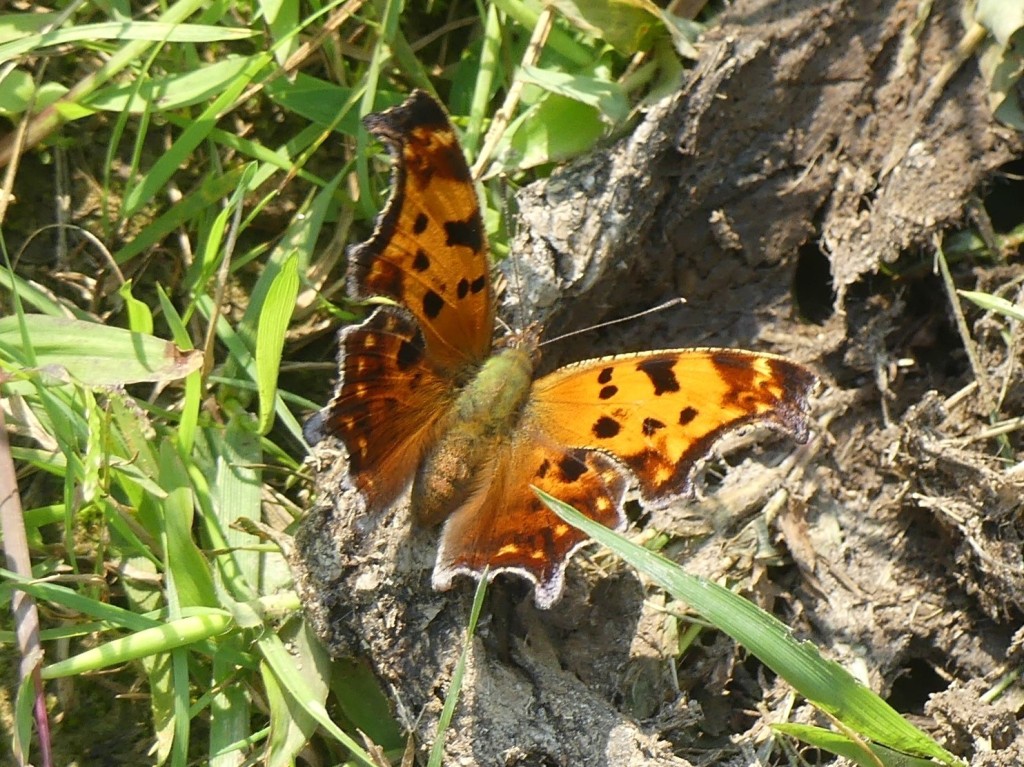
EASTERN COMMA BUTTERFLY

Okay, yes you’re right, a butterfly is not something that crawls in the night, but bear with me. Before this magnificent Eastern Comma butterfly emerged from it’s chrysalis, it was a caterpillar. And caterpillars do indeed crawl around in the night. Many prefer to feed at night so as to avoid detection by predators in the daytime.

EASTERN COMMA CATERPILLAR

Remember that beautiful Eastern Comma butterfly photo you just saw? Well, this (photo above) is what the Eastern Comma caterpillar looks like. Host plants for this caterpillar include nettles, elms and hemps. Adult Eastern Comma butterflies will overwinter under tree bark, leaves and similar locations, while most other caterpillars overwinter in a cocoon or chrysalis. I believe there are only about four or five butterflies that overwinter as adults in Ohio.

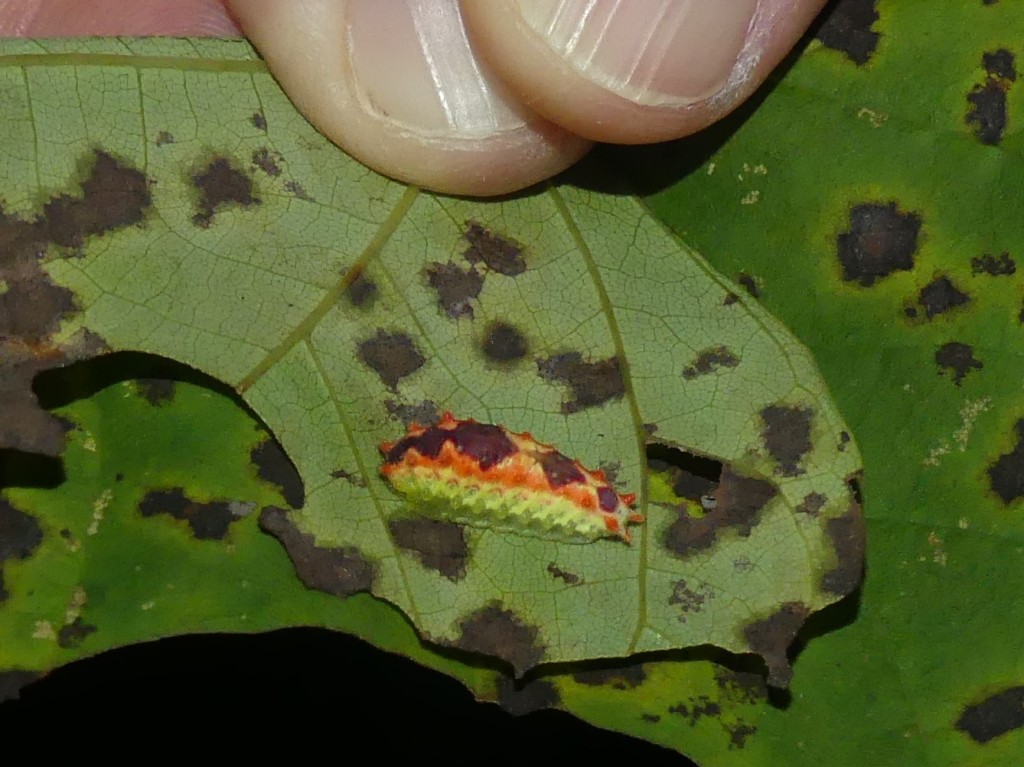
QUESTION MARK CATERPILLAR

The Question Mark butterfly is very similar in appearance to the Eastern Comma, but the Question Mark caterpillar (above) has different coloring compared to it’s Eastern Comma “cousin.”

The Silver Spotted Skipper are plentiful in central Ohio. For identification purposes, skippers fall somewhere in between being a butterfly or a moth. Here’s a photo (below) of one on Bergamot.

SILVER-SPOTTED SKIPPER ON BERGAMOT

And here’s what the Silver-Spotted Skipper looks like in caterpillar form. Tiny and cute! Looks like something from a cartoon doesn’t it?

SILVER-SPOTTED SKIPPER CATERPILLAR

Caterpillars are easier to find at night if you use a UV flashlight. The little creatures will gently “glow” in the dark and help you detect them. However, it’s very important that should you disturb these for a photograph that you return it to the same tree or shrub afterwards. Some caterpillars are generalists eating many different types of plants, while others are specialists and will only be able to eat from a particular plant/tree.

One type of caterpillar that is seen quite readily is the Tussock moth. There are several species of these rather nondescript moths with their brown/tan/gray coloring. But their caterpillars are anything but nondescript.

BANDED TUSSOCK MOTH CATERPILLAR

The one in the photo above is a Banded Tussock moth caterpillar. Actually, this is really a tiger moth caterpillar, despite it’s name.

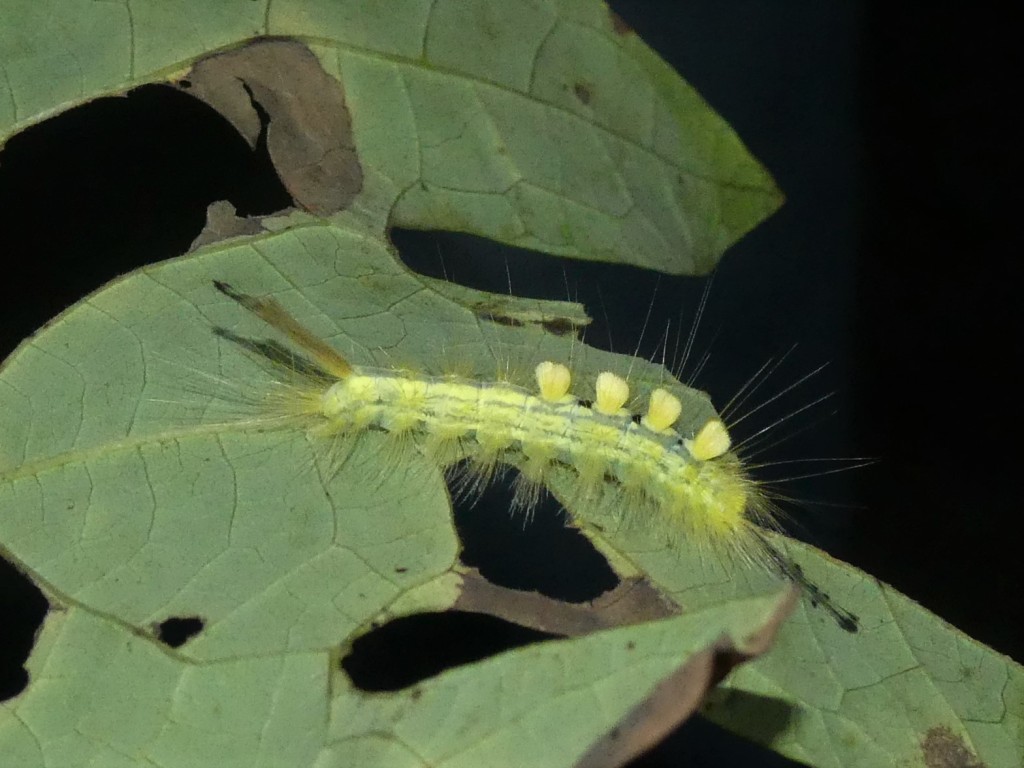
SYCAMORE TUSSOCK MOTH CATERPILLAR

The cute little pale yellow caterpillar above will become a Sycamore Tussock moth, named appropriately because its host (and preferred) plant is the Sycamore tree although it will eat other plants.

DEFINITE TUSSOCK MOTH CATERPILLAR

The photo above is a Definite Tussock moth caterpillar. Quite different in color and appearance from the other two. But beware, touching any of these Tussock caterpillars can cause a very uncomfortable itchy rash.

AMERICAN DAGGER CATERPILLAR

Another caterpillar that appears visually similar to the Banded Tussock is the American Dagger. This caterpillar will also cause a very itchy rash if touched, so be very careful when photographing these. The American Dagger moth is another rather nondescript moth of multiple shades of tan and gray. But I find this shaggy caterpillar adorable!

SPOTTED APATELODES CATERPILLAR

Here’s another interesting caterpillar. This one is a Spotted Apatelodes which is covered with what appears to be soft hair and sporting red “boots” on it’s little legs. Cute, but I’ve also read the caterpillar is poisonous although the adult moth is not.

BLACK-WAVED FLANNEL CATERPILLAR

At first glance, one might think this is some type of cocoon, but it’s the Black-Waved Flannel caterpillar. Cute but avoid at all costs! The hairs can embed into the skin and make one very sick. The moth on the other hand is a rather shaggy looking tan and brown but alas, also very dangerous to touch.

DELICATE CYCNIA CATERPILLAR

And while we’re looking at rather hairy caterpillars, here’s another one – the Delicate Cycnia moth caterpillar – also known as the Dogbane Tiger moth. And with good reason, as they they prefer milkweed species, especially Dogbane. This one was rather easy to find, as most of the leaves were stripped from a Dogbane plant with about eight of these caterpillars feeding on it.

Okay, we have now covered quite a few hairy caterpillars, how about we look at some with very distinctive shapes and colors?

IO (eye-oh) CATERPILLAR

This cute little one is an Io (eye-oh) caterpillar. And also one you should never touch. I wish I could share a photo of the Io moth, but I’ve never been fortunate enough to photograph one (and I try to use only my own photos in this blog.) The moth is very beautiful. Predominantly yellow with big black “eyes” on its hindwings. Well worth searching for a photo online to see it!

PURPLE-CRESTED SLUG CATERPILLAR

This tiny little caterpillar is a Purple-Crested Slug moth and is (yes, you guessed it) a species of slug caterpillar moth. They are generalists and can feed on a variety of trees and plants. Their “slug” name comes from the caterpillar’s resemblance to slugs.

SPINEY OAK-SLUG CATERPILLAR

This little guy is a Spiney Oak-slug caterpillar. Also a member of the slug moth family. I’ve read the spines are venomous and can cause serious health issues if handled. While “oak” is in the caterpillar’s name, they also feed on cherry and willow species as well as oaks. The moth is dark brown with pale green splotches on its wings.

SADDLEBACK CATERPILLAR

And here’s yet another spiney looking caterpillar. This one is the Saddleback, appropriately named with it’s cute little brown and green “saddle.” Yes, it’s also another slug moth. And one you need to avoid because of its venomous spines.

STINGING ROSE CATERPILLAR

This orange beauty (about an inch long) in the photo above is a Stinging Rose Caterpillar and yet another one to avoid due to the venom from the stinging spines. The moth this one will become is a beautiful one of pale green, yellow and brown.

HAG MOTH CATERPILLAR

This little brown blob is something that could appear to be bird excrement, but is actually a Hag moth caterpillar, sometimes called a monkey slug. I’ve read they’re legless and have spines with stinging hairs. The caterpillars are about an inch in length.

HICKORY HORNED DEVIL

Here’s one that could stop you in your tracks…the Hickory Horned Devil. With a name like that and those orange black-tipped “horns” it almost screams “stay away from me” but this one is harmless. This caterpillar is about the size of a large hot dog. These caterpillars can be found on hickory, walnut, sweet gum and other trees. The Hickory Horned Devil becomes a beautiful large Regal moth that is gray, tan and orange and nearly 6 inches across.

SADDLED PROMINENT

This caterpillar has the learned the art of self-disguise. It is the Saddled Prominent and it blends in quite well with the leaves. These caterpillars can defoliate trees when they occur in large groups. The moth is a gray-green color and rather “hairy” looking.

PAWPAW SPHINX CATERPILLAR

This PawPaw Sphinx also blends in well with its environment. And yes, it does like to eat PawPaw leaves, but it is also known to eat other tree leaves and plants as well.

TURBULENT PHOSPHILA CATERPILLAR

This white-spotted, black/white/yellow vertically striped caterpillar is a Turbulent Phosphila. It appears to have two heads but doesn’t. Its host plant is greenbriar, a brambly vine with heart-shaped leaves and while not invasive, it is very aggressive.

And finally, if you’re not too tired of seeing all the things that crawl around in the night, here’s something that’s just darn cute.

A SPIDER WITH A SMILE!

Yep. It’s a spider with a smiley face! I believe it’s a White-Banded Crab spider. But regardless, it’s just darn cute and I couldn’t leave it out of this blog.

I hope you’ve enjoyed seeing the things that “crawl in the night.” Many of these were new to me before going on the Shawnee Nature Safari. All nighttime photos in this blog were my first effort at taking photos in the dark, so thank you for hanging in there with me and being tolerant.

And until next time, keep exploring nature up close, cause it’s pretty darn amazing!

A Part of It All

Sometimes, if you’re fortunate, you get the unique opportunity to experience nature at a completely different level. It’s hard to describe, but it’s as if you feel you’re a part of your surroundings, not just observing it. It’s a very special gift that doesn’t happen often. For me, that depicts my time spent at Rifle River Recreation Area in northeastern Michigan.

We camped in the primitive area in August and found beauty beyond words. Many pristine lakes offered canoeing adventures. Quiet early mornings paddling on mirror-smooth surfaces that reflected the skies above. No traffic noise. No motor boats. Nothing but the gentle sound of the paddle entering the water as you slowly move along, with loons calling in the distance.

You won’t find loons on very small lakes, as they require up to a quarter of a mile of open water to be able to lift off and fly because of their relatively heavy bodies.

Sometimes you’re rewarded with loons that decide to share the lake with you. And if you’re very lucky and your timing is right, they just might have immature ones with them, teaching them how to feed themselves. Guarding them. Protecting them.

Teaching them how to find breakfast… Until eventually it will be time for them to find their own way from freshwater lakes to winter on the east coast.

You can completely lose yourself on a paddle in Michigan. Whether it’s on one of the many lakes or on nearby streams that connect lakes together such as this one. Pristine waters with wildlife all around you.

It’s not uncommon to see Green Herons along the banks, keeping an observant eye upon you.

Or sometimes it’s an Eastern Kingbird in the overhead branches…

Or this Dragonhunter dragonfly who was ovipositing eggs in the stream just ahead of our canoe, and then decided to take a momentary break on a nearby shrub. Beautiful coloring on this big girl. The wing venation is so delicate in these creatures…almost lace-like.

And a new one for me is this American Rubyspot. A beautiful damselfly. I’ve read the males have a red head and thorax, so I’m assuming this is a female.

You may also see a Bald Eagle or two in your adventures. They’re not uncommon here, and sometimes seem very curious like this one.. Did you know they can live 20 years or more?

Being so near the water you’re also rewarded with views of flowers you may not see very often elsewhere. Like this Fen Grass of Parnassus. Small petite flowers with the most exquisite veining. Once you see it, it’s not something you easily forget.

Another flower that resides close to water is this Bur Marigold. It’s in the daisy family and has long stems. A very showy flower that I’ve read reproduces from seed.

When you paddle on a lake or stream, you have opportunities to see nature up close, like this view of a young Killdeer which blended so well into its surroundings, it was difficult to photograph. But well worth the effort. Such a quiet little well-camouflaged bird – as are their eggs. Killdeer usually lay 4 to 6 eggs – eggs that are sometimes laid in stones along a driveway and are so well camouflaged that you can look right at them and not see them at all.

Camouflage in required in nature for survival. Most creatures embrace it, like this Northern Leopard frog blending into the rocks.

And there’s always Mother Nature’s artwork wherever you look, like this American White Waterlily. You’ve seen it numerous times I’m sure in photographs, but there’s just something about this flower when it’s just below the edge of your canoe, floating gently on the water. No one planted it. No one takes care of it. It just is. Beauty, simple and pure.

I’ll leave you with just one more photograph of something that struck me as particularly beautiful. Oh, it’s not a rare flower or bird, or anything extraordinary by most standards. It’s probably pretty common – what I believe to be an Orange Hawkweed. Yes, to most people, a weed.

But on this day, while having lunch along the riverbank, canoe resting peacefully on the edge of the shore, it caught my attention and brought me back to the realization that we’re all a part of nature. We don’t just observe it. We are a part of it, as it is a part of us.

Until next time…

Face to the Sun

I read somewhere the flower head (capitulum) of a sunflower will track the sun when it is young and growing, and will eventually face east when mature. Tracking the sun in this manner is called heliotropism. To me, it’s a bit of magic in the plant world.

WATERCOLOR OF SUNFLOWER

Many articles have been written about the common sunflower (Helianthus annuus) and why the flower heads follow the sun. It’s believed there is unequal growth in the plant stem. The east side of the plant stem grows more during the day than the west side, and vice versa during the night, thus allowing the flower head to move. But that changes when the plant is mature and its stem stiffens; then the flower head will face the east.

I sometimes wonder whether it’s somewhat similar for humans. No, not that we grow more on one side than the other. But that we excel when we turn our face to the sun and feel the first morning light hit the face with a gentle warmth and a promise of the day to come. Is that fanciful? Perhaps.

But I know I experience a lift to my mood when the sun is shining. I also know I feel my mood elevate when I see the the extraordinarily beautiful creatures and plants that nature provides. Maybe, just maybe, that’s my equivalent of having my “face to the sun.” Here’s some of my face to the sun moments from earlier this week…

Just before I put on my sandals to go out for a walk, this glorious creature appeared on the bushes by the patio. It made me stop in my tracks and grab the cell phone for a quick photo. A very obliging creature I must say. It’s a female Eastern Tiger Swallowtail. While males and females are both yellow, only the female has the blue wash of color near its tail. It’s even more miraculous to see considering its lifespan is only about two weeks.

EASTERN TIGER SWALLOWTAIL FEMALE

Okay, so I’m now on my way for a walk, and this creature greets me as I head out the front door. A Hummingbird Clearwing moth on another butterfly bush. Again, very accommodating to allow a cell phone so close for a photo. I’ve read these creatures only have one brood in northern states, laying small green eggs on the underside of leaves. Once hatched, they feed on plants and then drop to the ground to spin a cocoon and pupate where they will hide amongst leaf litter during the winter until they emerge in the spring. Yet another reason why allowing some leaves to remain on the ground can be a very good thing.

HUMMINGBIRD CLEARWING MOTH

Now, on with my tale…so I’m headed out for a walk when I also encounter this beautiful little Common Eastern bumblebee on a Great Blue Lobelia plant. The bee is a tiny female – only about half the size of what one normally thinks a bumblebee should be. She’s a great worker for the colony. See the yellow pollen on the hind leg? She sweeps the pollen off her legs and it collects in what’s known as the corbicula (pollen basket) on the hind legs. It’s how she carries this food back to the nest for the young.

COMMON EASTERN BUMBLEBEE ON GREAT BLUE LOBELIA

You never know what you’re going to see when you’re out walking. Some of the most amazing things we so easily overlook. Like this Chicory plant. It’s a pretty common sight. It grows quite readily along roadsides at this time of year. The flowers open in the morning, and close up in the early afternoon after a morning of sunshine. The bloom only lasts one day. And new blooms appear the next day. Amazing that this plant can so easily handle bad soil and road salt. I admire it for it’s toughness. And beauty.

CHICORY

We have a lot of Common Mullein growing along the bike trail this time of year. They’re huge, spiky looking plants, some easily reaching six feet tall. It’s an invasive plant in Ohio. But when you look very closely at the flowers, they’re amazing. This little Western Honey bee seems to think so. Easy to see the pollen collected on its hind legs.

WESTERN HONEY BEE ON COMMON MULLEIN

And finally, one more beautiful creature that also caught my attention and made me smile. A female Monarch butterfly on Purple Coneflowers. She’s a beautiful specimen. No torn or tattered wings. A Monarch will go from egg, to larvae, to pupa to adult butterfly in just about 30 days. And most likely she will soon be heading south for Mexico with the goal of reaching her destination in November, as I believe she may be fourth generation.

MONARCH ON PURPLE CONEFLOWER

There are so many beautiful things to observe in nature, just like the sunflower that turns its face to the sun tracking its warmth, growing tall and strong. I believe by observing and appreciating the beauty of nature around us every day that we too can experience the feeling of having our “face to the sun.”

Until next time, keep observing nature up close.

Of Expectations

Let me tell you a story. Once upon a time…no, not that story. It’s the story of leaving a home in a rather bucolic setting on 3 acres along a river where a multitude of birds, water fowl, flowers and butterflies abounded. And moving into a brand new home in a subdivision on a postage-stamp-sized lot. Easier to maintain. Single story. Better for the body as it ages, right? I had expectations of sterile, orderly subdivision bushes and shrubs with no birds, no flowers, no butterflies, no nature. Just shoot me now…

So…during Covid prime time 2020, we ripped out some of those “sterile subdivision bushes” (yes, I have more to do) and created what we hoped would attract pollinators. It certainly didn’t look promising when the flowers were planted.

NEWLY PLANTED FLOWERBED 2020

Here’s just a portion of that same flower bed in 2021. If you plant them, they do grow!

SAME FLOWERBED 2021

We also added a rear patio which now hosts a multitude of blooming flowers along with Arrowwood Viburnum and Serviceberry bushes. Are they all native plants? Unfortunately no, but a portion of them are – or at least the ones I could get my hands on last year.

Surprisingly it didn’t take long for nature to find us.

In the spring, we had a momma Mallard duck and ten little ones declare our little retention pond their home.

MOMMA MALLARD AND 10 BABIES

They would visit our bird feeder daily to find anything that may have fallen (or that we may have deliberately dropped to the ground). They stayed almost all summer until they grew to full size and flew off to begin their new adult adventures. That’s Momma to the right in the photo below. She would anxiously watch over the little ones while they ate. She was a good Momma (though somewhere along the line she lost two).

SAME MALLARD FAMILY

Ducks weren’t our only water fowl visitors. We periodically had a Great Egret that decided those little frogs and tadpoles in the pond were pretty tasty as well. Made for a great mid-morning snack.

GREAT EGRET

We also had a few surprises…like this Canada Goose and Mallard duck that decided to be best buds for the day. Swimming around the pond together. No other ducks or geese in the pond, just these two. Who knew?

CANADA GOOSE AND MALLARD DUCK

And surprisingly, even in a new subdivision with no large trees, birds also made our area their home.

Shortly after our house was built, we had a visitor (Northern Rough-Winged Swallow) that was quite beautiful, which unfortunately for us decided the HVAC exhaust pipe would make a fine nesting place. Who needed to built a nest in a hole in a creek or river bank? This one was perfect. Not! It didn’t take long to add a screen to the pipe and encourage this little lady to find a more appropriate home elsewhere.

NORTHERN ROUGH-WINGED SWALLOW

We had a pair of Tree Swallows fledge 7 this year in our nest box. Turns out the retention pond is great for easily finding insects to feed their hungry little brood. It was a very successful year for them. We also had nests of Mockingbirds and House Finches in shrubs in neighboring yards so there were plenty of these little birds fluttering around.

TREE SWALLOW

And much to our amazement, we had a Red Headed woodpecker that visited quite frequently. Seems our suet was within easy flying range of the treed area he called home. Red Headed woodpeckers are more rare in Ohio than they used to be with their numbers dwindling over the years.

RED-HEADED WOODPECKER

And not to be outdone, we had a very surprising visitor just this past week. Yep, a wild turkey. In a brand new subdivision. Huh! I guess nature really does come to you if you let it.

WILD TURKEY

The retention pond was extremely good for attracting dragonflies and damselflies. Delicate creatures that are exquisite when viewed closely like these Familiar Bluets.

FAMILIAR BLUET DAMSELFLIES

Or (what I believe to be) an Eastern Forktail, which is only about an inch long.

EASTERN FORKTAIL DAMSELFLY

Frogs were commonplace here. In spring and summer many voices were heard. Tree frogs, American Toads and Bull frogs would be the accompaniment when drifting off to sleep at night. This little Gray Tree Frog decided he liked our grill. We had to persuade him that there are better places to reside (and ones that don’t get hot).

GRAY TREE FROG

The flowers drew in their own admirers. Hummingbirds were constant visitors.

HUMMINGBIRD

As were many butterflies and moths. This Eastern Tiger Swallowtail had been battered about quite a bit; its wings showing the damage. Often times this damage is a result of eluding predators such as birds. Butterflies can continue to fly with damaged wings, but if one becomes broken, they cannot fly and will die.

EASTERN TIGER SWALLOWTAIL BUTTERFLY

Adult Painted Lady butterflies (like the one in the photo below) like Asters, Ironweed, Blazing Star and Joe Pye weed among others. Typically flowers that are 3 to 6 feet tall. In this photo it’s on Butterfly bush although Blazing Stars and Ironweed are both found close by.

PAINTED LADY BUTTERFLY

And this female Monarch. Though not visible from this photo, the male Monarch is distinguished from a female by having two black dots on its hind wings.

FEMALE MONARCH BUTTERFLY

This tiny little Summer Azure was also seen flying about. To give you a better perspective of size, it’s on a piece of clover in the backyard.

SUMMER AZURE

Bees and other insects were also regular visitors. This is a Two-Spotted bumblebee on Purple Coneflower. And if you look closely, there’s a green sweat bee right behind the bumblebee.

TWO-SPOTTED BUMBLEBEE ON PURPLE CONEFLOWER

And one of my all-time favorites. This is a Bombus fervidus (Golden Northern Bumblebee). Gorgeous, isn’t she? Not one that you see on a regular basis in Ohio.

GOLDEN NORTHERN BUMBLEBEE (Bombus fervidus)

Bumblebees have a unique lifecycle, living just one year and in most cases, less than a year. A fertilized Queen overwinters in the ground by herself. In the spring, she flies low over the ground locating a suitable habitat for a nest. She then feeds on nectar and pollen to gain strength, then begins laying eggs in the new nest. Her first nest will be of all daughters, then she ceases to forage and focuses on laying successive generations of eggs (all females). The new daughters will now be the workers that will collect nectar and pollen for the nest and all future eggs/larvae. In late summer the Queen will produce both males and females. Both sexes will mate with different colonies of bumblebees, while the rest of the daughters who have worked so diligently throughout the summer will die off, as will the Old Queen and the males. The newly mated (fertilized) Queens will then overwinter in the ground, and the cycle will continue the following year. A Queen could produce 50 to 300 bees in a year.

We also get Eastern Carpenter bees with their “shiny hineys” which some people confuse with bumblebees. These are usually quite large bees but they have no sting. This one is on a Monarda (commonly called Bergamot or Bee Balm).

EASTERN CARPENTER BEE

One bee that was a visitor to our yard was the European Wool Carder bee. It’s pretty unique. This male has black barbs that are visible at the end of its abdomen. It’s actually quite territorial and will chase away other bees from areas it determines is “his.” It’s a non-native and rather aggressive with other bees.

EUROPEAN WOOL CARDER BEE

There are so many other things I could share with you. Beautiful flowers that burst with color. Queen of the Prairie, Lupine, Black-Eyed-Susan, Speedwell, Butterfly Weed, Cardinal flower, Coreopsis, Great Blue Lobelia, Ironweed and more – flowers that can attract nature to your yard.

Beautiful color for the yard. For fresh-cut flowers. For the birds, bees and other insects that live amongst us. Even in a newly constructed subdivision.

I’ve changed my expectations about what it means to live in a new subdivision. Maybe, just maybe, I’ve given you something to think about when your expectations tell you something won’t work or isn’t possible. Perhaps you will consider digging your hands in the dirt and plant something new – sometime that may attract welcome visitors such as what you’ve seen here. There’s a lot of nature out there just waiting for you to give them a helping hand.

Until next time, keep exploring nature up close.

Nature’s Jewels

Sometimes I have to stop and reorient myself to the magic of nature in front of me. Is it a human tendency to not see what’s obvious? Are we always looking for the grand and glorious without actually realizing the magic right in front of us? I’m not sure what the answer is to that one. I just know sometimes I have to stop. Slow down. And bring back that inner wonder of a 4-year old child that really does see it.

On a hike this past week, the sunlight landed just perfectly on an Ebony Jewelwing damselfly. Now wait…before you close this blog or have your eyes glaze over at the mention of an insect, just take a look at this one. It’s something I’ve not seen till now.

Oh, don’t get me wrong. I’ve seen plenty of Ebony Jewelwings. The one in this photo is a female and is generally described as having brown colored wings with white spots at the tips. But on this day, the sunlight caught this creature and made me truly see why it is called a “jewelwing.” The metallic sheen to the thorax, the look of almost gold threads decorating its wings. Exquisite.

The males are also colorful in their own way with jet black wings and an almost metallic blue abdomen. How did nature create such beautiful colors in such a delicate package? Amazing what we see when we look.

Nature’s jewels come in all colors, whether one is talking about insects or flowers. This one caught my eye as well; I think because the contrasting color combination is so dramatic. Surprising that this little flower fly is only about a half inch long. It’s a Margined Calligrapher – also known as a hover fly. It seeks nectar and pollen. It’s a bee mimic and gains protection from would-be predators as a result. It not only helps pollinate flowers, it also eats aphids from those flowers. A true jewel of nature in many aspects!

And with more flowers coming out in bloom right now, so do more bees. Like this little one. It’s from the genus Melissodes (long-horned bees) but unfortunately this photo isn’t good enough for a species ID. As you can tell by the photo, they’re pretty good pollinators. Only females collect pollen; males do not.

I’m always mesmerized by the coloring of bees, like this Two-Spotted Bumblebee I found on my flowers this week. Dramatic contrast against the vivid purple of the flowers, don’t you think? Ohio has about 10 different species of bumblebees, with the most widespread being the Eastern Common. I’m always thrilled when I find a species that isn’t quite so prolific. Not sure why…guess it’s just recognizing it’s something out of the ordinary.

And, as usual, sometimes when you take photographs you manage to capture more than what your eye originally saw, like in the photo below. I took the photo to capture the bumblebee, not seeing it had a sidekick friend.

The tiny bee to the left could be an Osmia in the genus Agapostemon because it appears to be bright green metallic and carrying pollen on its abdomen. But there are also some cuckoo wasps which look somewhat similar. Just guessing on this one; the photo isn’t clear enough to determine. But still a thrill to catch two bees on this Purple Coneflower.

Sometimes you never know what you might find on flowers, like on this Yellow Pond Lily which was a true surprise upon closer inspection. I saw the bee enter the flower from a distance away and zoomed in to see what it might be, but the damselfly on the edge and the two below on the stem were a true surprise. I do appreciate the zoom on my FZ300!

And speaking of catching a photo of something you weren’t expecting…It took me a while to realize what was happening in this photo. This female Eastern Pondhawk flew off with what looked like a twig in it’s clutches. Curious behavior. Until I looked closer at the photo and realized that “twig” was (unfortunately for the damselfly) lunch for the dragonfly.

Golden hues abound in the summer and catch ones eye. We’re fortunate to be near a very successful breeding ground for Prothonotary warblers. This flooded woody area offers many nest boxes mounted to trees just above the water. Food is plentiful there for them and their young. Catching sight of this winged wonder always makes me smile.

As does this dainty little Summer Azure butterfly. A delicate pale blue with a wingspan of just one inch, it’s a tiny little thing that flits about very quickly. Its size is more apparent when seen on this piece of clover that is commonly found in most yards. Such a delicate little butterfly.

Nature’s jewels…all of them. And they’re all around us if we only take the time to stop. Slow down. And really see what’s in front of us. There’s so many jewels of nature out there that can bring a smile to the face, a lightness to the heart, and yes, even a spring to your step.

Until next time, keep exploring nature up close. I hope you find some jewels of nature that bring you joy.

Gossamer wings…

Butterflies always mesmerize me – enough so that I’ve been known to instantly stop in my tracks to admire and observe. So much beauty in such a delicate fragile package. A true miracle of nature.

I try to put names to them, but even more importantly I like to focus on their behaviors. Some flit by your face and do a few circles around you like some Eastern Tiger Swallowtails have done to me quite often. Though once in awhile, one lands and does a nice pose.
Even the underside of their wings are colorful with vivid orange and blues with a black stripe along the body.

Some butterflies are so absorbed in their acquisition of nectar that they’re practically oblivious to humankind, unless that is, you get too close, move suddenly or create a shadow over them. So…maybe they’re not so oblivious. Perhaps that’s what makes the photography such a challenge.

Zebra Swallowtails are rather notorious for flitting quickly and avoiding photos, at least in my experience. They’re a very beautiful butterfly, perhaps because I so rarely see them, although they are found in the eastern U.S. Their host plant for laying eggs is the Pawpaw tree as this is the only kind of food the caterpillars will eat, which is somewhat similar to the Monarchs requiring milkweed.

There is another type of Zebra butterfly; this one is the Zebra Longwing. While somewhat similar, it’s overall shape is quite unique. They are typically found in southern states in the U.S. plus parts of Mexico and Central America. Its grace and beauty are unparalleled.

Zebra Longwings are unique not only in looks but also in lifespan. Most butterflies lifespans are just one month or less, while the Zebra Longwing can live up to six months because they eat not only nectar but also pollen. They collect pollen and externally secrete a substance to combine with the pollen to make it liquid so they can drink it. The pollen helps extend their lifespan.

Of course, there are exceptions to standard butterfly lifespans. The Monarch lifespan can be 2 to 6 weeks except for the last generation which (I’ve read) can live about 8 months. This is the generation that migrates south in the fall and north in the early spring. There are other butterflies that overwinter as adults in Ohio including the Mourning Cloak, Eastern Comma and Question Mark.

And…here’s a photo to exemplify that Zebra Longwings and Monarchs play well together.

There are many beautiful and unique butterflies out there. Take this Question Mark for example. It’s shape is very similar to the Eastern Comma with the most distinguishing feature the pattern of dots on the forewing, and even then it’s easy to confuse the two. Both the Question Mark and Eastern Comma feed on nectar and enjoy the liquid from rotting fruit. It’s a super sugar charge for them.

The White Peacock is another beauty on the wing found in predominantly south Florida and southern Texas in the U.S. and also in Mexico and Central America. This beautiful creature feeds on nectar from plants such as Spanish Needle which was plentiful in many parts of Florida. This gorgeous beauty unfortunately has been in battle and lost part of it’s wing.

Another butterfly found in southern states is the Queen. It’s a majestic beauty with mahogany brown wings illuminated by white spots and outlined in black. Stunning! The Queen and the Monarch can easily be mistaken for one another due to their similar coloring, but they also have another factor in common. They both feed on milkweed and are toxic if birds should decide they look edible.

And not to be outdone is the Spicebush Swallowtail with it’s vivid black and blue coloring. As the name implies, it’s hostplant is the spicebush though I’ve read they also like white sassafras as well. The adults favorite source of nectar is Jewelweed, Joe-pye weed and honeysuckle.

And here’s a second photo of the Spicebush swallowtail that shows rather dramatically the “tail” in swallowtail.

Another colorful butterfly is the Common Buckeye with its toasty brown and orange coloring with eye-catching eye spots, though this photo isn’t a good rendition of that with it’s faded coloring and tattered edges. This little one has seen better times.

One of the largest and most magnificent butterflies is the Eastern Giant Swallowtail. It has a wingspan of up to or more than 6 inches. It is actually the largest butterfly in North America. Nectar plants for this butterfly include milkweed, butterfly bush and zennia. Once you see this beauty flying about, you just may be out there planting things that attract it. It’s pretty memorable to see.

The photos of the butterflies I’ve shared with you in this blog were taken while in Florida this past winter. Their beauty brightened my winter adventures and brought smiles to the face. I hope they brought smiles to your face as well.

Until next time, keep exploring nature up close.