Bee amazing

This has been an unusual year for everyone. One of the things I’ve gravitated to has been learning online about nature, as well as experiencing it outside.

This fall I participated in a 5-week online class about bees in the eastern United States. Now I’m probably like many of you, and at the mention of bees I instantly thought of honeybees and the nasty stings of yellow jackets. But the Eastern Bees 101 class offered by The Ohio State University Extension office has changed my mind. Completely.

Bees are pretty amazing creatures! Let’s look at the bumble bee as an example.

Isn’t she beautiful? This is a Bombus fervidus or a female Golden Northern bumble bee. This is one you don’t see nearly as often as the Common Eastern bumble bee (Bombus impatiens) which is prevalent here in Ohio. Look at how “golden” she is. Her abdomen is yellow on the first four (tergal) segments with just the last two being black. A Common Eastern bumble bee would have just the first abdomen segment that is yellow. In the photos below you can easily count those segments.

And she has a unique black “stripe” across the top of her thorax (the middle part of her body where her wings attach).

Bumble bees live a year or less, depending upon whether they are male, female workers or the queen. They are primitively eusocial, that is…partly social and partly solitary. Their life cycle explains this.

A fertilized queen will emerge from underground in April to early May. She will be by herself. She will feed on pollen and nectar after her winter “nap” and will frequently be seen flying close to the ground looking for a good place for a new nest. She then starts a nest and lays eggs – all daughters. The eggs will quickly turn into larvae, which the queen provisions with pollen and nectar so they may become bumble bees.

Once the daughters go from larva to bumble bee, they are able to forage for food for the nest, and the queen stays in the nest and lays successive generations of eggs. She will lay anywhere from 50 to 300 eggs over the summer (depending on the species of bumble bee).

Queens have the ability to determine whether their eggs will be male or female. In late summer she produces what will be future queens and males. Males will find mates from different colonies and the new queens will mate with males from other colonies. At this point the hardworking daughters in the colony will die, as will the old queen and the males.

Newly mated queens will find a hibernaculum (a place to hibernate for the winter). And next spring the cycle will start all over again.

There is so many interesting things about bees – such as how they carry pollen and nectar, which is different for different bee species. A female bumble bee has what is called a “corbicula.” It’s a smooth indentation in the upper part of their hind leg that is slightly concave. This allows them to carry a mixture of pollen and nectar back to the nest.

The photo below is of a female Common Eastern bumble bee. If you look closely at the leg you can see a slight bit of yellow on the corbicula. Only bumble bees and honeybees have a corbicula. Other bee species may transport pollen on the underside of their abdomen, or on their hairy legs or even eat it and regurgitate it to their young. It varies based upon the type of bee.

I was fortunate enough this summer to be at Clear Creek Metro Park and see a bumble bee “warming up” on a flower. Bumble bees have this unique ability to disengage their wings and operate their flight muscles in order to warm their bodies. Sort of like how we shiver. Bumble bees need to have a body temperature of at least 80 degrees Fahrenheit in order to fly. I’m only sorry I wasn’t able to get a good photo of this to share with you.

And one final item you might find interesting…if you look carefully in the early fall, you just might see some of those male bumble bees “sleeping” on flowers in the early morning hours because once they initially leave the nest, they never return to it. If you ever see a bumble bee “sleeping” on a flower, you can be assured it will, in all likelihood, be a male.

Bumble bees are really pretty docile and aren’t aggressive (unless you threaten them or their nest). The photos in this blog were obtained not by a zoom lens but rather by getting my camera close without being threatening.

I hope the next time you see a bumble bee, you take a minute to look more closely. They’re really very beautiful and interesting creatures.

Until next time, keep exploring nature up close.

Sheldon Marsh

Exploring nature preserves is a great way to banish “Covid fatigue.” It’s like a mini vacation wrapped up in a single day and provides a bit of exercise, fresh air and restores the spirit. I can highly recommend it.

This week we packed our hiking boots, a snack, water and drove an hour or so (on as many backroads as possible) to explore Sheldon Marsh state nature preserve near Lake Erie in Ohio. It’s offers about 470 acres, is home to 300 species of birds and is a well-known place for quite a number of wildflowers in the spring.

SHELDON MARSH

But it’s not all marshy, by any means. Even at the end of October the leaf colors are beautiful, though a bit past their prime.

The Preserve offers some wide straight, wide trails directly to the beach area, but I would suggest following the woods trail instead. It meanders through the trees and provides great views of the marsh and the creatures that live there.

According to signage, the Marsh has hundreds of turtles that bask along the shoreline including Midland painted turtles, snapping turtles and the Blandings turtle (Emys blandingii or Emydoidea blandingii). According to Wikipedia, Blandings turtles are an endangered species in some areas of the eastern U.S. and Canada, can reproduce for 80 to 90 years and show little or no common signs of aging. Wow! That’s a turtle I would like to see.

Unfortunately on this day there was little if any sun so it wasn’t conducive to those basking turtles (which is why I plan to come back).

This area is very attractive to ducks and shore birds. On this day we saw Wood ducks, Mallards. Gadwells, Canada geese, cormorants and Great Blue Herons. I have a few photos to share of these, but the zoom on my FZ300 wasn’t quite up to it, as the ducks/geese were quite a distance away.

GREAT BLUE HERON (forefront) and WOOD DUCKS (rear)

We also ran into a pretty aggressive groundhog. Now before you start laughing (I did too when a fellow visitor first warned me), take a look at the photos. They just might change your mind.

NORMAL GROUNDHOG, RIGHT? NOT!

Now normally groundhogs are pretty timid. They run away when they see a human. Not this guy! He would look at you, then come out onto the trail and face you like he was taking a stance. If you moved, he moved to face you and showed some teeth. He didn’t act rabid; he just acted old and mean like we were on his turf – which we were I suppose. Poor guy.

But that didn’t stop us from sliding around him to get to the Lake. It was a bit windy on this day and quite choppy. The gray/blue skies blended well with the icy gray color of the lake. The wind was quite loud in the tree branches and leaves along the shoreline.

Very near the water in some shrubby areas was a Yellow-Rumped warbler flitting about. They DO move quickly. I was surprised I could get any photos at all.

This is a barrier beach and (according to signage) is one of the most fascinating habitats at Sheldon Marsh. It’s one of the largest protected beaches on Lake Erie’s south shore. It provides the potential for bird nesting habitat of such endangered species as the Common Tern (Sterna hirundo) and Piping Plover (Charadrius melodus). (The Common Tern is listed as endangered in Ohio and the Piping Plover is on the federally endangered list.)

BARRIER BEACH AREA

If you get the opportunity, take a break from “Covid fatigue” and visit Sheldon Marsh. It’s a glorious place to explore nature and let go of some of life’s stresses. While not too many people feel comfortable going on vacations these days, a mini-vacation day trip to a nature preserve is almost perfect.

VISIT SHELDON MARSH STATE NATURE PRESERVE

Until next time, keep exploring nature up close.

A New Appreciation

My favorite season of the year is Spring. Always has been. Primarily because I am always so in awe of the new little leaves on the trees and the promise of spring wildflowers popping through the ground, especially after living with bare tree branches and cold Winter weather.

But I moved into the Fall this year with an amazing new respect for the season. In the past I’ve seen it as the beginning of Winter, wherein I dread the cold weather and have a feeling that everything has died. But this year, for the first time in my life, I truly embraced Fall. I really reached out and was amazed to find a new appreciation for the glorious color and splendor all around me.

And as much as I hate to admit it, I think it’s a side effect of the Covid pandemic, wherein you realize how important it is to appreciate each day. I know everyone always says to try to find the positive side of everything, but I think in this case, the positive side found me!

Just look at this photo. It’s of a rail trail (the Ohio to Erie Trail in central Ohio). It’s probably much like a trail you have in your area – perhaps in a local park, or in a neighborhood – but it’s absolutely glorious in the Fall! I’m so shocked that I’ve never appreciated this in the past.

I went on a hike at Boch Hollow state nature preserve earlier this week with friends. The colors in southern Ohio weren’t yet at their peak, but it still supplied yet another amazing Fall experience.

PHOTO CREDIT: Robert Papps

This scene mesmerized me. It was as if God had flipped on the light switch and illuminated the forest. There weren’t the vivid oranges and reds that maple trees provide, but it had an appeal all its own. It was primarily a beech/oak area of the woods with steep ravines and beautiful golden leaves gently filtering down to the forest floor. Quiet. Peaceful. The rest of the world just didn’t exist. No politics. No news updates. Just you, and the earth and the realization that it really is possible (at least for a time) to let go of all the “stuff” that bogs down our lives. And just be.

Of course we always have a few creatures to keep us company on any hike. Little friends whose primary goal this fall may be to build up their food supplies to survive the winter. This little guy (or gal?) blended well into the background. He was as curious about us as we were about him. Usually chipmunks don’t stick around long before they sprint off to find their hidey hole for protection. This guy was the exception.

While this wasn’t a bird watching trip, we were able to capture a photo or two of a White-throated sparrow hiding in the brush. I’ve never had much appreciation for sparrows in the past. I guess I’ve seen them as rather non-descript brown birds that weren’t nearly as appealing as warblers in the Spring. But I don’t see how I could have overlooked this little beauty with it’s spots of yellow, black head stripes and brilliant white throat. Another new appreciation I guess.

One thing I’ve learned to appreciate this Fall is when I see something suddenly illuminated by sunlight. Almost like (just like the earlier forest scene in this blog) a light switch is turned on and a spotlight focuses on something in an extraordinary way. I thought I’d share one of these with you.

TURKEY TAIL FUNGI

This is Turkey Tail. The sun just beamed down on this one specific thing for a very short time, while all around it, the area stayed dark. Like someone was saying “just LOOK at this!” And you don’t have a choice but look and admire. Turkey tail (Trametes versicolor) is a polypore mushroom and if you haven’t seen this before, you’re in for a treat, because this little jewel comes in many, many colors. They can be shades of brown, tan, gray, black, green, tinged in purple… and I’ve yet to read exactly why they are the colors they are. Oh I suppose there has to be research out there somewhere that explains it, but I haven’t read it yet. Maybe a reader of this blog will share that with me sometime.

And I can’t end this blog without offering another mesmerizing photo of Fall. This one is from a trail close by. It offers a little glimpse of the stream below (which is very low right now), as well as the beautiful colors of the tree canopy above the trail. It’s an absolute pleasure to walk there.

I hope you take the time to fully embrace the colors of Fall and, like me, learn to appreciate its beauty every single day. May your path be lined with the many wonders nature provides.

Until next time, keep exploring nature up close.

A Walk in the Meadow

I’ve done quite a lot of walking this year, partly due to Covid and partly to seek the beauty that surrounds me every day. Many times those walks have led me to the woods. There’s just something so appealing about walking through towering trees and realizing the history that must have been occurring when they were just saplings. But also I’ve found meadows can be just as appealing in a very different way.

Like this pollinator meadow at Caesar Creek State Park. This view made me stop in my tracks to admire it’s magnificent color. Quiet. Calm. Peaceful. The bees loved it. And so did I.

Not too long ago I visited Wolf Run Regional Park which is just east of Mt. Vernon, Ohio. It’s on about 288 acres with 10 miles of trail that lead through woodland, open field and meadow – quite a nice combination. The sun was shining the day I visited though most of summer’s wildflowers were winding down.

Big blue stem and Indian grass were scattered about the area, but my eye was caught more often by the handful of wildflowers that were still blooming, like Gray-headed Coneflower (Ratibida pinnata), Purple Coneflower (Echinacea purpurea) and Partridge Pea (Chamaecrista fasciculata). They were still hanging in there producing just a few more blooms. It’s the end of the season, but it’s encouraging to know these are perennials and they will be blooming here again next year.

But not to worry, some birds (like this sparrow) enjoy those Gray-headed Coneflower seeds immensely. The birds are probably very pleased these flower heads have dried.

Many times I don’t know the name of something I find fascinating. But that’s okay too because I find when I’m just strictly focused on naming something I may not really SEE the beauty before me. Here’s an example. I’m not sure what this flowering plant is, but take a good look at the close up photo. See the water droplets on it sparkling like little pearls? Isn’t that stunning?

And here’s a little treasure I nearly walked on. A small wild strawberry (Fragaria virginiana), blooming in the grass near the edge of the trail. A gift of nature waiting to be seen and admired.

Fall is a wonderful time to enjoy the many types of asters, milkweed and goldenrod. Did you realize there are more than 20 species of goldenrod in Ohio? I feel guilty in admitting I didn’t have a clue until now. The Cleveland Museum of Natural History has a fantastic field guide, Goldenrods of Northeast Ohio, that does an exceptional job of identification and includes a dichotomous key to assist (https://www.cmnh.org/goldenrods).

Here’s another member of the aster family that is one of my favorites, Ironweed (Veronia). It can be about 6 foot tall or more and has the most brilliant purple flowers. You’ll see it in many fields this time of year. It’s a wonderful source of nectar for butterflies and bees.

I hope you’ve enjoyed a walk in the meadow with me. Exploring a meadow in the early morning when the temperature is crisp, there’s few people about and there’s glistening dew sparkling on the flowers – you just can’t beat that. I hope you find time to explore a meadow soon.

Until next time, keep exploring nature up close.

Boch Hollow State Nature Preserve

In a small rural area near Bremen in southeastern Ohio, tucked away into the rolling curvy roads, you will find Boch Hollow State Nature Preserve. It’s located on about 600 acres and features a small pond within a mile of the trail head and seven miles of magnificent hiking trails through wooded areas, ridges and riparian corridors. And if you visit on a weekday, you will most likely find next to no one there.

I was amazed by the large number of Poplar trees there, along with Red and White Oaks. Big, beautiful, massive trees that have undoubtedly seen a lot of history over their lifetimes. Impressive in stature.

The trails are fairly narrow once you get through the initial mowed path leading to the pond, but it’s well well defined and easy to follow. The trails hug the hillsides and encourage you to venture further into the preserve.

I feel remiss for not including a photo of the pond, but when we were there a young couple were enjoying a swim and had sufficed with underwear as swimming garments. Not a good thing to take a photo in this situation.

The topography was interesting, making me wish I knew more about geology that I do, so the best thing I can offer is a photo. This rock formation reminded me of the helm of a big ship. Appropriate given its size. It’s even larger than it looks in this photo.

There was quite a variety of fungi on the forest floor. I find these creations of nature so wonderful. I mean how can you look at these things and not be amazed by them? How do they form? Why are they the colors they are? Why are they in such different shapes? How do the delicate gills form beneath? All are mysteries to me.

SOMETIMES MOTHER NATURE ILLUMINATES WHAT YOUR EYE SHOULD SEE

Okay…enough of the fungi.

Let me share with you something very special we came upon around one bend of the trail…a small little cemetery dating back to the 1800s. Forgotten. Neglected. Distant relatives undoubtedly long gone.

The tombstones were very difficult (and in some cases impossible) to read, although one appeared to be a young son who died April 1, 1815 at the age of 5 months. Two other readable death dates on a couple of the stones were 1836 and 1840. It was sad to see. It made me wonder what their life stories were and how they came to be in this part of Ohio. Ohio became a state in 1803 but it was still a very young state at that point. I did some Google searching but could find nothing further about this cemetery.

I’ll leave you with one last look at the beautiful trail through Boch Hollow nature preserve. If you find yourself looking for a great hike, I can recommend this one. Very few visitors during the week and a great place to explore nature.

Until next time, keep exploring nature up close.

The Forest Floor

Some of the most magnificent artistic creations of nature can be found on the forest floor. Of course that sometimes means being down on hands and knees, camera close to the ground to capture something from an unusual angle.

One of the things I’ve been trying hard to do this summer is really observe what is around me, rather than just walking through life seeing what I expect to see. I miss so much of what nature has to offer when I forget to truly explore like a four-year-old.

AMANITA SECT. LEPIDELLA

Fungi fascinate me. Their unique shapes, colors and ability to pop up out of seemingly nowhere (and sometimes overnight) are amazing. Like this Amanita. It reminds me a bit of a dumbbell the way the bottom is of similar shape to the top. There are several hundred species of this type of fungi. Some are vivid colors or red or yellow.

SUMMER OYSTER MUSHROOM

These are Summer Oyster mushrooms. They are vividly brilliant white and look so delicate when seen from underneath. Their intricate gills remind me of an old fashioned silky pleated skirt. A true work of art, or at least to me it is.

SUMMER OYSTER MUSHROOM

But along with the beautiful and delicate also come what most would describe as a “standard” mushroom, but is really one of the most deadly ones in the forest – the Eastern North American Destroying Angel. Part of the universal veil on this mushroom can be seen at the bottom of it. A universal veil refers to a membrane covering on a fungi when it is starting to grow. As it grows, this breaks sometimes leaving bits on the top of the fungi and/or at the bottom, such as shown in this picture.

My take on fungi: DO NOT EAT MUSHROOMS FOUND IN THE WILD. Even experts in the field have been fooled by fungi that look similar to other edible ones. I just admire them and buy my mushrooms from the grocery store.

EASTERN NORTH AMERICAN DESTROYING ANGEL

But the forest floor isn’t all about fungi. It’s a wonderful world to explore, with new trails around every corner. Who wouldn’t want to find themselves on this boardwalk on a cool summer morning. Doesn’t it look inviting?

FOREST BOARDWALK

Or on this magnificent trail…where birds, chipmunks and squirrels keep you company. Where troubles and worries seem to cease to exist, and it’s just you and the forest. The sound of leaves rustle gently in the trees. And peace surrounds you.

BLACKHAND GORGE TRAIL

And flowers, of course, like this little yellow jewel. I believe it’s a Woodland Sunflower but not positive. This group of wildflowers always keep me guessing, but I so admire their beauty and ability to thrive in all types of circumstances.

WOODLAND SUNFLOWER ?

But look closer, and you will see the tiny little bug that likes this flower. This little one is in the Geron genus, but I couldn’t identify it beyond that due to the poor photo quality (and inexperience identifying bugs). The bug capture was pure accident, but it just goes to show when you take a photo you sometimes never quite realize what you’re actually getting.

GERON ON WOODLAND PLANT

And sometimes you just get lucky and manage a quick photo of something you happen upon, like this Green heron. There were somewhere between six to eight Green Herons in this small wetland area just off a very-little used trail in Blackhand Gorge state nature preserve. They were not very happy that we were sharing their wetland area, so we quietly observed and left them to their day.

GREEN HERON

Sometimes when I’m hiking I find beauty in things most would probably consider very unconventional, like the moss-covered roots of this tree. So many shades of vivid green and roots that stretch out across the ground like fingers holding onto the earth. Rather artistic. Mother Nature should be proud of this one.

Perhaps next time you find yourself in the woods, you’ll take a look around. Admire the beauty there and be sure to look at what great works of art you can find on the forest floor.

Nature at our Doorstep

I’m finding after months of hearing way too much news about Covid that I’m a bit on edge and desperately searching for avenues of normalcy. But, as always, I make sure I have a mask in my pocket when I walk out the door of the house with camera in hand.

In an effort to explore further afield, I’ve been trying to include a weekly “day trip” to different nature preserves. It feels a bit like a mini-vacation and provides the fun of exploring new areas while staying away from news headlines. That’s a win-win in my book.

JOHNSON WOODS NATURE PRESERVE OLD-GROWTH FOREST

There’s a terrific 200-acre old-growth forest in north eastern Ohio in Wayne County called Johnson Woods Nature Preserve. Some trees are said to be 400 years old. Signage states “Johnson Woods appears to be the largest and best old-growth woods found in Ohio.” And I would agree with them. My photos do not do it justice.

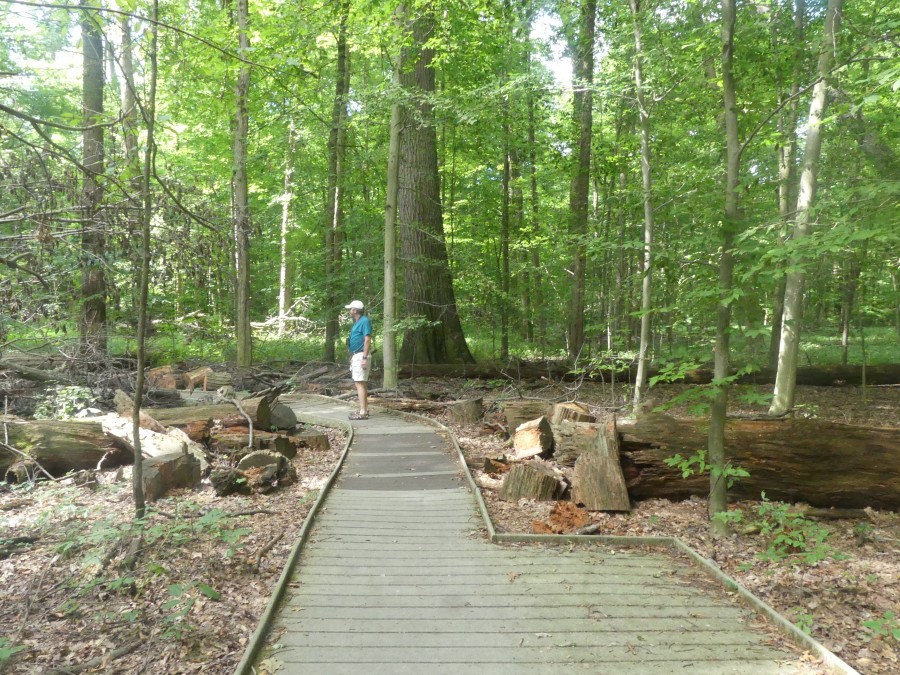
Upon entering the forest and walking on the 1 1/2 mile boardwalk trail, we were greeted by newly fledged Eastern Wood-Pewees being fed by a parent. Cute little guys that couldn’t quite fly straight nor land on a branch without wobbling a bit. But they’ll learn.

EASTERN WOOD-PEWEE

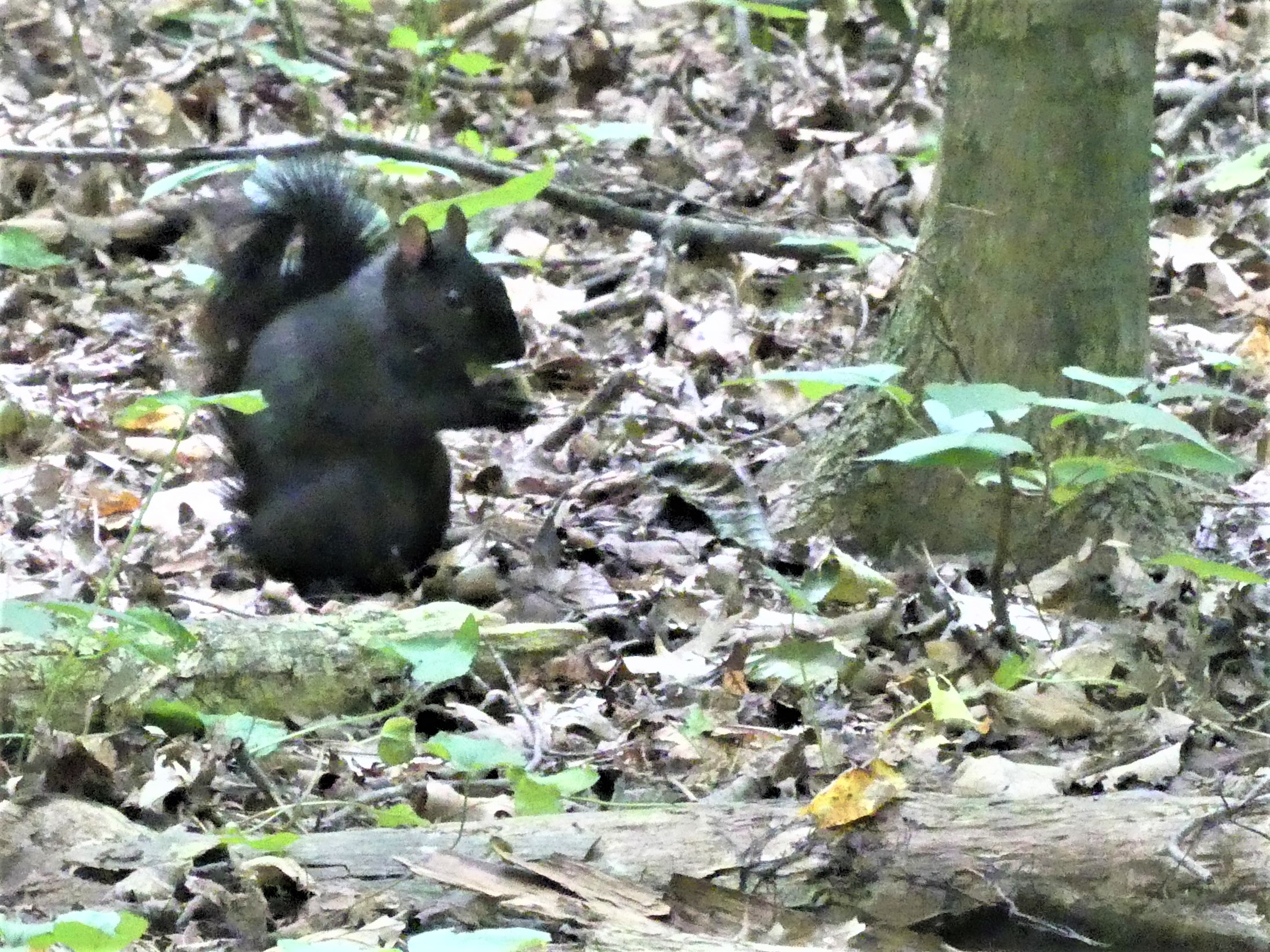
Eastern Gray Squirrels were plentiful, including black ones. I always thought the black ones were a separate breed, but found otherwise. Smithsonian says they’re a result of interbreeding between gray and fox squirrels which results in a faulty gene giving them their black color. According to Wikipedia, this occurs in less than 1% of gray squirrels. Some say the black squirrels are more aggressive and territorial.

The boardwalk is quite an accomplishment all by itself. The woods looks like it could be quite wet in the spring, so this would be the only way visit and maintain dry feet. More than 60 species of wildflowers have been documented here in the spring. Cardinal flowers were blooming quite well this past week and close enough to the boardwalk to get a picture.

1 1/2 MILE BOARDWALK
CARDINAL FLOWER

While you’re in this area, it’s well worth a trip to Barnes Preserve as well. It’s a nature park that is very close by. While it also offers walks through a woods, it’s the flowering meadows, vernal pool and pond that attract the eye here. And very few visitors. Makes one feel like it’s your own private nature preserve!

BARNES PRESERVE POND

Follow the trail through the meadow and down a wood-chip path to this glorious little pond. A wonderful place to contemplate the world – or just watch nature around you and absorb the peaceful setting. Like the mother mallard duck with her 8 nearly-full-grown babies following her every move through the pond. Or watch the Azure Bluet damselfly or Widow Skimmer dragonfly flit about the pond and grasses.

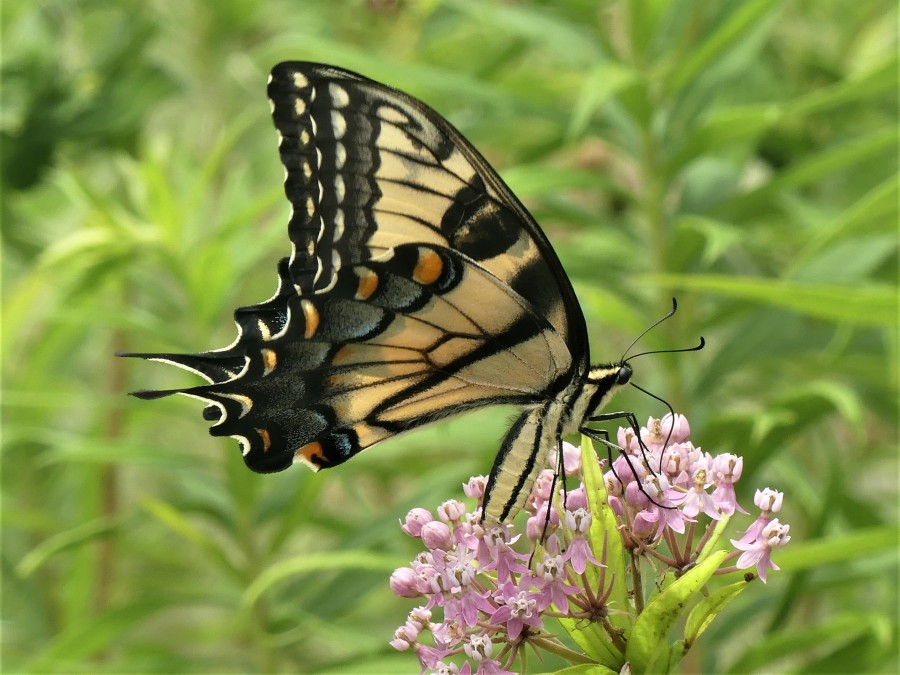
The wildflower meadow there is spectacular. Blue vervain was growing in magnificent patches, along with milkweed which was attracting many butterflies like this Eastern Tiger Swallowtail.

BLUE VERVAIN
EASTERN TIGER SWALLOWTAIL

Also in the meadow was what I think is a Rosepink. It’s a beautiful flower that has the most magnificent color. It’s a biennial which flowers in its second year and grows up to three foot tall. It’s common to the eastern United States, but it’s a new one for me. Looks like Mother Nature got out her water color paints to do this one.

Tucked into a corner of the woods was a little wetland pond that had been built as a class science project. It was shallow enough to attract quite a number of frogs as well as the most beautiful red Meadowhawk dragonfly. I thought perhaps it was a Ruby Meadowhawk (a new one for me), but I later learned that this dragonfly is very difficult to identify unless you have it in hand, and even then it’s not a sure thing. Oh well, a girl can dream…

MEADOWHAWK DRAGONFLY

I hope you’ve enjoyed the travels through these preserves. There’s so many wonderful things in nature to observe and explore. And it may be even closer than you think.

I can highly recommend a day trip to a preserve to give you a new perspective and appreciation of nature. It’s a great way to let go of problems and worries and ground oneself to what really matters. Nature doesn’t seem to be one bit bothered by Covid. Stay safe.

Until next time, keep exploring nature up close.

A Hidden Gem

Have you noticed how many people are out and about lately? Running. Walking. Biking. Pushing strollers with kids (or dogs, yes – not kidding). It’s a good thing, but it makes social distancing more of a challenge, which is why I’m always looking for interesting places to go to get my “nature fix” without joining the crowds.

This past week it was Chadwick Arboretum North.

I went on a Tuesday morning, and I saw five people in the two hours I was there. It’s truly a hidden gem in the middle of Columbus. Chadwick is a little nature oasis on The Ohio State campus, just off SR 315 and Lane Avenue (2235 Fred Taylor Drive). It boasts a 3.5 acre Research lake which allows fishing (catch and release) and lots of pollinator habitat, not to mention more dragonflies and damselflies than I could begin to count (or photograph).

I always have a camera in hand, hoping to catch that next great photo or find that particular camera angle that makes a scene eye-catching. I’m not so sure I’ve achieved that, but I do have a few that you might enjoy.

I always learn something new when I’m out in nature. That’s a given. On this day I found an Allegheny Monkeyflower that was on the edge of the lake. It’s a beautiful flower that looks a bit like a snapdragon but isn’t.

It gets its name because the bloom is supposed to look like a monkeys face – but I couldn’t see it no matter how I tried. It’s native and grows near water. It was about three feet tall and it spreads by both seeds and rhizomes. It attracts butterflies and is a larval host for the Common Buckeye and Baltimore Checkerspots. It’s a perennial and blooms June to September. It’s an endangered species in Maine.

I’ve been taking online pollinator classes this past spring and summer through the Ohio State University extension service, so this blog will be filled with a number of “critters” on flowers. It expands my education to not only identify what I’m seeing, but also understand a bit of its behavior and preferred environment. Plus, it’s just fun to do.

On this day the Brown-belted bumble bees (Bombus Griseocollis) were favoring the Coneflowers and Wild Bergamot/Bee Balm. Brown-belted bumble bees are recognizable (at least for me) for the brown belt that is on the T2 area of their back, which can be seen in the photo below.

BROWN-BELTED BUMBLE BEE

Of the bumble bees in Ohio, it is estimated that 19% are Brown-belted. The most common bumble bee (69%) is the Eastern Common bumble bee (Bombus Impatiens).

The Arboretum also had a number of Hibiscus flowers lining the lake. They had big, beautiful pink flowers that were filled with insects and bees, like this Hibiscus Turret bee (Ptilothrix bombiformus). It’s a solitary ground nesting bee. This one is has a bit of pollen on it, and I believe it’s a male that is waiting for a female to arrive for mating purposes.

Wasps were also enjoying the flowers. This may be a Metric Paper wasp (Polistes metricus) but am unsure of that identification. Due to the red coloration, it may be a female, but don’t quote me.

Here’s a cute little guy (a Western honey bee I believe but the photo isn’t good enough to confirm that). But what intrigued me was actually the flower that it was on – a Flowering Rush (Butomus umbellatus). A reed like wetland plant growing at the pond edge. They spread by rhizomes and can grow to four feet tall. While the flower is very pretty, it is an invasive plant in Ohio.

As mentioned earlier, there were a number of dragonflies and damselflies all around the pond area. Many dragonflies were doing great sweeping flights around the lake, but were too much for my poor camera to capture. I had to wait for those that would land on something. But a few did cooperate. Eastern Pondhawk dragonflies did quite a bit of posing that day. They’re pretty impressive due to size and color.

MALE EASTERN PONDHAWK DRAGONFLY
FEMALE EASTERN PONDHAWK DRAGONFLY

There were a couple of pennant dragonflies that were very colorful – the Halloween pennant and the Calico pennant. Both bright vivid bits of color that attract the eye.

HALLOWEEN PENNANT DRAGONFLY
CALICO PENNANT DRAGONFLY

And finally, here’s a male Twelve-spotted skimmer missing a wing, poor little thing. Most likely due to a close encounter with a predator. I’ve read that even with a damaged or missing wing they can still fly and find food. Obviously he wouldn’t be able to fly as well as an undamaged dragonfly.

And finally one last dragonfly I always find beautiful, the male Widow skimmer. Dramatically beautiful.

MALE WIDOW SKIMMER DRAGONFLY

I would be quite remiss if I didn’t give you one last look at Chadwick Arboretum North and encourage you to go for a visit. It’s a beautiful, peaceful area right in the middle of Columbus. And it always provides new nature wonders to explore.

CHADWICK ARBORETUM NORTH

Until next time, keep exploring nature up close.

A Walk in the Woods

There’s nothing like a walk in the woods to bring things back into perspective. Sometimes I find myself contemplating too many “what ifs” and “what might be’s” and not focusing on the here-and-now. A walk in the woods can help realign what’s important and help one let go of those things that are simply out of one’s control.

My walk in the woods on this day brought some of the unusual and unexpected, like this Barred Owl. I think it was watching me as much as I was watching him (or her). It did surprise me that it was roosting in an area that had dense tree branches and leaves. Normally I would expect it to be in a dark shaded area with tall trees and a bit more open space, but perhaps he was en route to a better roosting area. The Barred Owl is one of eight types of owls found in Ohio, and its call is readily identified as “Who cooks for you.” The Barred Owl has a rounded head, dark eyes, yellow bill and rounded tail. Perhaps you’ll see one on your next walk in the woods.

The trail was primitive in that it wasn’t the typical gravel path that one finds in a lot of parks these days. It was what I would classify as a good trail to hike. There were areas with large trees and those with more thicket-like areas like the one below. It’s always a treasure to find a quiet spot with few people and lots of nature. It’s also cool on hot summer days.

A number of birds were scouting for food among the trees and shrubbery (and mostly eluding my camera) except for this Prothonotary warbler and Scarlet Tanager. Both of which just popped up on the trail in front of me. Little brilliant bits of bright color that one can’t ignore and wouldn’t want to.

I also came across one of the largest Sassafras trees I’ve ever seen. The leaves of the Sassafras look rather like the shape of a mitten. The bark is very dense and somewhat resembles a Black Walnut tree. I’ve seen lots of Sassafras trees in the past, but none that were nearly this large. It was impressive.

This year I’ve seen very little fungi on my walks. Perhaps because it’s been too dry lately? I did happen upon this vividly colorful one. iNaturalist seems to think this may be a Wax cap, but I’m not sure about that. Fungi identification isn’t my strong suit.

Out in a sunny area, I found even more colorful species like this Blue-fronted dancer and Black Swallowtail butterfly – both enjoying the sunshine. They’re beautiful creatures that can be fascinating to watch and very challenging to photograph.

BLUE-FRONTED DANCER DAMSELFLY
BLACK SWALLOWTAIL BUTTERFLY ON CLOVER

This year I’ve noticed more milkweed than I can remember seeing in past years. They’re in fields, along roadsides and even in yards. It would be nice to think that people are planting more milkweed (or allowing it to grow) due to the awareness that we’ve lost a good percentage of our Monarch butterflies (Danaus plexippus) in the past 20 years. The loss has occurred due to a number of things including breeding habitat loss and pesticide usage.

Douglas Tallamy’s latest book, Nature’s Best Hope, promotes the value of incorporating native plants in yards, regardless of yard size or even if it’s just a pot on the patio of an apartment.

A New Approach to Conservation That Starts in Your Yard.

While I didn’t see a Monarch on milkweed this day, I did find bees and beetles on them, like these two guys hanging upside down. I loved the fact these two critters were similarly colored and were working side by side. Diverse, yet harmonious. I think we can learn from that.

Until next time, keep looking at nature up close.

A camping we will go…

Not sure what’s happening in your corner of the world these days, but Covid is raising its ugly head in Ohio with 19 counties on the “red” list, and the potential of more being added next week. Sometimes it’s hard to wrap my head around how to live life and still be cautious in this pandemic.

Our most recent effort involved taking a camper, canoe and hiking boots and heading to Alum Creek State Park. We could be self-contained with minimal exposure to others, while still enjoying the outdoors safely away from other people – and make us feel like we’re on vacation (or at least think we are). It’s not Michigan or Colorado, but it’s still pretty beautiful when you’re out paddling.

North of the state park is an area of low horsepower and no wake – a good thing if you’re in a canoe and don’t want ski boats to swamp you. It’s pretty peaceful there early in the morning with few boats of any kind. Native wildlife is always about. Like this turtle, which I believe is a Map turtle though I’m no turtle expert. It’s not a great photo, but I liked the reflection in the water.

Our paddle on our first day out took us near an Osprey nesting area, though we had to be content with taking photos from a great distance. Ospreys are in the hawk family and can live 15 to 20 years.

Most of the nests in the area seemed to have osprey on or near them. The ospreys were vocal but we were far enough away to not cause them concern. There’s a young chick just visible in the photo below.

Herons also abounded. Many times we had Great Blue Herons flying along with us as we explored the coves. They’re magnificent birds that always amaze me when I see them flying, though they have what I think of as “prehistorical” vocalizations when startled.

We also had two sightings of Green herons, though only one photo opportunity. Green herons are rather stocky-looking birds with yellow legs. They’re well known for hiding in bushes and branches. It was a very pleasant surprise to have one come out and pose.

TheCornellLab All About Birds web site (a great web site!) posted an “Amazing Fact” about Green herons that I hadn’t heard before (https://www.allaboutbirds.org/guide/Green_Heron/):

The Green Heron is one of the world’s few tool-using bird species. It often creates fishing lures with bread crusts, insects, and feathers, dropping them on the surface of the water to entice small fish.”

One day we were fortunate to have a couple of very dear friends come paddle with us. We explored a “finger lake” portion of the area that narrowed down quite a bit and challenged my paddling (and ducking of branches) skills. You would never know there is a pandemic when you’re out here. It’s a great escape I highly recommend.

This area is absolutely beautiful. You can take a picnic lunch along and chill out by the water. With nobody in sight. Peaceful. Quiet.

While paddling close to shore, we spotted a Prothonotary warbler as well as some Tree swallows that didn’t mind sharing the area with the “intruders” in the canoe. The warbler was much more interested in finding good things to eat.

Even though most of the creatures seen on this trip were in the bird category, we also saw a number of dragonflies and damselflies. Most were too elusive for photos, though one little Dancer (I think it may be a Blue-fronted dancer) did stick around for a bit. How could you not love a face like this little one has? This guy is less than 1.5 inches long; amazing!

I would be remiss if I didn’t thank my “Stern Master” (yes folks, he made that title up when I asked what the guy in the back of the canoe is called) and partner in adventures, my husband. Kudos for handling the canoe as still as possible so my photos weren’t fuzzy and out of focus.

So if you find life a bit too heavy at times, I can recommend a paddle on whatever quiet river or stream might be close to you. It doesn’t have to be somewhere distant or grand. Just a quiet corner where you’re away from others and you can watch nature around you. It’s good for the psyche and can put a smile on your face.

Until next time, keep exploring nature up close. And stay safe.