This is a challenging time of year to write a nature blog. Trees have gone dormant; their once colorful leaves are but a distant memory. The flowers of spring, summer and fall are nonexistent except for dried seed hoping to be transported on the wind to begin anew in another location. Nature’s reproduction system at work…
Not far from where I live are several Sweet Gum (Liquidambar styraciflua) trees. They are rather barren looking this time of year, as are most deciduous trees. Leaves are long gone, although branches create a natural artwork of its own. At first glance one might think the Sweet Gum could be almost any tree species. Nothing out of the ordinary until you look a bit more closely.
Seed pods hang precariously on its branches. In late fall/early winter seed pods are a warm dark brown, some having already dispersed their seeds.
Pods are sharp, prickly little things to the touch with what appears to have numerous little projections that are visually similar (at least to me) to the beaks of some seed-eating birds. And within that “beak” is a dark open hole. Seed pods may only be an inch and a half in diameter at most. It’s absolutely miraculous, don’t you think? Such intricate tiny detail, almost as if carved by hand. Here’s an up-close look.
Within those holes can be one or two seeds hiding away until they reach their maturity and escape their pod protection. The seeds are winged at one end which allow them to float on the wind and find a place they can take root and grow.
Seeds are small – perhaps just 3/8″ long and less than 1/8″ wide. Not all seeds make it to the ground to take root, as they are eaten by finches, towhees, nuthatches, Carolina wrens, chickadees, yellow-bellied sapsuckers, as well as squirrels and chipmunks. With that many seed “predators” it takes a lot for a Sweet Gum seed to actually sprout and develop into a sapling. A seed pod can have 40 or more seeds within it, depending upon the overall size of the pod. But not all of the seeds are fully developed. Immature seeds can look more like sawdust, as I found out when I left two pods drying on my desk.
Sweet gum seed pods have an interesting growth timeline and one most people never notice until they see the pods on the ground in the fall. It begins in the Spring when small green flowers appear. Trees are monoecious, which means they have both male (staminate) and female (pistillate) flowers. Male flowers are a yellow-green and grow typically on the upper side of a branch, while female flowers are green, smaller and grow on the lower side of a branch.
Wind helps pollinate the flowers which continue to grow throughout the summer and become a green hardened ball in late summer-early fall. The green balls turn brown and mature, eventually dropping seeds to fly away on the wind. However, it takes 20 to 30 years for a tree to be mature enough to produce flowers.
It’s easy to recognize a Sweet Gum tree with its five-to-seven sharply-pointed leaves which resemble a star. In the fall their leaves can turn spectacular shades of yellow, orange, red and even purple. Trees can grow to be up to about 70 feet in height though I’ve read some can be taller when growing in the wild.
This tree can be a host to more than 30 kinds of moths and butterflies including the Luna moth (photo below).
The Luna moth has a wingspan of about 4″ and is a spectacular moth to see with its vivid green coloring and tinges of pink/burgundy along wing edges. The Sweet Gum tree (along with Walnut, Hickory and Persimmon trees) are host trees for the Luna moth. Luna moth caterpillars eat the foliage and eventually pupate into a silken cocoon from which it emerges. It does not have a mouth and does not eat as an adult moth. Its sole purpose is to mate and produce eggs before it dies in about a week.
So next time you see a Sweet Gum tree, I hope you glance up into its branches and look for seed pods and recognize the importance of this tree to butterflies, moths and our natural world. I hope you find the seed pod to be as interesting and fascinating as I have.
I believe we all have a happy place. Somewhere that just naturally brings you joy. Puts a smile on your face. Lets you breathe a little easier. Deeper. Somewhere you let go of schedules, calendars, appointments and “to do” lists.
I found such a place in Michigan – Rifle River Recreation Area. It’s a State Park just east of Rose City MI. It’s not fancy. And the best campsites are ones that have no electric or water and are nestled deep into the woods. But you’re surrounded by beauty beyond comparison.
Numerous lakes invite you to canoe, fish or take a swim on a hot day. And if it’s June, you just might be lucky enough to find Showy Lady Slippers.
Showy Lady slippers are a rare treat to find. It’s an orchid that one hardly ever sees in northern North America, primarily due to habitat loss. These plants like woodlands and wet areas. But they don’t often survive transplanting. I’ve read that a hundred years ago they were so common you would often see them in flower vases in churches. But no more. Which is why it is such a joy to find them.
And if your timing is right you just might hear the call of loons on the lake, or see one pop up out of the water in the distance while you’re paddling your canoe.
You might also experience the feather light touch when a dragonfly lands on your knee or shoulder as you paddle along the quiet banks in the morning, listening to the warblers fill the air with beautiful music.
It’s my happy place filled with nature that calms the mind and touches you like nothing else can. I wish I could take you to this place. Share it with you.
But perhaps a few photos will help you feel some of the magic that lives there. Where caterpillars are vibrantly colored jewels. Where native blue flag graces the area. Or you find insects with gossamer wings that are their own unique art. And Yellow lady slippers that hug the base of a tree.
I hope you have such a happy place that makes you smile and breathe just a little bit more deeply. Someplace that beacons you to explore and look closely at the beauty that surrounds you. Someplace where you let go of your troubles and worries and “just be.”
Until next time, keep exploring nature up close. And find your happy place.
I’m not a “birder” not in any real sense anyway. But I enjoy birds…seeing them…hearing them…learning about them. Especially birds I don’t normally see. Perhaps that’s why I so enjoy spending some time in Florida during the winter. Well, that and the warm weather and sunshine too!
Shorebirds come to mind first. Like this Black-necked stilt. A beautiful little thing that looks like it could have been hand painted; its coloration is exquisite. You’ll find them wading along the shallow edges of lakes and ponds, marshes and other wetlands in search of food such as a variety of insects, crayfish, tadpoles, frogs and fish. With long pink legs, a thin relatively long bill, and black and white coloring, it’s quite distinguishable – even from a distance.
Another common shorebird that is seen quite often is the Greater yellowlegs (although I could be wrong about this ID and this may be the Lesser yellowlegs). It’s always been hard for me to distinguish the two if they aren’t in closer proximity to compare sizes. They also prefer wetland areas. You will often see them striding along in the water and sometimes even running after a small fish.
These two white beauties also love the lakes, ponds and wetland areas. The Great egret (larger bird) and the Snowy egret. Different in size? Definitely. But there’s also other differences in these two. The Great egret has a yellow bill and black feet. The Snowy egret has a black bill and yellow feet though they don’t show in this photo.
And here’s what those yellow feet look like!
But that’s not the only white shorebird you may see. This photo is of an immature Little Blue heron. I read something interesting on the Audubon website which suggested nature helps protect the immature Little Blue because it allows them to feed with flocks of Snowy egrets which stir up prey. Another distinguishing feature of this bird is it’s rather pale greenish legs.
And for comparison, this is an adult Little Blue heron. Quite different with its gray-blue coloring and tinges of maroon on the head and neck.
Did I mention that Florida has a LOT of white birds? This is a White ibis. Very distinctive with its long curbed bill and mesmerizing pale blue eyes. They’re very large wading birds with a body shaped almost like a football. You will see them quite often as they are numerous there. You will often see them in large flocks. One of the interesting things about the White ibis is that they’re not all white. They have black wing tips which you only see when in flight.
A somewhat similar sized bird is the Limpkin, with it’s “siren-like” call of alarm when they feel the need to warn of humans in the area. Limpkins tend to walk with a halting high-stepping gait, and I’ve read that may be why they were named as they were (limp-kin).
Limpkins are one of the few birds whose numbers are actually increasing over the last few years in Florida. It is believed this may be due to the increase of an invasive island apple snail there. Apple snails make up a large portion of the Limpkins diet. With the increase in food, the birds may be thriving.
This Roseate spoonbill was almost as curious about me as I was about her (or him). Roseate spoonbills are a medium to large bird – larger than a White Ibis but smaller than a Great Blue heron. They are white and pink, with rather vivid pink shoulders and rears (although this photo doesn’t show that). Juveniles are similarly colored but are paler, and they sport a feathered head for three years before they obtain their vivid breeding plumage. It’s quite possible that this could be a juvenile based upon what I’ve read.
According to Wikipedia, their vivid pink coloring comes from pigments (canthaxanthin carotenoid) in the food they eat.
Here’s a better shot of that spoonbill which is used quite well when foraging in shallow water for food. They swing their head back and forth in the water with their bill partially open to catch invertebrates. These spoonbills are quite social. They eat, nest and roost in groups.
Here’s an example of the socialization. There are many different birds in this photo that may not be readily identifiable, but some are Great egrets, Wood storks, White ibis, Glossy ibis and Roseate spoonbills.
This is a Glossy ibis. Similar long curved bill as the White ibis but the Glossy’s bill is a blue/black color. Most of it’s feathers appear nearly black except when the sun hits it just right and you see the glorious maroon and blue colored feathers along its back. The Glossy ibis is another medium sized wading bird. It’s breeding plumage can be much more vividly colored. They forage in shallow marshy areas and lower their bill into the muddy, silty water to feel for prey. They eat worms, insects, crabs, shrimp, frogs, toads and snakes, among other things.
They too spend their time socializing in flocks and nest in colonies of Ibis as well as other types of nesting birds such as egrets and herons. They lay three or four eggs in a nest of sticks which can be in trees, bushes or even on the ground. Both parents incubate the eggs and feed the chicks though the female does more than her share.
The Glossy ibis is very widespread throughout the world living in Europe, Asia, Africa and Australia as well as here in states from Maine to Texas (in the warm months). They winter from the Carolinas south to Florida and the Gulf Coast to Texas.
This small stocky bird is a Green heron. It has short legs, with maroon coloring about its neck and breast. The rest of this heron can appear to be black, dark blue, gray and/or green, as its back feathers are iridescent so it requires good lighting to really see its coloring properly.
Here’s a better look at the maroon coloring.
The Green heron is crow sized and sticks to an aquatic habitat of fresh water on wooded ponds, marshes and along rivers. It is not considered a wading bird, as it prefers to perch on logs or even the ground close by water. It’s very patient when foraging, stalking its prey very slowly. They are also known as intelligent “tool using” species. They have been known to drop a twig into the water to attract fish.
Green herons are primarily solitary birds, though they may nest in pairs but rarely in a large colony of birds. Their nests are composed of a platform of sticks that are in shrubs or trees that can be 5 to 30 feet above the ground, though there are times when they nest on the ground, but almost always close to water.
This rather mottled looking thing is a Ruddy turnstone, yes, another shorebird. It’s actually considered a sandpiper, with its short stocky features and slightly upturned bill (though this photo doesn’t show that well). This bird is common and widespread. They migrate from Canada south to the coastline. They’re known for flipping over stones and shells in search of food. They eat flies, spiders, beetles, wasps and bees, among other things. Their nests are nothing more than a shallow scrape with perhaps some leaf lining on rocky ground or vegetation. They lay 2 to 5 eggs which are incubated by the female. The Ruddy turnstone is fun to watch as it sprints along the shoreline, flipping a pebble and rushing onward to the next one.
Well, that’s a look at some of the shorebirds you might see should you visit the Florida waterways. These beautiful birds are well worth getting to know.
I hope you’ve enjoyed this Nature Views blog, and I hope you might have picked up some interesting little tidbit that perhaps you didn’t know. There’s a lot more information on the Internet about these birds, just waiting for you to explore.
Sometimes when I go out to explore nature, I find myself having expectations of what I might see or something I would like to see. But what I’m learning is if I can clear my mind of those expectations, I see so much more. It provides a deeper experience of the wonder of nature that captivates not only the eye, but the imagination as well.
I want to share some of those experiences with you – things you may find enticing. Most of the photos in this blog are from time spent camping in state parks in northern Florida this past winter.
Sometimes the sheer beauty of color just stops you in your tracks, like in this photo of an American White Waterlily. It reminds me of a painting with colors bursting forth, yet so very much more enticing than one could ever actually paint. Nature has a beauty all its own that we can only mimic with paint or photographs, which is why experiencing nature is so important.
Not far away from this little pond was a vast open area surrounded by trees. An area that had obviously experienced a planned burn within the last year. The sun was illuminating it and brought it to life with such an essence you couldn’t stop staring at it. It was breathtaking in its own right.
Hikes in state parks and preserves in Florida can often provide rare experiences…like this one that occurred in Paynes Prairie Preserve at Bolen’s Bluff just south of Gainesville. Paynes Prairie offers 21,000 acres where Bison and wild horses graze freely. Sometimes if we’re lucky, we can ID Bison with binoculars, but they’re usually tiny brown dots on the horizon. Sometimes we never see them at all. Today was different.
Bison. Lots of them and closer than we have ever experienced. A world away that was now on our doorstep. You could hear the quiet rustling of a light breeze through the weeds…the lumbering footsteps of Bison as they moved about grazing quietly.
We had hiked part of the trail out into the preserve when we spotted a group of Bison moving towards the trail we had just trod. Suddenly realizing they could cut us off for returning to the truck, we hauled it back in a hurry to make sure we weren’t cut off. And it was a good thing we did. The Bison group crossed the trail twice and were in no hurry to move on. This photo was taken with a zoom lens at a respectable distance, but perhaps a bit too close for my comfort. We were told there were only female Bison here now as the males were removed due to being a bit too aggressive.
And the wild horses decided to pay a visit as well. Probably about 125 feet away or so, just grazing peacefully.
Beautiful animals fortunate enough to be able to have a very large playground to roam at will.
In Florida we see quite a number of birds; we expect and anticipate that. But sometimes we are especially lucky to see those birds we NEVER see in the wild in Ohio.
Yes, an American Flamingo, and it’s NOT in a Zoo. This creature was a favorite of many photographers at the St. Marks National Wildlife Refuge this past winter. We had seen it the prior year, but it was only just a tiny pink/orange spec in the distance in any photo we could get. This year it was much more cooperative (and totally focused on getting breakfast).
The American Flamingo is primarily found in Central and South America, though they are seen sometimes in Florida. They’re big wading birds – about 5 feet tall. This Flamingo did not appear to have a mate this year (or last year either). I’ve read they live more than 40 years. Let’s hope a mate is in its future!
The Crested caracara is another such rare bird. It is found in just a very few places in Florida. I’ve only seen it at Kissimmee Prairie Preserve and on this day, this immature caracara was at Myakka River State Park. Seems the dead wild boar drew scavengers including Turkey Buzzards. The Crested caracara feeds on carrion and will defend its food from vultures, as we saw it do.
This Snail Kite is also something one rarely sees. It is listed as endangered federally and in the state of Florida. According to the Cornell Lab (www.allaboutbirds.org), it is estimated that there are just 1,000 Snail Kites in the U.S. Loss of habitat has been a factor in keeping their numbers down. Snail Kites need marshes, lakes and other types of wetlands that have fairly clear water. They feed almost exclusively on (yes, you guessed it) freshwater apple snails.
The photo above shows the Kite in action. Snail Kites clutch the snail in their talons, then fly to a perch to pry out the snail. This particular bird in the photo has been banded for research purposes.
While not a rare bird, the American Bittern is seldom photographed (at least by me). These medium-sized stout-looking herons have a unique shape with shorter legs. They have this wonderful uncanny knack of blending well into marshy reedy areas – so much so that you can easily paddle right by them without ever being aware they exist. They hold their pose very carefully without blinking an eye (or so I believe anyway). Most birds will fly or find a way to flee, not the Bittern. They hide in plain sight. It’s always a thrill to capture a photo.
Ahhh, a woodpecker you say! Yes, it is. But it’s a rare one – the Red-cockaded woodpecker, a female I believe. Also an endangered species. They excavate nests in living longleaf pines exclusively and are found primarily in the southeastern U.S. Males have small red feathers (cockade) just below it’s cap and above the white cheek area. I’ve read the term “cockade” dates back to the 1800’s and refers to an ornament on a hat. Who knew?
An albino squirrel you say? Not quite. This is actually a white-phase Eastern Gray Squirrel. While mostly white, there are tiny areas with some darker coloring. The white coloring is due to leucism, a gene mutation. While beautiful and rare to see, it unfortunately also makes it a wonderful target for prey.
This? It’s a venomous Pygmy rattlesnake. While it’s not rare, it is for me to run into it. So far, I’ve only come upon two of these in the last several years. It’s about two feet long with a reddish brown stripe down its back. While some say it’s venom is not deadly, it can pack a wonderful punch with excruciating pain and swelling. And it’s advised to get to get immediate medical help if bitten. These snakes can be found throughout Florida and a good portion of the Eastern U.S. Avoid them.
And now for something you may have NEVER seen…the White Ibis tree (although if you look carefully I believe there may be an outlier in there – a Great Egret). Not sure what’s up with that!
The White Ibis is a bird you will see quite often in Florida and other southeastern states. They are typically found feeding in flocks. Though I’ve got to admit I’ve never seen this many White Ibis in one tree before. So I’m counting this as a rare occurrence for me.
I hope you’ve enjoyed these unexpected (and sometimes rare) photos of this most recent jaunt through Florida. You never quite know what you will find, and that’s the fun of it!
When I became a Volunteer Naturalist several years ago, I imagined birds would become my passion and primary area of interest. And they did, for a few years. (Although I have to admit they still do when it comes to colorful migrating warblers or seeing fledgling Eastern bluebirds in the spring.) Then I thought perhaps plants would become my focus, as I love spring wildflowers and colorful perennials which attract pollinators and butterflies. But what has really garnered my attention surprisingly is native bees.
When the word “bee” is mentioned most people tend to think of honey bees or the pesky yellowjackets which are everywhere in the late summer/early fall. Honey bees are actually native to Europe, the Middle East and Africa. They are not native to the U.S. And yellowjackets? They’re not a bee, but rather are a type of wasp.
So what are native bees you might ask? Well there are probably about 400 to 500 bee species native to Ohio. And there’s a wide variety of them, from the tiny little iridescent sweat bee…
to the large bumble bee, which is big enough you can’t miss it.
Two-spotted bumble bee (B. bimaculatus) on clover
Bumble bees are generalists. That is, they obtain pollen and nectar from a variety of plants, which is a good thing as it helps supply them with food from early spring into fall. You will often see them fly from flower to flower, generally staying with the same species of plant rather than to just any flowering plant in front of them. I’ve heard that is because it is easier to remain with the same flower type (on each pollen/nectar run) to make it rather “mindless” to find the pollen and nectar but I don’t know if that’s true.
Black and Gold bumble bee (B. auricomus)
Unlike honey bees which can overwinter in hives and survive for sometimes several years, most bumble bees have a short lifespan in comparison. Queens can live generally a year, while worker bumble bees may only survive 3 to 6 weeks depending upon their job within the colony and their species.
The lifecycle of a bumble bee is quite interesting and truly amazing. In the fall, a mated queen will seek shelter underground, where she will go into a type of hibernation for the winter. All by herself.
In the spring, she will emerge when the temperature is warm enough. She will feed on pollen and nectar to gain her strength, then she will roam just above ground level seeking a suitable structure for a nest. Perhaps an old rodent nest, in leaf litter or near old logs. She will make tiny wax cups of pollen and nectar (pollen balls) and then lay an egg on each one. She will warm the eggs with her body so they will hatch within a few days and become larvae. The larvae will feed on the pollen ball. During this time, the queen is on her own. She has to seek pollen and nectar to feed herself, protect the nest from predators and incubate the brood.
The larvae will go through different stages before spinning a cocoon and metamorphizing into bumble bees. All of them will be female worker bees. The queen will continue laying eggs while the new worker bees go out to seek pollen and nectar for the colony.
Once the queen has enough worker bees, she will cease to go out and will remain on the nest producing eggs. Her workers will take care of feeding and maintaining the nest. They will keep new eggs warm so they can hatch. They will clean the nest of debris, as well as protect the nest from predators. And they will find nectar and pollen to bring back to the colony. It’s easy to understand why worker bees live a short life. It’s a tough one.
The nest may only have 50 to 300 bumble bees in total. In comparison, honey bee hives can contain upwards of 40,000 bees or more!
While queens are fertilized in fall before they hibernate for the winter, the queen has the ability to determine which sex they want their eggs to be. This allows them to lay eggs in the spring that are all female worker bees. And in late summer the queen produces eggs that are both male (drones) and female (gynes) which will become new queens.
The new queens and the drones will fly off to find a mate from other bumble bee colonies. After mating, the drones, the original queen (which started the colony) and any remaining worker bees will die. The newly mated queens will seek suitable shelters to hibernate through the winter — each of them totally on their own. Come spring, the cycle will begin anew.
Yes. Pretty amazing creatures.
Brown-belted bumble bee (B. griseocollis)
Bumble bees are very docile. They generally only sting when they’re threatened. I’ve gotten my cell phone camera pretty close to them without harm (as these photos show), though I try to not to be a pest. They are, after all, just trying to survive.
There are about 30 species of bumble bees in eastern North America, although only about 10 are considered common. The most often seen bumble bee in Ohio is the Common Eastern (Bombas impatiens) which you will see more than 50% of the time.
Common Eastern bumble Bee (B. impatiens)
There are many beautiful bumble bee species beyond the Common Eastern, such as the Brown-belted (B. griseocollis), Two-spotted (B. bimaculatus), Golden Northern (B. fervidus) (my favorite) and the Black and Gold (B. auricomus). I’ve photographed these over the last couple of years. Sometimes the bees are flitting about so quickly, it’s hard to make a positive ID without a photograph.
Golden Northern bumble bee (B. fervidus)
I’ve been fortunate to be a volunteer this summer for a bumble bee survey being done by the USGS Native Bee Inventory and Monitoring Lab in Maryland. Their project covers 13 states in the New England area. Their scope is to observe and identify bumble bees and the blooming plants they are obtaining nectar/pollen from. The end goal is to identify the appropriate species of plants/seeds to better encourage the sustainability of our bumble bees throughout the area. While Ohio is not within the 13-state scope of this project, we anticipate the data may be able to be used (if sufficient resources become available.) I certainly hope so!
I hope this research data ultimately helps us all better understand the types of plants we can use in our own yards to assist these amazing creatures to thrive. They pollinate the beautiful flowering plants that make our world a better place in which to live. I hope you’ve enjoyed this glimpse into the amazing world of some of our native bees.
If you’ve never been to Cedar Bog Nature Preserve (just south of Urbana OH), I’d highly recommend it. If you enjoy seeing nature at its finest, this is the place to explore. A 1.2-mile boardwalk guides you through the interesting ecosystem of the preserve. Wetlands, meadows and Northern white cedar embrace you as you meander some of nature’s finest. Conveniently placed benches invite one to sit a while and enjoy the coolness that comes from this unique area.
The name “Cedar Bog” makes one naturally assume that this preserve is a bog. It is not. True, there is a lot of water throughout, hence the need for the boardwalk. But Cedar Bog is actually a “fen.” A fen allows water from an aquifer to come above ground in places and continuously flow through the area. A long time ago, Ice Age glaciers buried the Teays River (just east of this area), and it is this aquifer that comes above ground in two places within the preserve. The alkaline water is cool and maintains the ambient temperature at a cooler level during the summer and warmer during the winter. So…water continuously flows through the area. Hence, it is a fen and not a bog.
Cedar Bog is said to contain the widest diversity of plants within the state and features 40% of the rare and endangered plant species in Ohio (https://historicsites.ohiohistory.org/cedarbog/). With such a diversity of plants, you will always find something new to attract your attention, regardless of the season. June is a great time to see the Showy Lady’s Slipper, which is said to be one of the tallest orchids in North America.
These delicate pink and white plants grow primarily in wetlands and wooded swamps. The fen is a perfect place for them. They thrive in this environment. And that’s a very good thing because these orchids are rare and considered threatened in Ohio. According to the U.S. Forest Service, these plants can take up to 16 years to flower for the first time. It’s especially amazing when you find that these orchids have a special symbiotic relationship with mycorrhizal fungi. They won’t just grow anywhere. So when you see them you will recognize that this is a rare plant indeed.
But orchids aren’t the only thing you will see as you wander.
There are open areas where wildflowers abound, such as (what I believe to be) Foxglove Beardtongue (Penstemon genus). It’s a beautiful little white flower with delicate purple stripes to guide bees inside for nectar. It’s a favorite of bumblebees. The plant is said to thrive in moist meadows but also tolerates compact urban soils – possibly a flower for all of our yards!
Here’s something that stopped me in my tracks.
The leaves on this plant looked to be a type of rose, but what is the spikey red ball? Not a flower. It’s a Spiny Leaf Gall Wasp (diplolepis polita). In the spring the larvae inside the gall will become mature wasps which will chew their way out and fly off to find a mate. The fertilized female will lay eggs in a leaf bud. The eggs will hatch, begin feeding, and the plant will grow a layer of cells around the larvae. (Amazing how nature protects itself.) Larvae will continue to grow inside the gall and eventually enter a pre-pupa stage which lasts throughout the winter. In spring it enters a pupa stage until it’s time for the wasp to chew its way out of the gall. And the life cycle will begin anew. Why is the gall spikey and red, and not smooth or otherwise shaped? Good question. I’m not sure. Perhaps a reader knows the answer to this?
Painted Skimmer dragonflies are out and about quite a bit in May and June. They enjoy marshy areas. This one posed quite nicely for a bit, though it was a distance away.
This male Ebony Jewelwing decided to sit a spell as well. Males have black wings and iridescent blue/green bodies which can be 2 1/4 to 3 inches in length. Females have brown wings and are a bit less colorful. These damselflies love shaded, cool, moist areas with slow-moving water and lots of vegetation. You’ll find them throughout the eastern United States. I’ve read they have a habit of turning their heads to watch us as we watch them. Certainly looks like that is the case here!
This Silvery Checkerspot butterfly is sometimes confused with the Pearl Crescent. It certainly confused me at first glance. They’re both small orange and black butterflies, although the Silvery Checkerspot is slightly larger. One way to distinguish them is the small dots along their hindwings, which can be white-filled dots, and they also have more black around the outer wing edges. Easier to identify if they’re sitting still with wings outstretched, but much more difficult if they’re flitting about. They do seem to like being near water, while Pearl Crescents you will see in varying environments.
And sometimes you find things you don’t necessarily expect…
Like this baby Barred Owl having breakfast, although it did stop long enough to take a look at the humans on the boardwalk below before quietly enjoying it’s food. Food undoubtedly provided by a parent owl which was in a nearby tree keeping a watchful eye on the little one.
Cedar Bog can offer much to those who love nature and slow down to explore its depths. It’s a great place to wander and learn.
In central Florida there is a very special state park called Myakka River. While it’s known by visitors as a place to see alligators, it holds so many more wonders of nature. Its beauty is breathtaking. It’s the type of place that holds you entranced even without the multitude of birds and other creatures that call it home.
The wide array of greens and blues in the scenery are magnificent to behold on this late January day. Dried grasses rustle softly in the wind. The waters are calm, with mirror reflections of the sky.
The slow-moving waters of Myakka River meander between narrow banks. Shorebirds hunt peacefully nearby. Like this Great Egret with its recent catch. I was told it may be an armored catfish, which are considered invasive in Florida, and sometimes challenging for a bird to swallow (depending on the size of the fish).
Quite often you will see birds of different species hunting or abiding peacefully together in the waters. Like these Roseate Spoonbills and Wood Storks. Roseate Spoonbills are interesting to watch when feeding. They swing their wide bill back and forth beneath the water, literally mining for food.
On this late afternoon/early evening the Wood Stork decided it was time to bathe (or was it just playing?). He was pretty interesting to watch him splash about, totally ignorant of its audience.
One shorebird which is usually quite reticent to have its photo taken is the Green Heron. But when they’re on the hunt, their single-minded focus is second to none.
There is one bird I think is rather peculiar looking with its red legs, large curved bill and pale blue eyes. The White Ibis are all white except for their black wingtips seen when flying. They roost in trees and shrubs and are native to coastal states from North Carolina to Texas and even further south.
This year, we were fortunate to see a multitude of Glossy Ibis. You would definitely not mistake it with the white one! The Glossy Ibis has dark bills and legs, and the most miraculous looking wing feather colors when the light strikes it just right.
Herons of numerous species abound in Myakka River state park. There never seems to be a shortage of Little Blue Herons. Like this one. It’s coloring is blue-gray with maroon around the neck. It’s a quiet bird you see frequently by itself, wading in and amongst the greenery near shore.
The juvenile Little Blues are not blue at all, but are white. Their legs and feet are a greenish yellow. I’ve read their coloring will change to a mottled white/blue in a sort of “molt” before they become adults and develop their blue/gray/maroon coloring.
And then, of course, there’s the Tricolored Heron which is white and blue/gray, although there appears to be some maroon coloring around the neck as well. Their behavior is comical to watch, with their quick movements, sharp stops and starts as they run after prey. This one is in a more relaxed pose with its neck tucked in.
We would be remiss if we didn’t include a photo of a Great Blue Heron. It’s a much larger bird. This one we see in Ohio quite often along shallow streams. The Great Blue emits a loud, almost prehistoric cry when disturbed. It’s something you won’t forget when you hear it.
The Black Crowned Night Heron is a much stockier heron than the ones preciously shown. As the name implies, it is active at night and roosts during the day. Usually you might get a photo of one sleeping in a shrub, although the one in the photo below was awake and watchful.
This year I also managed to get a photo of a Yellow-Crowned Night Heron – a first for me! It’s smaller than its cousin the Black-Crowned Night Heron. This photo was not taken at Myakka, but I couldn’t resist showing a photo of my “new” find.
And we mustn’t forget Sandhill Cranes. You hear their melodious calls early in the morning and in the early evening as they fly high overhead to or from their roosting areas. They’re beautiful creatures. If you ever get a chance to see their mating dance, it’s something you won’t forget. They jump and spin. Sometimes toss up a clod of dirt into the air while they perform.
But birds were not the only winged wonders at Myakka River state park. One of the most beautiful butterflies I found was this White Peacock, with it’s exquisite brown/tan/white coloring. It’s native to Florida, southern states and central America. It’s landed on a Spanish Needle flower in search of nectar.
Some of the equally beautiful creatures at Myakka are small. Very small. Like this Great Pondhawk dragonfly which landed amongst the dried Live Oak leaves. Again, another “first” for me. According to iNaturalist, it is prevalent through South America and is primarily found in the southern regions of the U.S. although there have been a few sightings further north. Its vivid green coloring is spectacular.
This is the second time I have seen a Bobcat at Myakka River state park. I apologize for the poor photo but it caught me unaware. This photo was taken early one morning along the main roadway through the park. We must have been walking very quietly because the cat didn’t seem to realize we were there.
And to end this very long blog, I have to include a photo of what most visitors seek when visiting the park. Alligators. Some are just babies, like this one on the log. It was perhaps a foot and a half long.
While some gators are pretty large. This big boy could easily be 8 feet in length, or more. I was very content to guess its length from a distance…a great distance.
If you find yourself in the Sarasota FL area, consider visiting Myakka River state park. Explore more than just the 7-mile drive through the park. Take some hikes. It’s well worth it. You will discover so much more than you expected. The natural wonders at Myakka are varied and plentiful. It can enrich your life as it has done mine.
I guess it’s natural towards the end of the year to take time for reflection. Some quiet time to think. Perhaps to assess where you are in life or simply reevaluate what’s important. And perhaps even more importantly, what’s not important. To get rid of the “clutter” in your mind. To find the place inside that is just “you.”
Nature is where I unerringly find the real me. It’s where I stop and take the time to really see what is around me. Not just look at it. But to experience it. To feel it. To breathe.
Most times I have a camera in hand, or at least a cell phone. Oh, the photos aren’t necessarily good but they’re enough for me to slow down and remember not only what was in front of me, but also how it made me feel. The awe and wonder of nature’s beauty, like this collage of colorful leaves that floated to this particular arrangement through no human intervention.
Perhaps it’s how the light filters through the trees in a woods, like a spotlight illuminating your path and brightening your day.
Or the wonder of two different tree species growing together, sharing nutrients and helping each other to thrive. Like this black walnut and maple. Sharing resources to grow stronger. Perhaps it’s a lesson we could all learn from. If we could only slow down enough to see it.
Beauty in nature captures the eye and the mind if we only let it. Nature’s harmony is all around us. Like this Great Spangled Fritillary with a small bee sharing nectar from a thistle.
I too need to be reminded to slow down and really see what’s in front of me. I almost walked right on by this innocuous little thing in the pasture field till a friend pointed it out and told me what it was.
It’s a praying mantis (mantid) egg sac. The first I’ve ever seen (or rather, the first I’ve ever fully recognized as such). The little sac (called ootheca) is about one inch long and the outside looks like foam but is hard. I’ve read the eggs overwinter and emerge in spring as 1/2 inch nymphs that look like a praying mantis but don’t have wings yet. And there can be from 50 to 200 of them in a single egg sac. Amazing.
Beauty in nature comes in many forms. This tree had me stopping in my tracks to wonder how this growth happened.
And stand in awe and wonder how the tree survived whatever had caused it to be shaped like this. Yet it continued to grow. Perhaps rather like we survive tough times and have the resilience to “soldier” on through it all. Just another reflection of nature in its many forms and the lessons it has to provide.
I hope you are fortunate enough to take a few moments to stop and really see whatever view of nature may be around you, wherever you live. To marvel at its magnificence. And stand in awe and wonder of its beauty. Whether it’s an close up view of the intricacies of an insect, such as this Gold-marked Thread-waisted wasp…
or experiencing the cold quiet hush of a partially frozen wetland on a morning walk.
May your Holiday and New Year be filled with awe and wonder of the nature that abounds around us all.
Let me tell you a story. Once upon a time…no, not that story. It’s the story of leaving a home in a rather bucolic setting on 3 acres along a river where a multitude of birds, water fowl, flowers and butterflies abounded. And moving into a brand new home in a subdivision on a postage-stamp-sized lot. Easier to maintain. Single story. Better for the body as it ages, right? I had expectations of sterile, orderly subdivision bushes and shrubs with no birds, no flowers, no butterflies, no nature. Just shoot me now…
So…during Covid prime time 2020, we ripped out some of those “sterile subdivision bushes” (yes, I have more to do) and created what we hoped would attract pollinators. It certainly didn’t look promising when the flowers were planted.
NEWLY PLANTED FLOWERBED 2020
Here’s just a portion of that same flower bed in 2021. If you plant them, they do grow!
SAME FLOWERBED 2021
We also added a rear patio which now hosts a multitude of blooming flowers along with Arrowwood Viburnum and Serviceberry bushes. Are they all native plants? Unfortunately no, but a portion of them are – or at least the ones I could get my hands on last year.
Surprisingly it didn’t take long for nature to find us.
In the spring, we had a momma Mallard duck and ten little ones declare our little retention pond their home.
MOMMA MALLARD AND 10 BABIES
They would visit our bird feeder daily to find anything that may have fallen (or that we may have deliberately dropped to the ground). They stayed almost all summer until they grew to full size and flew off to begin their new adult adventures. That’s Momma to the right in the photo below. She would anxiously watch over the little ones while they ate. She was a good Momma (though somewhere along the line she lost two).
SAME MALLARD FAMILY
Ducks weren’t our only water fowl visitors. We periodically had a Great Egret that decided those little frogs and tadpoles in the pond were pretty tasty as well. Made for a great mid-morning snack.
GREAT EGRET
We also had a few surprises…like this Canada Goose and Mallard duck that decided to be best buds for the day. Swimming around the pond together. No other ducks or geese in the pond, just these two. Who knew?
CANADA GOOSE AND MALLARD DUCK
And surprisingly, even in a new subdivision with no large trees, birds also made our area their home.
Shortly after our house was built, we had a visitor (Northern Rough-Winged Swallow) that was quite beautiful, which unfortunately for us decided the HVAC exhaust pipe would make a fine nesting place. Who needed to built a nest in a hole in a creek or river bank? This one was perfect. Not! It didn’t take long to add a screen to the pipe and encourage this little lady to find a more appropriate home elsewhere.
NORTHERN ROUGH-WINGED SWALLOW
We had a pair of Tree Swallows fledge 7 this year in our nest box. Turns out the retention pond is great for easily finding insects to feed their hungry little brood. It was a very successful year for them. We also had nests of Mockingbirds and House Finches in shrubs in neighboring yards so there were plenty of these little birds fluttering around.
TREE SWALLOW
And much to our amazement, we had a Red Headed woodpecker that visited quite frequently. Seems our suet was within easy flying range of the treed area he called home. Red Headed woodpeckers are more rare in Ohio than they used to be with their numbers dwindling over the years.
RED-HEADED WOODPECKER
And not to be outdone, we had a very surprising visitor just this past week. Yep, a wild turkey. In a brand new subdivision. Huh! I guess nature really does come to you if you let it.
WILD TURKEY
The retention pond was extremely good for attracting dragonflies and damselflies. Delicate creatures that are exquisite when viewed closely like these Familiar Bluets.
FAMILIAR BLUET DAMSELFLIES
Or (what I believe to be) an Eastern Forktail, which is only about an inch long.
EASTERN FORKTAIL DAMSELFLY
Frogs were commonplace here. In spring and summer many voices were heard. Tree frogs, American Toads and Bull frogs would be the accompaniment when drifting off to sleep at night. This little Gray Tree Frog decided he liked our grill. We had to persuade him that there are better places to reside (and ones that don’t get hot).
GRAY TREE FROG
The flowers drew in their own admirers. Hummingbirds were constant visitors.
HUMMINGBIRD
As were many butterflies and moths. This Eastern Tiger Swallowtail had been battered about quite a bit; its wings showing the damage. Often times this damage is a result of eluding predators such as birds. Butterflies can continue to fly with damaged wings, but if one becomes broken, they cannot fly and will die.
EASTERN TIGER SWALLOWTAIL BUTTERFLY
Adult Painted Lady butterflies (like the one in the photo below) like Asters, Ironweed, Blazing Star and Joe Pye weed among others. Typically flowers that are 3 to 6 feet tall. In this photo it’s on Butterfly bush although Blazing Stars and Ironweed are both found close by.
PAINTED LADY BUTTERFLY
And this female Monarch. Though not visible from this photo, the male Monarch is distinguished from a female by having two black dots on its hind wings.
FEMALE MONARCH BUTTERFLY
This tiny little Summer Azure was also seen flying about. To give you a better perspective of size, it’s on a piece of clover in the backyard.
SUMMER AZURE
Bees and other insects were also regular visitors. This is a Two-Spotted bumblebee on Purple Coneflower. And if you look closely, there’s a green sweat bee right behind the bumblebee.
TWO-SPOTTED BUMBLEBEE ON PURPLE CONEFLOWER
And one of my all-time favorites. This is a Bombus fervidus (Golden Northern Bumblebee). Gorgeous, isn’t she? Not one that you see on a regular basis in Ohio.
GOLDEN NORTHERN BUMBLEBEE (Bombus fervidus)
Bumblebees have a unique lifecycle, living just one year and in most cases, less than a year. A fertilized Queen overwinters in the ground by herself. In the spring, she flies low over the ground locating a suitable habitat for a nest. She then feeds on nectar and pollen to gain strength, then begins laying eggs in the new nest. Her first nest will be of all daughters, then she ceases to forage and focuses on laying successive generations of eggs (all females). The new daughters will now be the workers that will collect nectar and pollen for the nest and all future eggs/larvae. In late summer the Queen will produce both males and females. Both sexes will mate with different colonies of bumblebees, while the rest of the daughters who have worked so diligently throughout the summer will die off, as will the Old Queen and the males. The newly mated (fertilized) Queens will then overwinter in the ground, and the cycle will continue the following year. A Queen could produce 50 to 300 bees in a year.
We also get Eastern Carpenter bees with their “shiny hineys” which some people confuse with bumblebees. These are usually quite large bees but they have no sting. This one is on a Monarda (commonly called Bergamot or Bee Balm).
EASTERN CARPENTER BEE
One bee that was a visitor to our yard was the European Wool Carder bee. It’s pretty unique. This male has black barbs that are visible at the end of its abdomen. It’s actually quite territorial and will chase away other bees from areas it determines is “his.” It’s a non-native and rather aggressive with other bees.
EUROPEAN WOOL CARDER BEE
There are so many other things I could share with you. Beautiful flowers that burst with color. Queen of the Prairie, Lupine, Black-Eyed-Susan, Speedwell, Butterfly Weed, Cardinal flower, Coreopsis, Great Blue Lobelia, Ironweed and more – flowers that can attract nature to your yard.
Beautiful color for the yard. For fresh-cut flowers. For the birds, bees and other insects that live amongst us. Even in a newly constructed subdivision.
I’ve changed my expectations about what it means to live in a new subdivision. Maybe, just maybe, I’ve given you something to think about when your expectations tell you something won’t work or isn’t possible. Perhaps you will consider digging your hands in the dirt and plant something new – sometime that may attract welcome visitors such as what you’ve seen here. There’s a lot of nature out there just waiting for you to give them a helping hand.
Winter has color? Isn’t it always just drab gray in Ohio? Not really…
Granted, winter doesn’t have the wondrous colors of spring, summer or fall, but it offers something that isn’t as readily noticed in the other seasons. Textures. For those of us who love to be outside, it forces the senses to see beyond color and observe more deeply. It does take effort, and practice. But it’s well worth it.
Take for example the colors and textures of goldenrod (Solidago). It’s a perennial plant with more than 100 species. Its pollen is heavy so while it is transported by insects, it is not transported by wind and really can’t be blamed for seasonal fall allergies. Goldenrod is practically everywhere if you look in winter. It’s seeds provide food for many birds including chickadees, finches and juncos. At this time of year, its seeds are just waiting for the wind to distribute them far and wide. The fluff on these seeds are soft to the touch. It’s easy to see how the wind can carry the seed away so effortlessly.
Sometimes it’s the combination of plant seed that catch the eye, like this Mullein foxglove alongside goldenrod. Mullein foxglove has small bright yellow flowers in summer, can grow to 5 feet or more and has hundreds (if not thousands) of seeds per plant. The black seed pods are quite unique in shape and are actually pretty hard.
Lichen readily retains color in winter. No surprise here. I’m sure you’ve seen it in a number of places. Trees both alive and dead may have lichen growing on it, but you sometimes find more color and variety on dead limbs like this one. This lichen has fruiting bodies (apothecia) which are the cup-like organisms with the dark brown centers. There are a tremendous number of lichen species. I haven’t even begun to learn enough to try an identification as yet. But I do find the mixture of colors and textures amazing.
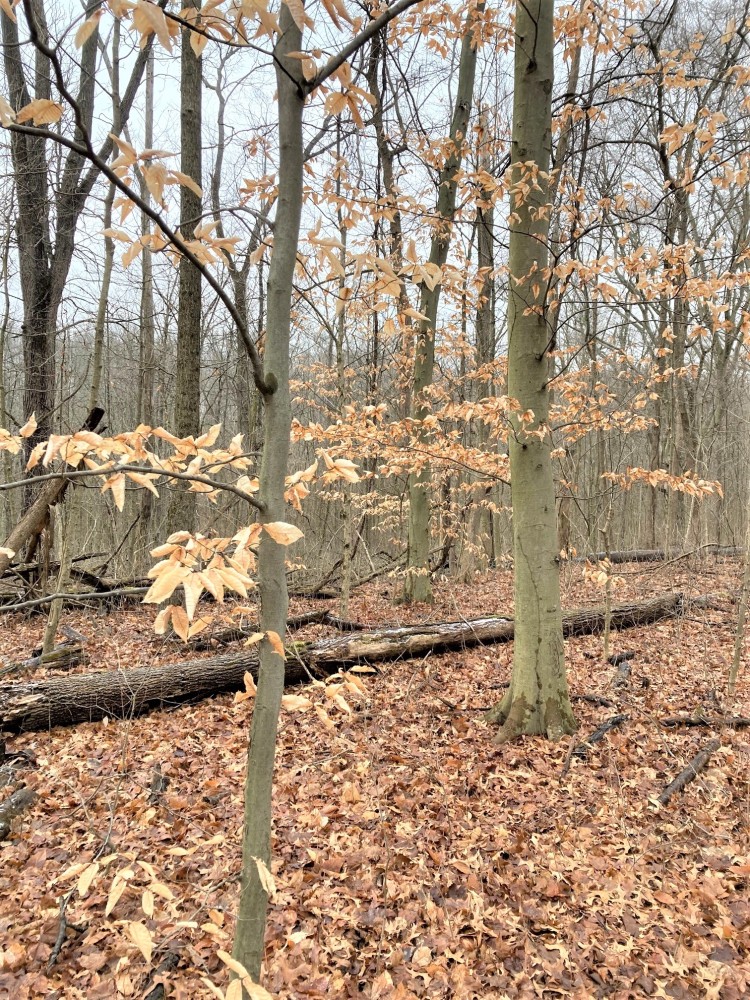
While walking in the woods at this time of year, it’s very easy to identify beech trees. They’re one of the few trees that retain their leaves, which appear almost paper-like. As the leaves age, they fade a bit to a lighter shade. If you look closely, you can see buds at the branch terminus.
I’ve always wondered why beech trees (and some oaks) retain their leaves while other deciduous trees drop theirs. Seems this is a question many people ask, and according to various websites and research there are many suppositions. Some believe that retaining leaves or dead plant matter (known as marcescence) could be because these trees are on dry, infertile soil – such as where oaks and beech trees typically grow. Retaining leaves during the winter could help beech trees to slow decomposition of leaves so they deliver organic matter to the soil in spring when it’s needed most. Some think retaining leaves helps hold snow for more moisture for the tree. I’ve also read that retaining leaves could be a frost protection for buds, and that it is also a deterrent to deer browsing. Are any of these accurate? No one seems to know definitively, at least based upon what I’ve read.
With leaves off most trees and plants, it’s much easier to see some of the berries that remain. Unfortunately most of those remaining red berries may be from invasive honeysuckle (at least in Ohio). That is a food for some birds but mostly described as “junk” food as they don’t have the nutrition that berries from native plants provide. Recently I ran across some black berries – no, not the good tasting blackberries we have in summer. These were small and slightly oval, clustering somewhat like grapes and almost a blue-black color. I wasn’t sure what these might be. But based upon cursory research, I believe these are privet. Yes, another invasive plant unfortunately. But colorful nonetheless.
Plants are not the only thing providing color in the winter. Animals do too and sometimes you don’t know what you may find – or learn. I heard something skittering in the leaves and stopped – motionless – to watch this squirrel. It was frantically digging at the leaves and then upended itself so it’s entire head was covered by leaves. And it stayed that way for awhile. Looking for acorns? No. My guess is it was burying a nut. After completion of the burial procedure, it meticulously arranged, and rearranged, and rearranged yet again the leaves over top of the area. Then he was gone like a shot.
Birds offer color in the wintertime. Bright red Cardinals. Colorful Blue jays. Eastern bluebirds. Even (what some call) the lowly sparrow provide color, though granted, some (like this Song sparrow) are not very vivid with their tan, brown and black coloring. But their song more than make up for it.
And sometimes there is drama to add to the color. Like when this Cooper’s hawk swooped in to catch breakfast in my backyard. One can admire the color and magnificence of this hawk. And also realize, all creatures need to eat to survive. Hopefully it didn’t eat one of my favorite birds.
Winter color is everywhere if one looks closely enough. And it has its own dramatic beauty, like that of the bird above. Or perhaps it’s the magnificence of a small stream rippling through a winter woodland with hushed quiet all around. The color and texture of winter is all around us. And it’s up to us to find that beauty and recognize its value in our lives. Winter has much to offer, if we only take a closer look.




 Nature Views