Gossamer wings…

Butterflies always mesmerize me – enough so that I’ve been known to instantly stop in my tracks to admire and observe. So much beauty in such a delicate fragile package. A true miracle of nature.

I try to put names to them, but even more importantly I like to focus on their behaviors. Some flit by your face and do a few circles around you like some Eastern Tiger Swallowtails have done to me quite often. Though once in awhile, one lands and does a nice pose.

Even the underside of their wings are colorful with vivid orange and blues with a black stripe along the body.

Some butterflies are so absorbed in their acquisition of nectar that they’re practically oblivious to humankind, unless that is, you get too close, move suddenly or create a shadow over them. So…maybe they’re not so oblivious. Perhaps that’s what makes the photography such a challenge.

Zebra Swallowtails are rather notorious for flitting quickly and avoiding photos, at least in my experience. They’re a very beautiful butterfly, perhaps because I so rarely see them, although they are found in the eastern U.S. Their host plant for laying eggs is the Pawpaw tree as this is the only kind of food the caterpillars will eat, which is somewhat similar to the Monarchs requiring milkweed.

There is another type of Zebra butterfly; this one is the Zebra Longwing. While somewhat similar, it’s overall shape is quite unique. They are typically found in southern states in the U.S. plus parts of Mexico and Central America. Its grace and beauty are unparalleled.

Zebra Longwings are unique not only in looks but also in lifespan. Most butterflies lifespans are just one month or less, while the Zebra Longwing can live up to six months because they eat not only nectar but also pollen. They collect pollen and externally secrete a substance to combine with the pollen to make it liquid so they can drink it. The pollen helps extend their lifespan.

Of course, there are exceptions to standard butterfly lifespans. The Monarch lifespan can be 2 to 6 weeks except for the last generation which (I’ve read) can live about 8 months. This is the generation that migrates south in the fall and north in the early spring. There are other butterflies that overwinter as adults in Ohio including the Mourning Cloak, Eastern Comma and Question Mark.

And…here’s a photo to exemplify that Zebra Longwings and Monarchs play well together.

There are many beautiful and unique butterflies out there. Take this Question Mark for example. It’s shape is very similar to the Eastern Comma with the most distinguishing feature the pattern of dots on the forewing, and even then it’s easy to confuse the two. Both the Question Mark and Eastern Comma feed on nectar and enjoy the liquid from rotting fruit. It’s a super sugar charge for them.

The White Peacock is another beauty on the wing found in predominantly south Florida and southern Texas in the U.S. and also in Mexico and Central America. This beautiful creature feeds on nectar from plants such as Spanish Needle which was plentiful in many parts of Florida. This gorgeous beauty unfortunately has been in battle and lost part of it’s wing.

Another butterfly found in southern states is the Queen. It’s a majestic beauty with mahogany brown wings illuminated by white spots and outlined in black. Stunning! The Queen and the Monarch can easily be mistaken for one another due to their similar coloring, but they also have another factor in common. They both feed on milkweed and are toxic if birds should decide they look edible.

And not to be outdone is the Spicebush Swallowtail with it’s vivid black and blue coloring. As the name implies, it’s hostplant is the spicebush though I’ve read they also like white sassafras as well. The adults favorite source of nectar is Jewelweed, Joe-pye weed and honeysuckle.

And here’s a second photo of the Spicebush swallowtail that shows rather dramatically the “tail” in swallowtail.

Another colorful butterfly is the Common Buckeye with its toasty brown and orange coloring with eye-catching eye spots, though this photo isn’t a good rendition of that with it’s faded coloring and tattered edges. This little one has seen better times.

One of the largest and most magnificent butterflies is the Eastern Giant Swallowtail. It has a wingspan of up to or more than 6 inches. It is actually the largest butterfly in North America. Nectar plants for this butterfly include milkweed, butterfly bush and zennia. Once you see this beauty flying about, you just may be out there planting things that attract it. It’s pretty memorable to see.

The photos of the butterflies I’ve shared with you in this blog were taken while in Florida this past winter. Their beauty brightened my winter adventures and brought smiles to the face. I hope they brought smiles to your face as well.

Until next time, keep exploring nature up close.

A Magical Place

There are times in life when you find a new, magical place that nearly defies description. One that almost overwhelms the senses and can take you beyond anything you’ve experienced before. A place that makes all your senses come alive, and you realize how wonderful it is just “to be” in that moment.

There’s a state park in Florida called Hillsborough River that became “that place” for me this past winter. Oh, some might say it’s similar to other state parks there, and it may be, but I want to share some of what I experienced with you. Then you can decide if it’s truly magical.

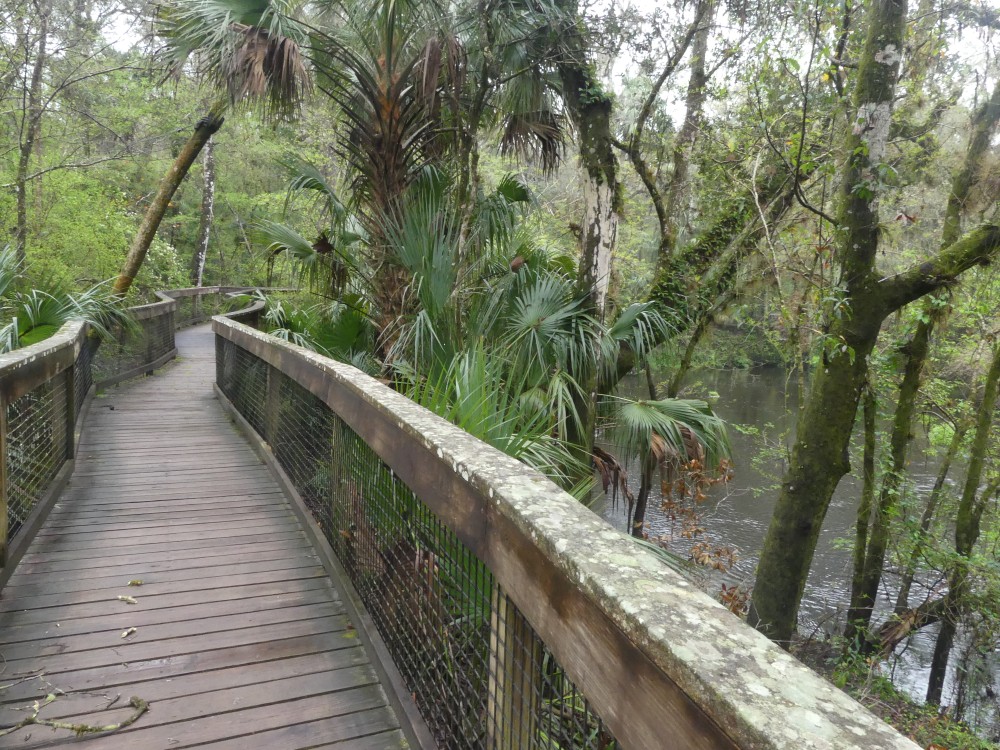
As the name implies, the Hillsborough River flows through the park. And it appears almost “jungle-like.” It’s dense with overhanging palm trees and sweeping branches of live oaks dripping with Spanish moss and epiphytes (air plants). Underbrush can be thick limiting the view in places. Birds erupt in song overhead in the tree tops, and bridges like this one provide trail access to both sides of the river.

A suspension bridge lures you invitingly across the river and onto single-track trails replete with nature where flowers abound. Such as this Carolina Jessamine.

It’s a native vine that blooms with a two-inch long trumpet-like flowers in late winter to early spring in Florida. Its golden yellow color, reminiscent of the sun, fills the eye with wonder and provides a sweet glorious fragrance that embraces you as you walk by.

And winged creatures accompany you on your journey. This Queen butterfly was rather prolific along a portion of one trail. It’s deep rich mahogany color is quite striking with the black wing edging and vivid white spots. It’s a native of some of the southern states across the U.S. and an amazing sight for me as it’s one I rarely see.

Other butterflies in Florida are also quite striking, like this Zebra Longwing (also called Zebra Heliconian). It’s a native of the southern U.S. states and central America and has a wingspan up to 4 inches. It feeds on both nectar and pollen which helps extend it’s life cycle.

On this magical day at Hillsborough River I was also fortunate to watch a Zebra Longwing and a Monarch playfully explore flowers lining the bank of the river. Neither seemed bothered by the others presence as they shared these flowers in their search of nectar.

There’s an interesting trail that skirts along the river, offering spectacular views of nature and wildlife, with boardwalks that beckon you along its length.

The river is truly a pleasure to behold. It meanders through the park and provides not only glorious vistas to the human eye, but also to those creatures that inhabit the park, like this Little Blue heron which finds ample food along the river banks.

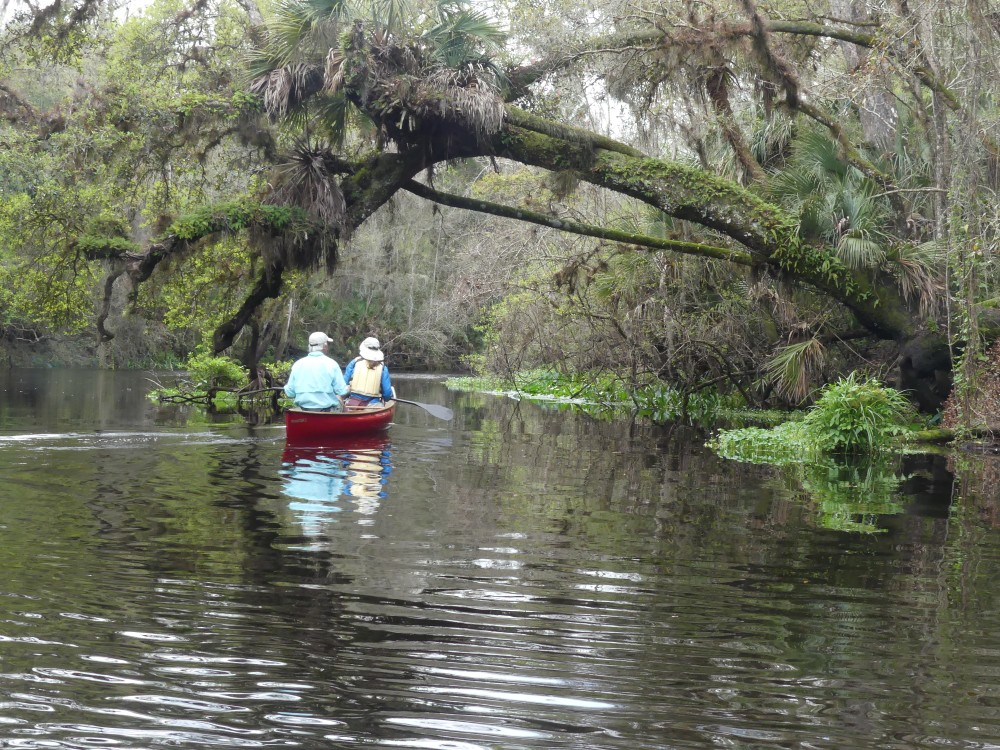
The river is a true joy to paddle as well and is rather mesmerizing with its overhanging branches and unique vistas at every turn…scenery that is difficult to describe for its full effect on the senses.

Cypress trees line the stream in places, with water lilies edging the banks. Quiet. Peaceful. Simplistic as you quietly slip the paddle into the water moving the canoe forward in your journey.

You share the river with many creatures, such as this Great Blue heron which was peacefully observing and unbothered by our presence.

Here’s a closer look at a Great Blue so you can truly appreciate its magnificence.

And alligators, of course. Most are preoccupied with absorbing the sun’s warmth, although they usually keep an eye on you.

Birds flitter about the trees and shrubbery. Sometimes just a glimpse, while others stretch out their wings to the sun, like this male Anhinga.

Flowers line the river banks around you. And sometimes, the sun focuses a spotlight like nothing else can. This is a Swamp lily (Crinum americanum) I believe.

Nature provides the most dramatic visions in colors almost beyond the imagination. Like this Roseate Spoonbill which was carefully maintaining its balance with wings outstretched as it moved further up the branch. The outstretched wings give you a good glimpse of the varying rose colors that make this bird so striking.

Turtles bask in the sun where fallen logs provide perfect venues for them. Often you will see six or more turtles on a single log. A turtle’s shell is made of bone and is part of its spine. UV light from sunshine is needed for vitamin D for bone and shell growth, which is why you will see turtles frequently basking in the sun.

One of my favorite turtle photos is the one below with mom and baby, reflecting the exact same pose. “I wanna be just like mom.”

Turtles are truly amazing creatures. I admire their abilities. Many of these little guys balance precariously on a rounded surface, with legs stretched and fully extended. I’ve often wondered whether this is needed for balance, or just because the sunshine feels good on the skin. No matter…it appears they enjoy it immensely.

I could share many more photos of glorious flowers, butterflies, birds, dragonflies, but these photos I’ve shared should be enough for you to decide. So…is Hillsborough River state park a truly magical place? It is for me.

Until next time, keep exploring nature up close. I hope you find your magical place too.