Wekiwa Springs

Ever seen a Sherman’s fox squirrel? Probably not unless you visit northern Florida or southern Georgia where they call home. Come along on this journey of Wekiwa Springs State Park and neighboring natural areas of Apopka FL to see what wonderful colorful creatures abound.

The Sherman’s squirrel is a bit larger than other squirrels and prefers sandy areas with long-leaf pines. Coloring can vary though they typically have a black head with white ears, nose and tips of feet. They are a bit elusive, like this one who thought it was hidden by laying flat on a branch above me.

Squirrels aren’t the only thing to inhabit trees. Red headed woodpeckers are a special sight to behold with their bold red head and striking black and white coloring. They’re particularly special for me as their numbers have decreased in Ohio and are not seen nearly as often as they once were.

Pileated woodpeckers are also of the same coloring but larger in size with quite different vocalizations. We were very lucky to have multiple sightings of these dramatic birds in most of the Florida state parks we visited this past February and March.

But shore birds were the most dramatic and amazing on most of our explorations. Whether paddling in canoes or on the shoreline, birds abound.

An immature Little Blue heron explores the shore seeking breakfast. Very intent and focused.

While not too far away a Green heron is also scouting the banks as well. These little guys are shorter and stocker than most other herons, and generally not posing quite as well as this one.

One of my all-time favorite birds (and the most difficult for me to get a photo of) is the Belted Kingfisher. This male was quite a distance away, but halted its flight long enough for my quick photo.

The Glossy Ibis is one bird I don’t see quite as often as the others, but when the light hits the feathers just right, it’s easy to understand how it got it’s “glossy” name. According to what I have read, I believe this to be a breeding bird which can be identified by the pale lines extending from the bill to the eye.

Another fisherman this day was the Snowy Egret with it’s distinguishing markings of black legs and yellow feet – though this photo does not show that. I believe this bird to be an immature as its legs are a dull yellowish green.

And then there’s this little cutie. Small, and a bit on the chunky side with not much of a tail to speak of, you might think this is a duck but it’s not. It doesn’t have webbed feet but rather has “lobes” on it’s toes (which to me, if I had to describe it, looks rather like it has little paddle toes) which surprisingly makes it a good swimmer. It’s small, actually smaller than a crow in size. This is a breeding Pied-bill grebe which you can tell by its whitish bill which has a vertical black stripe. Normally the bill is a yellowish brown.

And speaking of breeding attire, here’s a Great Egret in it’s breeding attire with long plumes of feathers over its back and neon green skin between bill and eye area. It’s a large bird – about three foot tall. Very elegant looking.

Then there’s this beauty – a Tri-colored heron. It’s a mix of grayish-blue, white and almost lavender in color. This is a non-breeding heron indicative of it’s yellowish legs and without breeding plumage.

And of course, we have the Great Blue heron – the largest heron in North America. Majestic. Regal. And when disturbed, you hear the ear-piercing call that sounds almost prehistoric.

These beautiful brown/cinnamon colored ducks with their dark gray bills and legs are Fulvous Whistling ducks – a new one for me. Beautifully colored. No ID on the black and white ducks accompanying them because they turned their heads in all photos taken. Too busy preening feathers – one does have to keep up appearances.

Here’s a beauty – a Ring-necked duck, a breeding male. Magnificent colored bill with black tip. Looks almost like artwork. It is…nature’s artwork.

And yet another type of duck. These are Blue-winged Teals. I’ve read they’re smaller than a Mallard. They fly great distances, migrating between Canada and some as far as South America. They’re some of the latest ducks to fly north in the spring and earliest ducks to fly south before winter.

And looking out over the water, observing all the water fowl below, is a Bald Eagle. Truly majestic and magnificent. We saw quite a large number of Bald Eagles in Florida State Parks, with some parks having 11 or more nesting Eagle pairs.

And so, whether you’re hiking wonderful trails like this one in Wekiwa Springs State Park…

Or biking trails like this one…

Or exploring magnificent water vistas like this one (yes folks, that is an alligator partially submerged there)…

Wonderful nature adventures are awaiting you in Wekiwa Springs State Park and the natural areas of Apopka Florida.

Until next time, keep exploring nature up close.

A Magical Place

There are times in life when you find a new, magical place that nearly defies description. One that almost overwhelms the senses and can take you beyond anything you’ve experienced before. A place that makes all your senses come alive, and you realize how wonderful it is just “to be” in that moment.

There’s a state park in Florida called Hillsborough River that became “that place” for me this past winter. Oh, some might say it’s similar to other state parks there, and it may be, but I want to share some of what I experienced with you. Then you can decide if it’s truly magical.

As the name implies, the Hillsborough River flows through the park. And it appears almost “jungle-like.” It’s dense with overhanging palm trees and sweeping branches of live oaks dripping with Spanish moss and epiphytes (air plants). Underbrush can be thick limiting the view in places. Birds erupt in song overhead in the tree tops, and bridges like this one provide trail access to both sides of the river.

A suspension bridge lures you invitingly across the river and onto single-track trails replete with nature where flowers abound. Such as this Carolina Jessamine.

It’s a native vine that blooms with a two-inch long trumpet-like flowers in late winter to early spring in Florida. Its golden yellow color, reminiscent of the sun, fills the eye with wonder and provides a sweet glorious fragrance that embraces you as you walk by.

And winged creatures accompany you on your journey. This Queen butterfly was rather prolific along a portion of one trail. It’s deep rich mahogany color is quite striking with the black wing edging and vivid white spots. It’s a native of some of the southern states across the U.S. and an amazing sight for me as it’s one I rarely see.

Other butterflies in Florida are also quite striking, like this Zebra Longwing (also called Zebra Heliconian). It’s a native of the southern U.S. states and central America and has a wingspan up to 4 inches. It feeds on both nectar and pollen which helps extend it’s life cycle.

On this magical day at Hillsborough River I was also fortunate to watch a Zebra Longwing and a Monarch playfully explore flowers lining the bank of the river. Neither seemed bothered by the others presence as they shared these flowers in their search of nectar.

There’s an interesting trail that skirts along the river, offering spectacular views of nature and wildlife, with boardwalks that beckon you along its length.

The river is truly a pleasure to behold. It meanders through the park and provides not only glorious vistas to the human eye, but also to those creatures that inhabit the park, like this Little Blue heron which finds ample food along the river banks.

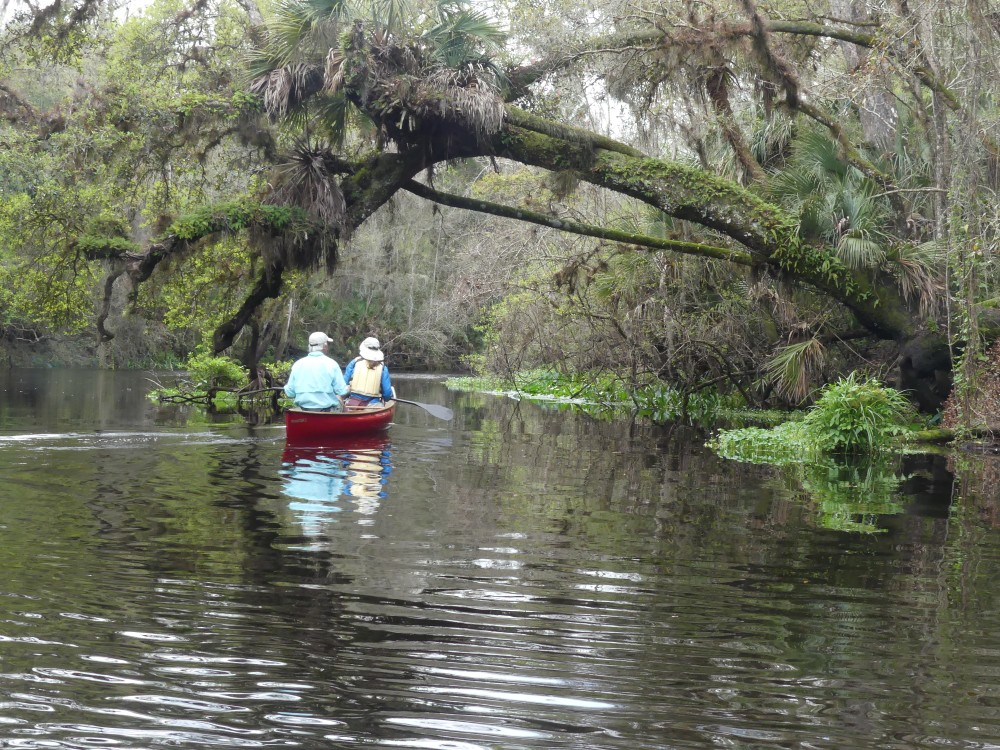
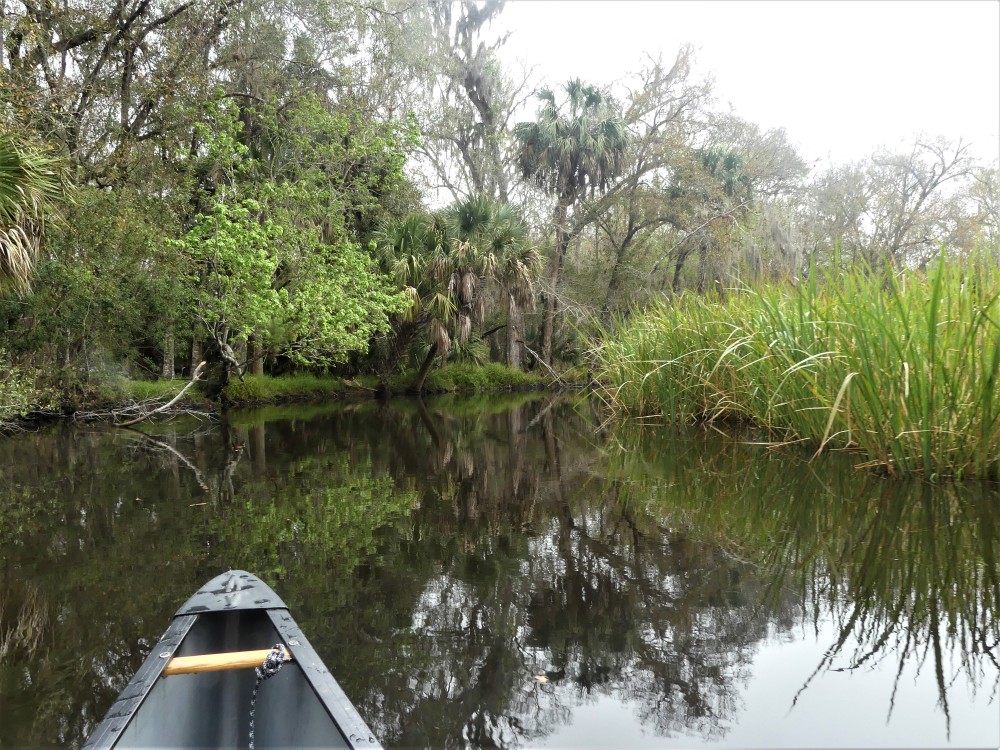
The river is a true joy to paddle as well and is rather mesmerizing with its overhanging branches and unique vistas at every turn…scenery that is difficult to describe for its full effect on the senses.

Cypress trees line the stream in places, with water lilies edging the banks. Quiet. Peaceful. Simplistic as you quietly slip the paddle into the water moving the canoe forward in your journey.

You share the river with many creatures, such as this Great Blue heron which was peacefully observing and unbothered by our presence.

Here’s a closer look at a Great Blue so you can truly appreciate its magnificence.

And alligators, of course. Most are preoccupied with absorbing the sun’s warmth, although they usually keep an eye on you.

Birds flitter about the trees and shrubbery. Sometimes just a glimpse, while others stretch out their wings to the sun, like this male Anhinga.

Flowers line the river banks around you. And sometimes, the sun focuses a spotlight like nothing else can. This is a Swamp lily (Crinum americanum) I believe.

Nature provides the most dramatic visions in colors almost beyond the imagination. Like this Roseate Spoonbill which was carefully maintaining its balance with wings outstretched as it moved further up the branch. The outstretched wings give you a good glimpse of the varying rose colors that make this bird so striking.

Turtles bask in the sun where fallen logs provide perfect venues for them. Often you will see six or more turtles on a single log. A turtle’s shell is made of bone and is part of its spine. UV light from sunshine is needed for vitamin D for bone and shell growth, which is why you will see turtles frequently basking in the sun.

One of my favorite turtle photos is the one below with mom and baby, reflecting the exact same pose. “I wanna be just like mom.”

Turtles are truly amazing creatures. I admire their abilities. Many of these little guys balance precariously on a rounded surface, with legs stretched and fully extended. I’ve often wondered whether this is needed for balance, or just because the sunshine feels good on the skin. No matter…it appears they enjoy it immensely.

I could share many more photos of glorious flowers, butterflies, birds, dragonflies, but these photos I’ve shared should be enough for you to decide. So…is Hillsborough River state park a truly magical place? It is for me.

Until next time, keep exploring nature up close. I hope you find your magical place too.

Paddling at Lake Kissimmee State Park

Without a doubt, Lake Kissimmee state park is a little piece of paradise, just awaiting those who love to explore. It’s located in the mid-central part of Florida and is quite literally, stuck in “the middle of nowhere” which is exactly where its charm lies. It’s where you go when you want to detach from the world and find your own brand of inner peace.

The photo above is the Zipprer Canal in Lake Kissimmee state park. It connects the park to Lake Rosalie. The canal is shallow but is perfect for kayaks or canoes, with Great Blue herons and Snowy egrets a common sight along its banks. And yes, the water really is that blue.

Paddling Lake Kissimmee is always enjoyable but there’s a wonderful 12-mile loop that lets you start at Zipprer Canal and take creeks and a couple of lakes to get back to Lake Kissimmee. The scenery is varied and absolutely amazing. Come on along on our journey…

ZIPPRER CANAL

Once you begin paddling on the Zipprer Canal, the terrain changes a bit (like the photo above) and offers areas that are habitat for Black-crowned night herons. I wasn’t fortunate enough to capture a photo of the heron just mentioned, but we did see several immature Little Blue herons.

IMMATURE LITTLE BLUE HERON

And several majestic Great Blue herons like this one, which was undisturbed by our presence and much more interested in finding breakfast.

GREAT BLUE HERON

Towards the end of the canal and closer to Lake Rosalie, we came upon this scene with overhanging branches dripping with Spanish moss that invited one to continue on. Doesn’t this remind you of something from a movie? Almost mesmerizing…

Add to that a wonderful little Kingfisher bouncing from tree to tree just in front of us. No great photo of it, of course, but here’s a very bad one just to give you an idea of what this little character looks like.

KINGFISHER

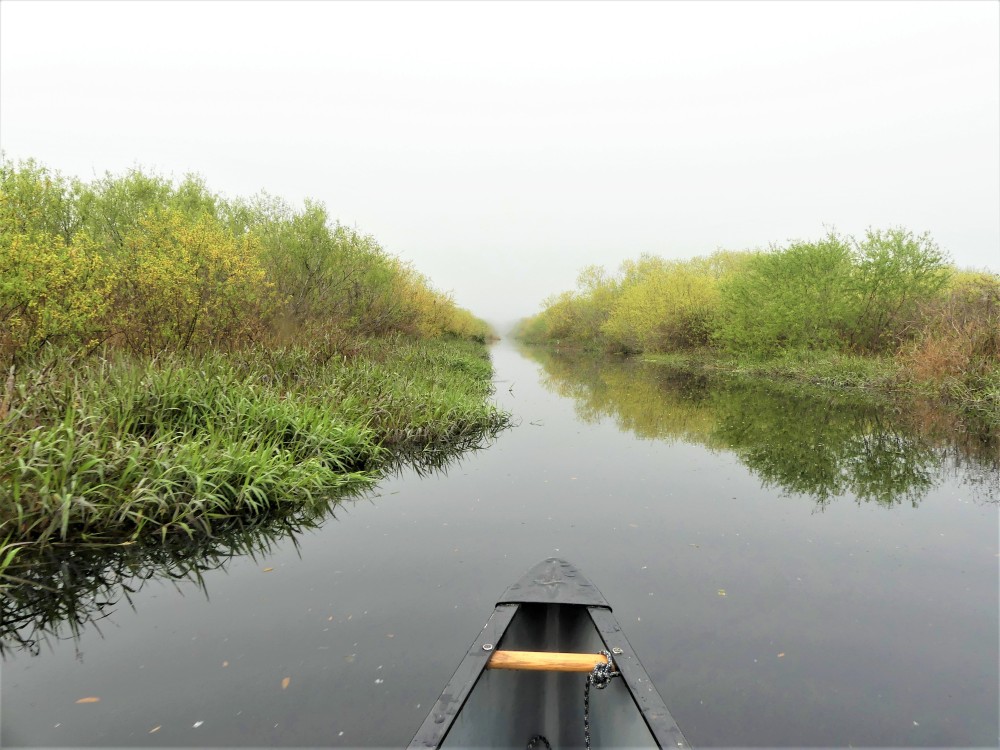
It was a rather foggy morning, so we hugged the shore of Lake Rosalie as we paddled the short distance to Rosalie Creek with friends. Kind of mesmerizing. And very very quiet.

PADDLING LAKE ROSALIE

But luckily the fog began to clear and made paddling the winding, narrow Rosalie Creek an absolute joy to experience. Not many power boats dare to enter this little creek, though we did encounter one brave soul who was lucky enough to find a place to turn around and safely retreat.

ROSALIE CREEK

Paddling this little creek required a few maneuvers to wind your way through, but there was essentially no current and the scenery was absolutely glorious. Eagles and ospreys circled overhead, and the ever-present Anhinga’s kept one company, like this female in the photo below.

FEMALE ANHINGA

And herons of course, Great blues, Little blues (photo below), and Snowy egrets.

LITTLE BLUE HERON

After Rosalie Creek, we moved into Tiger Lake which was blissfully calm and allowed us to paddle directly across to Tiger Creek. I’ve heard tales of having to paddle in strong winds across Tiger Lake at a 45 degree angle away from the creek in order to make it to that destination. I was certainly glad it was a calm day as our canoe weighed 69 pounds and could not be considered a lightweight one by any stretch of the imagination.

We encountered a bit of current paddling Tiger Creek, but it was very enjoyable. Blue skies with puffy white clouds above, the canoes moving smoothly through vivid-blue waters, bright green vegetation helping shore birds believe they’re totally hidden. What more is there to wish for?

PADDLING TIGER CREEK

Of course some birds come out to explore, like this Common Galenule.

If you’re exceptionally lucky on a paddle you might get to see this Snail Kite. It’s a majestic bird of prey. I’ve seen them flying before but have never been able to get a photo of one until now. I believe this one to be an immature Snail Kite based upon photos I’ve seen online, but don’t quote me. Snail kites (as well as Limpkins) feed on freshwater apple snails.

SNAIL KITE

And we couldn’t have a blog about paddling without throwing in at least one photo of an alligator. They’re a fairly common sight when one is near water here. Most are pretty peaceful and just hanging out, till a bird gets close enough to become dinner.

ALLIGATOR

And once through Tiger Creek, you get to Lake Kissimmee, which is big – nearly 35,000 acres. But our paddle is just a short jaunt from the creek into the other end of the canal which lets you return to Lake Kissimmee state park.

It’s been an absolutely wonderful 12-mile paddle beginning and ending at Lake Kissimmee state park. If you enjoy paddling, you will love this one. Put Lake Kissimmee state park on your “to do” list, but be sure to save a camping site for us! Hope to see you there sometime soon.

Until next time, keep exploring nature up close.

A View of Nature with a Florida Twist

In mid-January, we loaded up the camping trailer and headed to Myakka River state park near Sarasota Florida. For a week now I’ve been challenged with acclimatizing my eyes to the radically different change of environment. Very different from Ohio. Palm trees, live oaks dripping with Spanish moss and saw palmettos everywhere you look. And beautiful river scenes like this one of the Myakka River, with shore birds and alligators a common sight.

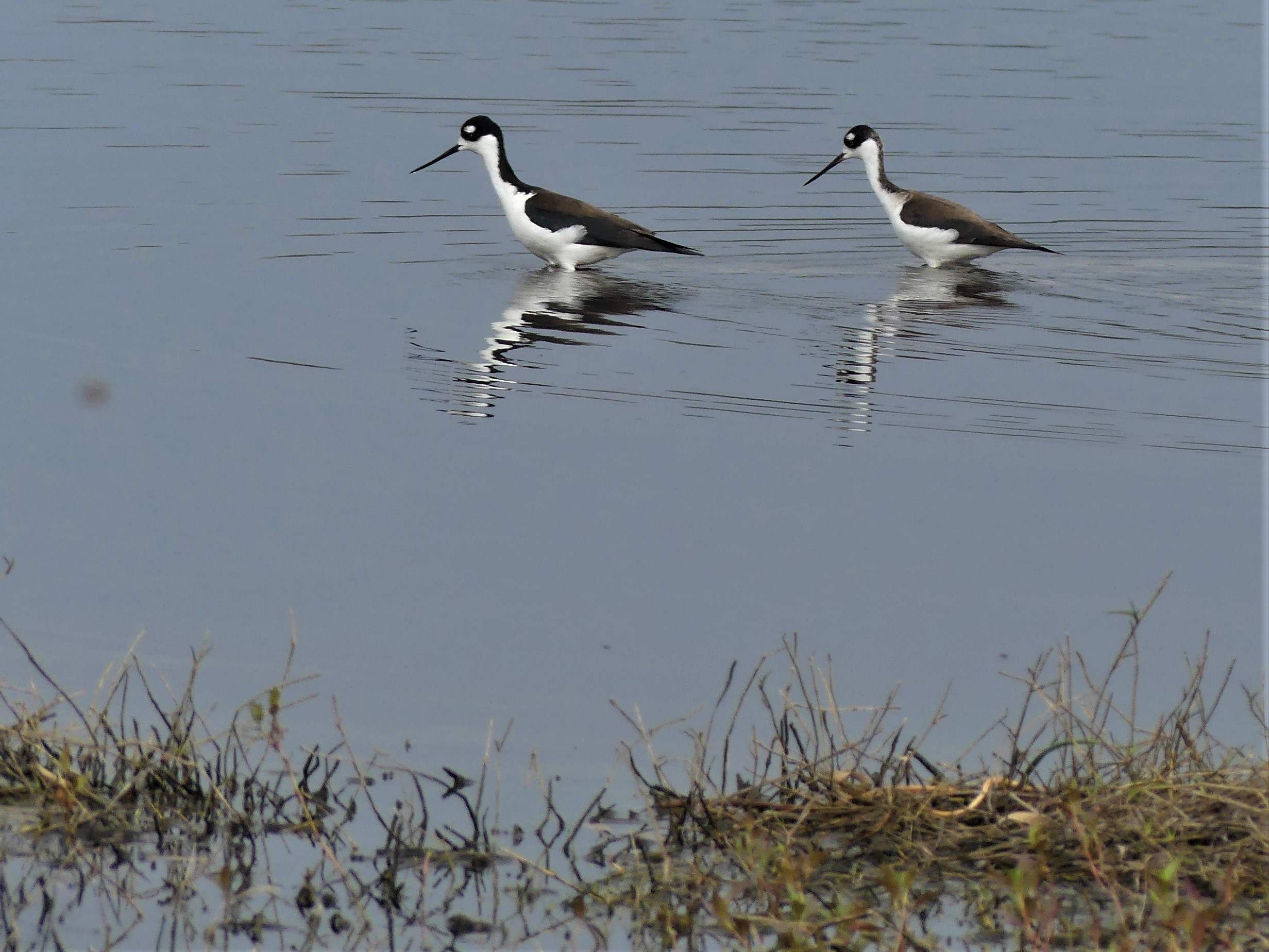
Shore birds are quite eye-catching. Like these two Black-necked stilts. They prefer shallow wetland that allows them to search for food such as dragonflies, small fish and sometimes floating seeds. I’ve read male and female stilts share nest building and only have one brood per year, with usually 2 to 5 young. It’s mesmerizing to watch them racing through the shallow water.

The Limpkin is one bird you won’t be able to ignore, even if you wanted to. Its loud siren call can be heard from great distances; it is the “town cryer” letting all know that non-birds (such as humans) are in the area. This one seems to have had a successful fishing adventure this morning. Limpkins live in the wetlands in Florida as well as in central and south America. They’re large birds – about 27 inches long and a wingspan of about 40 inches.

The alligator is one of their primary predators, and there’s plenty of those at Myakka River. The park is filled with weekend visitors whose primary purpose may be to see gators. On a recent paddle on Myakka Lake we saw about 50 of those “floating flotillas” slowly easing off the bank and into the water just ahead of our canoe. But there’s really nothing to worry about; though caution is required so you don’t inadvertently surprise one of them. (And yes, I have a great zoom feature on my camera to capture this photo.)

There are so many beautiful shorebirds to amaze the eye. I loved watching the antics of this Lesser Yellowlegs. It has bright yellow legs with a mottled gray back and white belly. Of course there’s also a Greater Yellowlegs – and yes, you guessed it, they’re a larger version with a bit longer and thicker bill.

White pelicans are fun to see. Big magnificent impressive birds. Beautiful in flight.

Not to be confused with Wood Storks. Which are also large and predominantly white with some black on the wings. But the heads of the two are extremely different. In flight, the Wood stork is beautiful but not so much when on the ground and one gets a closer look. Not sure why but its head sometimes reminds me of a turkey vulture. Now I feel the need to apologize to the poor Wood stork.

One bird that everyone will fall in love with is the Roseate spoonbill. It’s a glorious combination of white, pink and rose – hence part of its name. These creatures are so fun to watch when they’re “fishing” as they put their spoon-like bill beneath the water and then swing back and forth, rather like they’re dragging the bottom for food – hence the “spoonbill” part of the name. This photo was taken on a quite foggy morning, but I was thrilled to be able to get the picture nonetheless.

Another bird we find here is the Black-crowned night heron. This one we also see in Ohio.

On this morning, the big guy was roosting in a tree, snoozing away. As their name implies, they are primarily active at night. This is a medium sized heron, but fairly stocky as compared to others. Like this Little Blue heron below. Both are about 24 to 25 inches long.

Oh, by the way, the phrase “birds of a feather flock together” does seem to be true like these American White pelicans and the Black Skimmers in the foreground. We would frequently see various types of birds along the shore sharing habitat generally, but still staying within their own grouping. Black Skimmers are amazing to watch as they skim along the water with their lower mandible (which is longer than their upper mandible) slightly under the water until they contact a fish and snap their mandibles closed. Breakfast; check!

One of my favorite shore birds is the Snowy Egret which has black legs and yellow feet. These egrets are about two feet long and have a black bill with yellow around the eye. I love their plumage. Almost looks long enough to be combed.

Another white bird you will frequently see is the White ibis, though it is not all white as it has black wing tips. This one won’t be confused with other white birds if you look for the curved reddish bill. It’s almost of a similar size to the herons previous mentioned, being about 25 inches long.

And not to be outdone, here is bird I learned more about just today…the photo below is of a jake. No, I didn’t name it. It’s an immature male tom turkey. And yes, I had to look it up to see if what someone told me was accurate. According to what I read, a jake turkey is differentiated from a tom by its beard, tail feathers, head color, spurs and behavior. And it can sometimes be confused with a hen turkey. It becomes a tom turkey officially at two years of age. The jake has more of a pale red or blue head rather than a vivid red or blue head. And its beard is 2 to 3 inches rather than the 10 inches of the tom. But, don’t quote me on this one!

There are so many other photos I could share of the wildlife at Myakka River state park. It’s a fabulous place to visit, and one that we enjoy immensely. And just in case you want to canoe Myakka Lake, it’s absolutely beautiful, even with the alligators!

Until next time, keep exploring nature up close.

The color of winter

Winter has color? Isn’t it always just drab gray in Ohio? Not really…

Granted, winter doesn’t have the wondrous colors of spring, summer or fall, but it offers something that isn’t as readily noticed in the other seasons. Textures. For those of us who love to be outside, it forces the senses to see beyond color and observe more deeply. It does take effort, and practice. But it’s well worth it.

Take for example the colors and textures of goldenrod (Solidago). It’s a perennial plant with more than 100 species. Its pollen is heavy so while it is transported by insects, it is not transported by wind and really can’t be blamed for seasonal fall allergies. Goldenrod is practically everywhere if you look in winter. It’s seeds provide food for many birds including chickadees, finches and juncos. At this time of year, its seeds are just waiting for the wind to distribute them far and wide. The fluff on these seeds are soft to the touch. It’s easy to see how the wind can carry the seed away so effortlessly.

Sometimes it’s the combination of plant seed that catch the eye, like this Mullein foxglove alongside goldenrod. Mullein foxglove has small bright yellow flowers in summer, can grow to 5 feet or more and has hundreds (if not thousands) of seeds per plant. The black seed pods are quite unique in shape and are actually pretty hard.

Lichen readily retains color in winter. No surprise here. I’m sure you’ve seen it in a number of places. Trees both alive and dead may have lichen growing on it, but you sometimes find more color and variety on dead limbs like this one. This lichen has fruiting bodies (apothecia) which are the cup-like organisms with the dark brown centers. There are a tremendous number of lichen species. I haven’t even begun to learn enough to try an identification as yet. But I do find the mixture of colors and textures amazing.

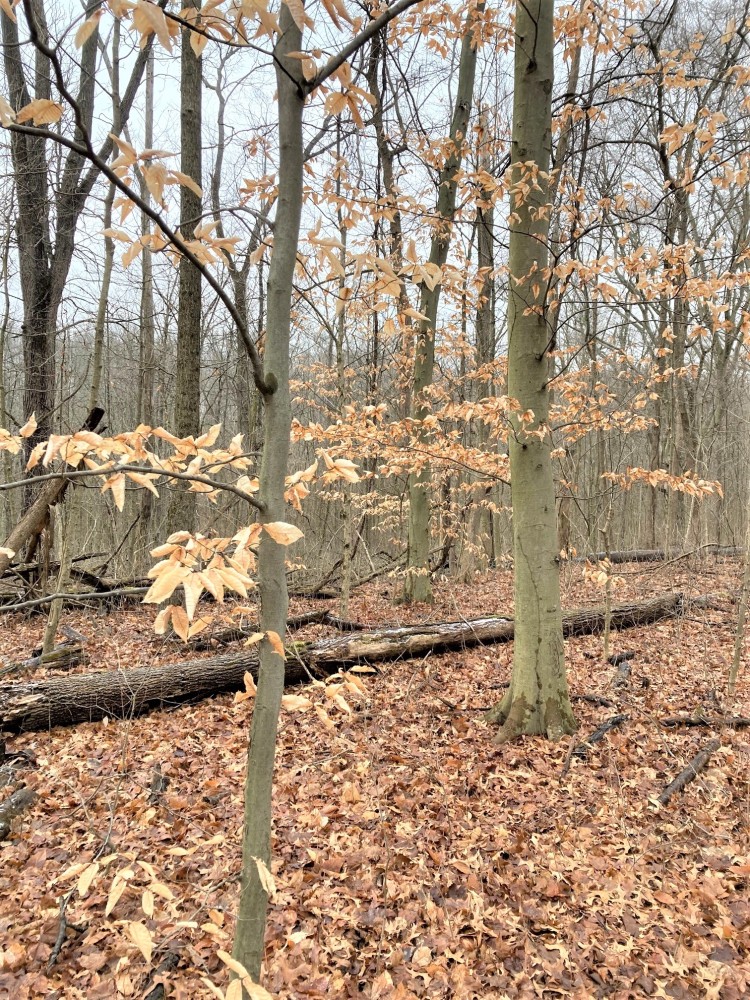
While walking in the woods at this time of year, it’s very easy to identify beech trees. They’re one of the few trees that retain their leaves, which appear almost paper-like. As the leaves age, they fade a bit to a lighter shade. If you look closely, you can see buds at the branch terminus.

I’ve always wondered why beech trees (and some oaks) retain their leaves while other deciduous trees drop theirs. Seems this is a question many people ask, and according to various websites and research there are many suppositions. Some believe that retaining leaves or dead plant matter (known as marcescence) could be because these trees are on dry, infertile soil – such as where oaks and beech trees typically grow. Retaining leaves during the winter could help beech trees to slow decomposition of leaves so they deliver organic matter to the soil in spring when it’s needed most. Some think retaining leaves helps hold snow for more moisture for the tree. I’ve also read that retaining leaves could be a frost protection for buds, and that it is also a deterrent to deer browsing. Are any of these accurate? No one seems to know definitively, at least based upon what I’ve read.

With leaves off most trees and plants, it’s much easier to see some of the berries that remain. Unfortunately most of those remaining red berries may be from invasive honeysuckle (at least in Ohio). That is a food for some birds but mostly described as “junk” food as they don’t have the nutrition that berries from native plants provide. Recently I ran across some black berries – no, not the good tasting blackberries we have in summer. These were small and slightly oval, clustering somewhat like grapes and almost a blue-black color. I wasn’t sure what these might be. But based upon cursory research, I believe these are privet. Yes, another invasive plant unfortunately. But colorful nonetheless.

Plants are not the only thing providing color in the winter. Animals do too and sometimes you don’t know what you may find – or learn. I heard something skittering in the leaves and stopped – motionless – to watch this squirrel. It was frantically digging at the leaves and then upended itself so it’s entire head was covered by leaves. And it stayed that way for awhile. Looking for acorns? No. My guess is it was burying a nut. After completion of the burial procedure, it meticulously arranged, and rearranged, and rearranged yet again the leaves over top of the area. Then he was gone like a shot.

Birds offer color in the wintertime. Bright red Cardinals. Colorful Blue jays. Eastern bluebirds. Even (what some call) the lowly sparrow provide color, though granted, some (like this Song sparrow) are not very vivid with their tan, brown and black coloring. But their song more than make up for it.

And sometimes there is drama to add to the color. Like when this Cooper’s hawk swooped in to catch breakfast in my backyard. One can admire the color and magnificence of this hawk. And also realize, all creatures need to eat to survive. Hopefully it didn’t eat one of my favorite birds.

Winter color is everywhere if one looks closely enough. And it has its own dramatic beauty, like that of the bird above. Or perhaps it’s the magnificence of a small stream rippling through a winter woodland with hushed quiet all around. The color and texture of winter is all around us. And it’s up to us to find that beauty and recognize its value in our lives. Winter has much to offer, if we only take a closer look.

Until next time, keep exploring nature up close.

A year like none other…

This past year has been a hard one for us all. We have had to step away from family and friends, isolating ourselves in an effort to not spread Covid further than it already has been. Isolation can be one of the cruelest forms of punishment, and unfortunately this has happened to us all.

But I continue to believe that we must seek a positive outlook, regardless of circumstances. Please don’t get me wrong. My life has had plenty of sadness, death and discouragement; I’ve not led a charmed life. Nor I believe does anyone…not really. We all have our crosses to bear in one form or another. But I believe it’s extremely important to our well-being to step back from our worries and find things that make us happy. Things that bring a smile to the face. Things to be grateful for. Appreciation of what is.

For me, that’s my escape to nature.

Earlier this year I started this nature blog you’re reading, Nature Views. And it’s been a true blessing for me. Because it’s let me explore nature more diligently, taking a camera with me wherever I go. Looking at things up close. Researching things I don’t know much about. Continually learning. And sharing what I’ve learned with you. Something I hope you’ve enjoyed.

Nature offers so much to us all. Research has shown that a walk in the woods can improve our physiological well-being. It can lower blood pressure. Decrease stress. And in some countries is even being written as a prescription. For me, I find I can breathe easier. Sounds strange I know. But there’s just something about being in a woods that restores me.

The peace, quiet and essence of just “being” surrounds you. You slow down to really listen to the birds. Hear a squirrel up on tree branch gnawing on a walnut. See the Tufted Titmouse rustling in the leaves on the ground. Hear the Blue Jay calling overhead. Notice the striking color of a Northern Cardinal amongst snow-covered branches – almost like a Christmas card. Or perhaps find a group of wild turkeys eating peacefully in a meadow. And if you’re extremely lucky, you get to see the very rare occurrence of a visiting Snowy Owl.

Nature offers us so much more than we can even imagine. It costs us nothing, yet provides a wealth beyond measure. If we only reach out to embrace it.

I hope you take some time to explore nature soon. Go to a local park. Visit a lake. Take a walk in the woods. Explore something new. You’ll be happy you did.

Until next time, keep exploring nature up close.

The colors of my world…

The colors of nature never fail to amaze me. Sometimes it’s as if someone had a 128-pack of crayons and went a bit wild. That’s especially true when you’re talking about the color of macrofungi which have large fruiting bodies, such as the ones you will see in this blog post.

Fungi (also commonly known by many as simply “mushrooms”) provide a valuable service in decomposition on the forest floor. Some fungi have a symbiotic relationship with trees or plants, while others cause disease and the ultimate death of a tree. Usually this is as a result of some kind of stress to the tree which blocks its defensive responses and allows insects and/or fungi to attack. Fungi are also a food source for wildlife. I once observed a slug eating one – not the most fascinating thing to watch, but it was something I had never seen before. And by the way, this slug was not a fastidious eater.

A large part of fungi are actually found underground in very dense threadlike hyphae found in the soil. When there are multiple interconnecting hyphae, it’s called mycelium. This is what allows fungi and trees or plants to develop a symbiotic relationship – one that is good for them both.

BRACKET FUNGI – PERHAPS A CINNABAR POLYPORE NEXT TO LICHEN

I discovered a new-found fascination with fungi a few years ago when I took a class that not only taught about the various types, but also had us exploring the woods to find them. Unfortunately I’m still not adept at good identification, but I certainly enjoy photographing them and I am continually learning. The colors, shapes and sizes are as amazing as the common names…names such as Bleeding fairy helmet, Eggs in a nest, Northern tooth, Witches butter, Turkey tail and Chicken of the Woods.

Speaking of which, here is what I believe to be Chicken of the Woods (Laetiporus sulphureus), although I typically see these much more brightly colored with shades of coral and orange. It could be this is drying as it loses some of its color at that time. Chicken of the Woods attacks the heartwood of the tree, so when you see this fungi, the poor tree is a goner.

CHICKEN OF THE WOODS

Turkey tail (Trametes versicolor) fungi is very prevalent in almost any woods with hardwood trees. The colors vary greatly – brown, gray, green, tan, rusty brown, even purple. It’s a very delicate looking fungi that reminds me of ruffles on clothing. The underside of this fungi has white to yellowish pores.

And of course, there’s also False turkey tail (Stereum ostrea) which can appear somewhat similar. It’s found mostly on dead hardwood species. Colors vary from tan to rust to greenish gray. The underside is generally light tan and smooth without gills, teeth or pores.

FALSE TURKEY TAIL

There are times when hiking in a woods that the fungi is so prominent it almost jumps out to grab you like this Northern Tooth (Climacodon septentrione) which prefers to grow on standing maple trees and is usually high above the ground. It’s pretty unmistakable. I’ve read that it enters the tree through some kind of wound and causes heartwood rot. It’s a parasitic fungus and is rather disheartening to see.

And then there’s these little guys which I almost walked on as they were growing directly on the trail – Ringless honey mushrooms (Armillaria tabescens). They’re an orange-brown color and usually like to grow on wood, such as oak and maple, so perhaps there was decayed wood beneath them just below the trail’s surface

RINGLESS HONEY MUSHROOMS

Sometimes mother nature throws a spotlight on something I believe you’re meant to see and observe, like this Bleeding fairy helmet or also called Bleeding Mycena (Mycena haematopus) which I found at a local park. The name refers to the red-like fluid that oozes from the fungi when it is cut. I didn’t test that fact, as I don’t like to disturb creatures in nature.

And this little orange guy I’m not sure what it is (perhaps witch’s hat?), but it reminds me of something that should have elves nearby. It’s the kind of thing you just can’t look at and not smile. Sometimes names just aren’t important.

And speaking of elves, how about a fairy ring like these? I’ve only seen fairy rings a couple of times. The photo below on the left shows a small one with the one on the right much larger. The fungi in the photos are the fruiting bodies with the mycelium beneath the soil. The mycelium is multiple threadlike hyphae that interconnect and grow throughout the soil – sort of like the roots of a plant. As the mycelium utilizes the nutrients in the soil at the center of the ring, the mycelium continues to expand outward, thereby making the ring larger each year, while the mycelium in the center of the ring dies, returning nutrients to the soil.

Sometimes you’ll stumble upon something that will truly amaze you, like these Ghost pipes, also known as Indian pipe (Monotropa uniflora). So delicate and practically translucent. They’re usually found in deep shady woods and can be up to about 8″ tall. They are not fungi, but rather a parasitic plant that gets its nutrients from trees, plants and decaying matter. They’re sometimes found near decaying trees and/or beech trees. But their color and shape was so interesting I just felt compelled to include them in this blog post.

I’m not sure of the identification of this colorful orange fungi. It was a little on the thin side and I didn’t get a good look at the underside of it. The color combination contrasting with the green plants, tree bark and moss is what made this one so dramatic for me. Like artwork in the woods.

And sometimes that artwork is rather unusual and reminiscent of something else in nature, like this Bird’s nest fungi (Family Nidulariaceae). It’s easy to see how it got its common name. Little miniature cups filled with tiny eggs, or so it appears. Those “eggs” are actually spore packets that will bounce out of their cup when hit by something as simple as raindrops. Nature’s pretty amazing at methods of reproduction.

And then there are these colorful translucent fungi known as Witches butter (Tremella mesenterica), a yellowy-orange type of jelly fungi. I’m not sure whether I love it because of its color or its common name. Both are appealing.

And finally, one last photo that had mother nature shining her light down on a particular spot again – my guess is this is a bracket fungi of some kind. But again, the contrast of colors made this particular photo one that stands out, at least to me.

So there you have it, some of the colors of my world as I continue to explore nature. With each new adventure there’s always something new. And always something new to learn.

Until next time, keep exploring nature up close.
The Preserves Among Us

This year has been different, to say the least. For all of us. One of the things that has proved helpful to me is exploring nature preserves – especially scoping out ones I’ve never visited or, in some cases, have never heard of. It’s like having little mini vacations. I explored a couple preserves near Lake Erie just a few weeks ago.

DuPont Marsh State Nature Preserve (SNP) is part of the Erie Metroparks in Ohio. The short loop trail (with it’s soft footing of pine needles) connects to a longer Metroparks trail that offers views of the marsh.

It’s a quiet place where nature thrives and encourages those wandering to slow the pace and absorb the peaceful surroundings. Ducks and other water fowl abound. Great egrets slowly move through the water, putting all their effort into fishing; their concentration and patience is quite admirable and readily pays off.

Wood ducks are notoriously camera shy. They generally fly at the slightest hint of human presence – a voice or even the slightest movement. So when I happened upon a large group of them I was extremely surprised to get a few quick photos through the tree branches. This photo shows probably just a third of the number of wood ducks enjoying this marsh cove on this day. One can imagine this is a favorite destination for many types of water fowl.

We also explored Old Woman Creek State Nature Preserve which is a National Estuarine Research Reserve. An estuary is typically defined as a place where salt water meets and mixes with fresh water. But in this case Old Woman creek mixes with water from Lake Erie and combines to create a chemically different water from either the creek or lake. It offers researchers a field laboratory to learn about estuarine ecology in a natural setting with habitats of marshland, forests, barrier sand beach, open water and swamp forest.

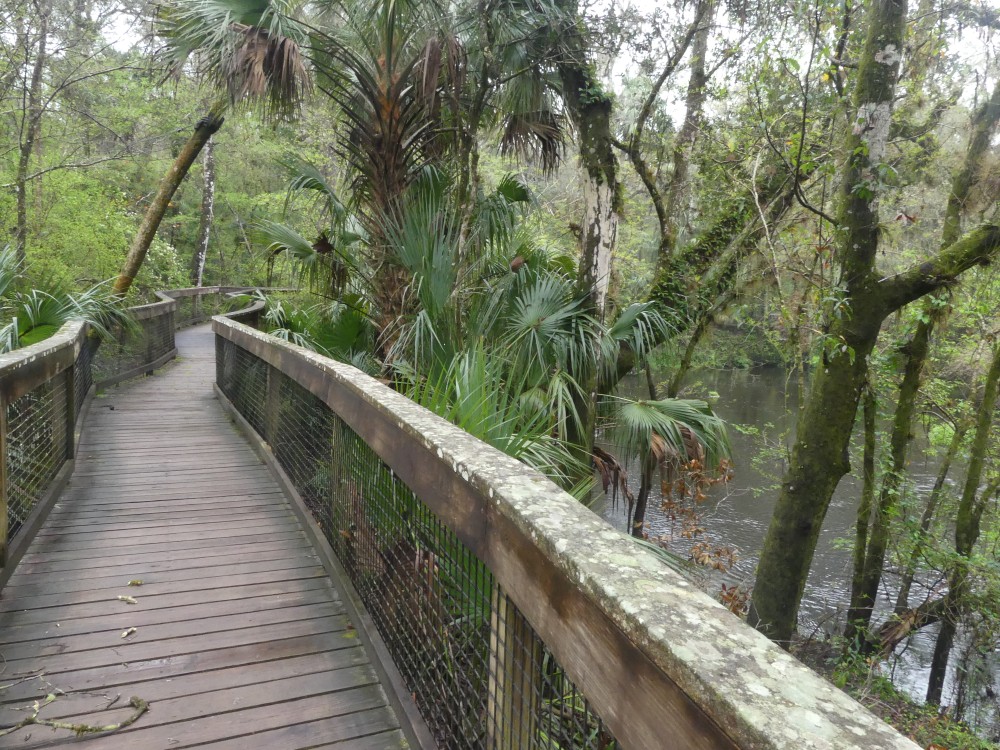
Boardwalk trails provide solid footing through potentially wet areas, while well-managed trails lead one through heavily wooded areas with magnificent views.

And in the midst of the woodland close to the estuary is a swamp forest. It’s an upland forest in an area that is poorly drained for a portion of the year. Soil here is too wet for most woodland trees, but it still provides habitat for some trees, shrubs, and wildflowers. It’s prime habitat for wood ducks, warblers, woodpeckers, belted kingfishers and even eagles.

I’ve never been particularly appreciative of scrubland – that is new growth areas with small scrubby trees and shrubs – although I have a new appreciation for it after visiting Old Woman Creek.

Scrub uplands never really caught my attention as particularly attractive but when I learned their value and their place in natural forest ecology, I now have a different mindset.

These scrubby areas provide habitat for bird nesting as well as provide a good food source. They protect birds during storms and can help as floodwater retention when located in lowlands. Because of their scrubby nature, it also protects animals from predators. Scrub lands are simply a natural progression through habitat changes over time. I guess I never really thought about it in this aspect before. Visiting Old Woman SNP expanded my view.

If you get the opportunity, take some time to visit Old Woman SNP and Estuary or any of the nature preserves near you. There is so much to explore and appreciate within the preserves. Nature abounds and awaits you.

Until next time, keep exploring nature up close.

The Forest Floor

Some of the most magnificent artistic creations of nature can be found on the forest floor. Of course that sometimes means being down on hands and knees, camera close to the ground to capture something from an unusual angle.

One of the things I’ve been trying hard to do this summer is really observe what is around me, rather than just walking through life seeing what I expect to see. I miss so much of what nature has to offer when I forget to truly explore like a four-year-old.

AMANITA SECT. LEPIDELLA

Fungi fascinate me. Their unique shapes, colors and ability to pop up out of seemingly nowhere (and sometimes overnight) are amazing. Like this Amanita. It reminds me a bit of a dumbbell the way the bottom is of similar shape to the top. There are several hundred species of this type of fungi. Some are vivid colors or red or yellow.

SUMMER OYSTER MUSHROOM

These are Summer Oyster mushrooms. They are vividly brilliant white and look so delicate when seen from underneath. Their intricate gills remind me of an old fashioned silky pleated skirt. A true work of art, or at least to me it is.

SUMMER OYSTER MUSHROOM

But along with the beautiful and delicate also come what most would describe as a “standard” mushroom, but is really one of the most deadly ones in the forest – the Eastern North American Destroying Angel. Part of the universal veil on this mushroom can be seen at the bottom of it. A universal veil refers to a membrane covering on a fungi when it is starting to grow. As it grows, this breaks sometimes leaving bits on the top of the fungi and/or at the bottom, such as shown in this picture.

My take on fungi: DO NOT EAT MUSHROOMS FOUND IN THE WILD. Even experts in the field have been fooled by fungi that look similar to other edible ones. I just admire them and buy my mushrooms from the grocery store.

EASTERN NORTH AMERICAN DESTROYING ANGEL

But the forest floor isn’t all about fungi. It’s a wonderful world to explore, with new trails around every corner. Who wouldn’t want to find themselves on this boardwalk on a cool summer morning. Doesn’t it look inviting?

FOREST BOARDWALK

Or on this magnificent trail…where birds, chipmunks and squirrels keep you company. Where troubles and worries seem to cease to exist, and it’s just you and the forest. The sound of leaves rustle gently in the trees. And peace surrounds you.

BLACKHAND GORGE TRAIL

And flowers, of course, like this little yellow jewel. I believe it’s a Woodland Sunflower but not positive. This group of wildflowers always keep me guessing, but I so admire their beauty and ability to thrive in all types of circumstances.

WOODLAND SUNFLOWER ?

But look closer, and you will see the tiny little bug that likes this flower. This little one is in the Geron genus, but I couldn’t identify it beyond that due to the poor photo quality (and inexperience identifying bugs). The bug capture was pure accident, but it just goes to show when you take a photo you sometimes never quite realize what you’re actually getting.

GERON ON WOODLAND PLANT

And sometimes you just get lucky and manage a quick photo of something you happen upon, like this Green heron. There were somewhere between six to eight Green Herons in this small wetland area just off a very-little used trail in Blackhand Gorge state nature preserve. They were not very happy that we were sharing their wetland area, so we quietly observed and left them to their day.

GREEN HERON

Sometimes when I’m hiking I find beauty in things most would probably consider very unconventional, like the moss-covered roots of this tree. So many shades of vivid green and roots that stretch out across the ground like fingers holding onto the earth. Rather artistic. Mother Nature should be proud of this one.

Perhaps next time you find yourself in the woods, you’ll take a look around. Admire the beauty there and be sure to look at what great works of art you can find on the forest floor.

Nature at our Doorstep

I’m finding after months of hearing way too much news about Covid that I’m a bit on edge and desperately searching for avenues of normalcy. But, as always, I make sure I have a mask in my pocket when I walk out the door of the house with camera in hand.

In an effort to explore further afield, I’ve been trying to include a weekly “day trip” to different nature preserves. It feels a bit like a mini-vacation and provides the fun of exploring new areas while staying away from news headlines. That’s a win-win in my book.

JOHNSON WOODS NATURE PRESERVE OLD-GROWTH FOREST

There’s a terrific 200-acre old-growth forest in north eastern Ohio in Wayne County called Johnson Woods Nature Preserve. Some trees are said to be 400 years old. Signage states “Johnson Woods appears to be the largest and best old-growth woods found in Ohio.” And I would agree with them. My photos do not do it justice.

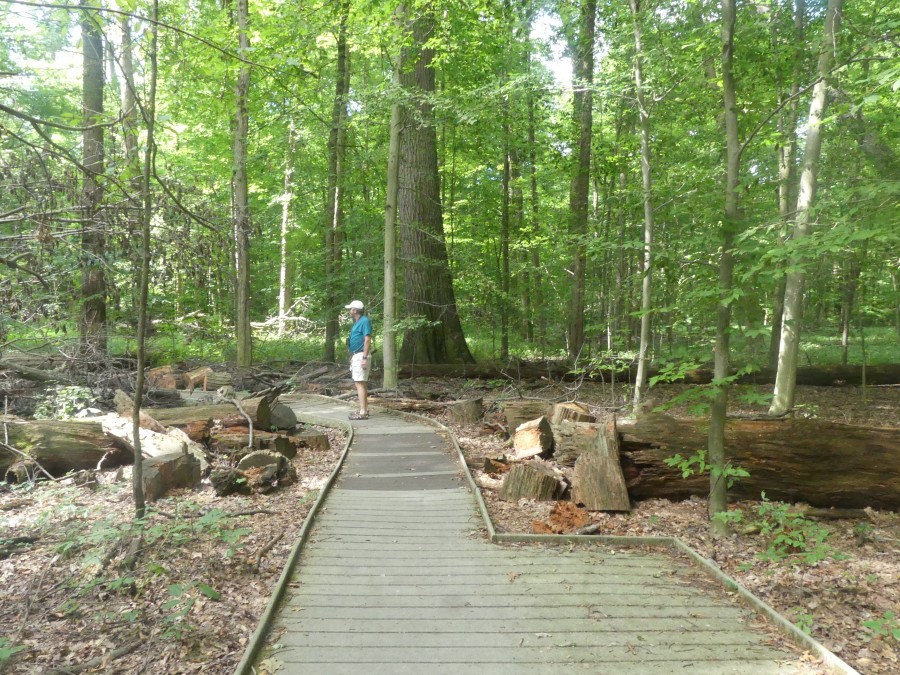
Upon entering the forest and walking on the 1 1/2 mile boardwalk trail, we were greeted by newly fledged Eastern Wood-Pewees being fed by a parent. Cute little guys that couldn’t quite fly straight nor land on a branch without wobbling a bit. But they’ll learn.

EASTERN WOOD-PEWEE

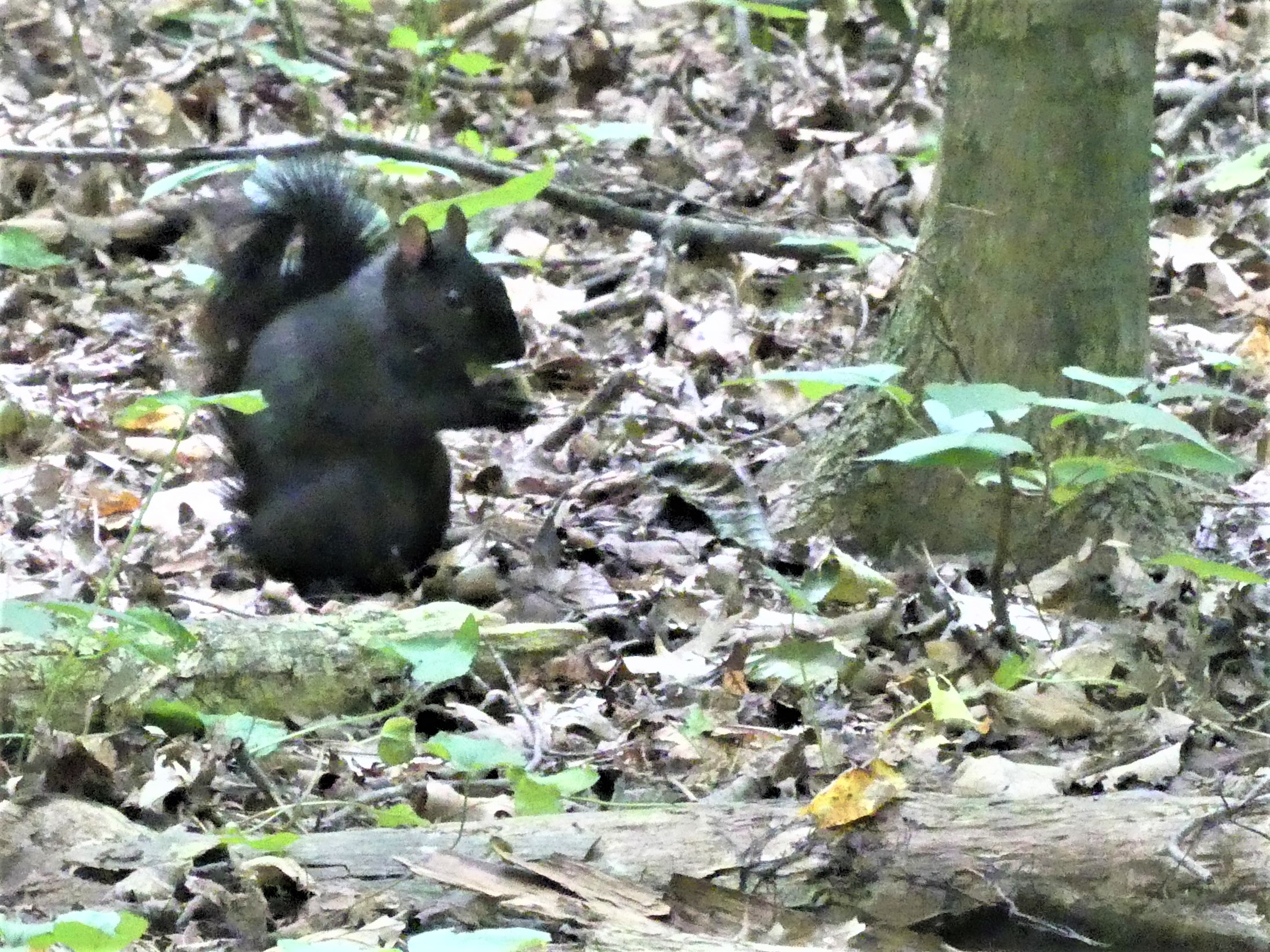
Eastern Gray Squirrels were plentiful, including black ones. I always thought the black ones were a separate breed, but found otherwise. Smithsonian says they’re a result of interbreeding between gray and fox squirrels which results in a faulty gene giving them their black color. According to Wikipedia, this occurs in less than 1% of gray squirrels. Some say the black squirrels are more aggressive and territorial.

The boardwalk is quite an accomplishment all by itself. The woods looks like it could be quite wet in the spring, so this would be the only way visit and maintain dry feet. More than 60 species of wildflowers have been documented here in the spring. Cardinal flowers were blooming quite well this past week and close enough to the boardwalk to get a picture.
1 1/2 MILE BOARDWALK
CARDINAL FLOWER

While you’re in this area, it’s well worth a trip to Barnes Preserve as well. It’s a nature park that is very close by. While it also offers walks through a woods, it’s the flowering meadows, vernal pool and pond that attract the eye here. And very few visitors. Makes one feel like it’s your own private nature preserve!

BARNES PRESERVE POND

Follow the trail through the meadow and down a wood-chip path to this glorious little pond. A wonderful place to contemplate the world – or just watch nature around you and absorb the peaceful setting. Like the mother mallard duck with her 8 nearly-full-grown babies following her every move through the pond. Or watch the Azure Bluet damselfly or Widow Skimmer dragonfly flit about the pond and grasses.

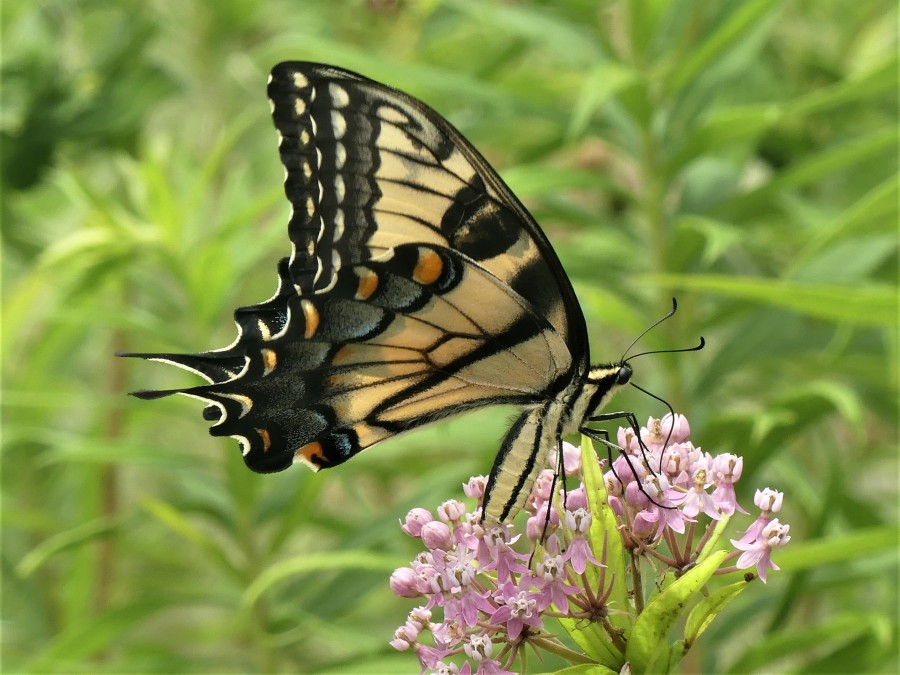
The wildflower meadow there is spectacular. Blue vervain was growing in magnificent patches, along with milkweed which was attracting many butterflies like this Eastern Tiger Swallowtail.

BLUE VERVAIN
EASTERN TIGER SWALLOWTAIL

Also in the meadow was what I think is a Rosepink. It’s a beautiful flower that has the most magnificent color. It’s a biennial which flowers in its second year and grows up to three foot tall. It’s common to the eastern United States, but it’s a new one for me. Looks like Mother Nature got out her water color paints to do this one.

Tucked into a corner of the woods was a little wetland pond that had been built as a class science project. It was shallow enough to attract quite a number of frogs as well as the most beautiful red Meadowhawk dragonfly. I thought perhaps it was a Ruby Meadowhawk (a new one for me), but I later learned that this dragonfly is very difficult to identify unless you have it in hand, and even then it’s not a sure thing. Oh well, a girl can dream…

MEADOWHAWK DRAGONFLY

I hope you’ve enjoyed the travels through these preserves. There’s so many wonderful things in nature to observe and explore. And it may be even closer than you think.

I can highly recommend a day trip to a preserve to give you a new perspective and appreciation of nature. It’s a great way to let go of problems and worries and ground oneself to what really matters. Nature doesn’t seem to be one bit bothered by Covid. Stay safe.

Until next time, keep exploring nature up close.