This past year has been a hard one for us all. We have had to step away from family and friends, isolating ourselves in an effort to not spread Covid further than it already has been. Isolation can be one of the cruelest forms of punishment, and unfortunately this has happened to us all.
But I continue to believe that we must seek a positive outlook, regardless of circumstances. Please don’t get me wrong. My life has had plenty of sadness, death and discouragement; I’ve not led a charmed life. Nor I believe does anyone…not really. We all have our crosses to bear in one form or another. But I believe it’s extremely important to our well-being to step back from our worries and find things that make us happy. Things that bring a smile to the face. Things to be grateful for. Appreciation of what is.
For me, that’s my escape to nature.
Earlier this year I started this nature blog you’re reading, Nature Views. And it’s been a true blessing for me. Because it’s let me explore nature more diligently, taking a camera with me wherever I go. Looking at things up close. Researching things I don’t know much about. Continually learning. And sharing what I’ve learned with you. Something I hope you’ve enjoyed.
Nature offers so much to us all. Research has shown that a walk in the woods can improve our physiological well-being. It can lower blood pressure. Decrease stress. And in some countries is even being written as a prescription. For me, I find I can breathe easier. Sounds strange I know. But there’s just something about being in a woods that restores me.
The peace, quiet and essence of just “being” surrounds you. You slow down to really listen to the birds. Hear a squirrel up on tree branch gnawing on a walnut. See the Tufted Titmouse rustling in the leaves on the ground. Hear the Blue Jay calling overhead. Notice the striking color of a Northern Cardinal amongst snow-covered branches – almost like a Christmas card. Or perhaps find a group of wild turkeys eating peacefully in a meadow. And if you’re extremely lucky, you get to see the very rare occurrence of a visiting Snowy Owl.
Nature offers us so much more than we can even imagine. It costs us nothing, yet provides a wealth beyond measure. If we only reach out to embrace it.
I hope you take some time to explore nature soon. Go to a local park. Visit a lake. Take a walk in the woods. Explore something new. You’ll be happy you did.
The colors of nature never fail to amaze me. Sometimes it’s as if someone had a 128-pack of crayons and went a bit wild. That’s especially true when you’re talking about the color of macrofungi which have large fruiting bodies, such as the ones you will see in this blog post.
Fungi (also commonly known by many as simply “mushrooms”) provide a valuable service in decomposition on the forest floor. Some fungi have a symbiotic relationship with trees or plants, while others cause disease and the ultimate death of a tree. Usually this is as a result of some kind of stress to the tree which blocks its defensive responses and allows insects and/or fungi to attack. Fungi are also a food source for wildlife. I once observed a slug eating one – not the most fascinating thing to watch, but it was something I had never seen before. And by the way, this slug was not a fastidious eater.
A large part of fungi are actually found underground in very dense threadlike hyphae found in the soil. When there are multiple interconnecting hyphae, it’s called mycelium. This is what allows fungi and trees or plants to develop a symbiotic relationship – one that is good for them both.
BRACKET FUNGI – PERHAPS A CINNABAR POLYPORE NEXT TO LICHEN
I discovered a new-found fascination with fungi a few years ago when I took a class that not only taught about the various types, but also had us exploring the woods to find them. Unfortunately I’m still not adept at good identification, but I certainly enjoy photographing them and I am continually learning. The colors, shapes and sizes are as amazing as the common names…names such as Bleeding fairy helmet, Eggs in a nest, Northern tooth, Witches butter, Turkey tail and Chicken of the Woods.
Speaking of which, here is what I believe to be Chicken of the Woods (Laetiporus sulphureus), although I typically see these much more brightly colored with shades of coral and orange. It could be this is drying as it loses some of its color at that time. Chicken of the Woods attacks the heartwood of the tree, so when you see this fungi, the poor tree is a goner.
CHICKEN OF THE WOODS
Turkey tail (Trametes versicolor) fungi is very prevalent in almost any woods with hardwood trees. The colors vary greatly – brown, gray, green, tan, rusty brown, even purple. It’s a very delicate looking fungi that reminds me of ruffles on clothing. The underside of this fungi has white to yellowish pores.
And of course, there’s also False turkey tail (Stereum ostrea) which can appear somewhat similar. It’s found mostly on dead hardwood species. Colors vary from tan to rust to greenish gray. The underside is generally light tan and smooth without gills, teeth or pores.
FALSE TURKEY TAIL
There are times when hiking in a woods that the fungi is so prominent it almost jumps out to grab you like this Northern Tooth (Climacodon septentrione) which prefers to grow on standing maple trees and is usually high above the ground. It’s pretty unmistakable. I’ve read that it enters the tree through some kind of wound and causes heartwood rot. It’s a parasitic fungus and is rather disheartening to see.
And then there’s these little guys which I almost walked on as they were growing directly on the trail – Ringless honey mushrooms (Armillaria tabescens). They’re an orange-brown color and usually like to grow on wood, such as oak and maple, so perhaps there was decayed wood beneath them just below the trail’s surface
RINGLESS HONEY MUSHROOMS
Sometimes mother nature throws a spotlight on something I believe you’re meant to see and observe, like this Bleeding fairy helmet or also called Bleeding Mycena (Mycena haematopus) which I found at a local park. The name refers to the red-like fluid that oozes from the fungi when it is cut. I didn’t test that fact, as I don’t like to disturb creatures in nature.
And this little orange guy I’m not sure what it is (perhaps witch’s hat?), but it reminds me of something that should have elves nearby. It’s the kind of thing you just can’t look at and not smile. Sometimes names just aren’t important.
And speaking of elves, how about a fairy ring like these? I’ve only seen fairy rings a couple of times. The photo below on the left shows a small one with the one on the right much larger. The fungi in the photos are the fruiting bodies with the mycelium beneath the soil. The mycelium is multiple threadlike hyphae that interconnect and grow throughout the soil – sort of like the roots of a plant. As the mycelium utilizes the nutrients in the soil at the center of the ring, the mycelium continues to expand outward, thereby making the ring larger each year, while the mycelium in the center of the ring dies, returning nutrients to the soil.
Sometimes you’ll stumble upon something that will truly amaze you, like these Ghost pipes, also known as Indian pipe (Monotropa uniflora). So delicate and practically translucent. They’re usually found in deep shady woods and can be up to about 8″ tall. They are not fungi, but rather a parasitic plant that gets its nutrients from trees, plants and decaying matter. They’re sometimes found near decaying trees and/or beech trees. But their color and shape was so interesting I just felt compelled to include them in this blog post.
I’m not sure of the identification of this colorful orange fungi. It was a little on the thin side and I didn’t get a good look at the underside of it. The color combination contrasting with the green plants, tree bark and moss is what made this one so dramatic for me. Like artwork in the woods.
And sometimes that artwork is rather unusual and reminiscent of something else in nature, like this Bird’s nest fungi (Family Nidulariaceae). It’s easy to see how it got its common name. Little miniature cups filled with tiny eggs, or so it appears. Those “eggs” are actually spore packets that will bounce out of their cup when hit by something as simple as raindrops. Nature’s pretty amazing at methods of reproduction.
And then there are these colorful translucent fungi known as Witches butter (Tremella mesenterica), a yellowy-orange type of jelly fungi. I’m not sure whether I love it because of its color or its common name. Both are appealing.
And finally, one last photo that had mother nature shining her light down on a particular spot again – my guess is this is a bracket fungi of some kind. But again, the contrast of colors made this particular photo one that stands out, at least to me.
So there you have it, some of the colors of my world as I continue to explore nature. With each new adventure there’s always something new. And always something new to learn.
We’re probably like a lot of people right now, trying to find outdoor activities to keep us active in cold weather yet still keep away from crowded parks. That can be a challenge. The Ohio state nature preserves usually work quite well, and we’ve been visiting quite a few of these lately. But today our destination was to walk part of the bike trail west of Gambier. It’s a pretty trail. Quite scenic. But that’s not what we actually explored…
Just off the trail, past the first bridge over the Kokosing River, was a dirt path leading through the woods and beside the river. Interesting. Thankfully it was an invitation we did not ignore. And that was an excellent decision, as this was our introduction to the 500-acre Brown Family Environmental Center. Until now, I’d never heard of it.
The trail followed the river and offered benches that would have been inviting on warmer days. Huge Sycamores lined a portion of the waterway, no doubt loving the wet low ground.
Along the way we saw a few trees that still had green leaves, which was surprising. It’s December. Leaves should have already fallen or at least be brown and dried by now, like on Red Oaks or Beech trees which retain their leaves. These were green. What’s up?
These were not the leaves of a tree. It was Oriental Bittersweet vines (an invasive) that had wrapped around the tree and was prolific enough to resemble tree leaves at first glance. Luckily someone had recently cut the 3″ thick vine near the base of the tree. Hopefully this tree will live to see another year because an environmentally conscious person recognized the destruction vines pose to trees.
The Kokosing River is 57 miles long. It’s watershed is 435 square miles covering a good portion of Knox county as well as parts of Morrow, Richland, Ashland and Coshocton counties. If you’re near in the summer, you’ll undoubtedly see kayakers floating peacefully along this State scenic waterway. The trail we were on continued along this river and then made a turn to cross the Kokosing bike path and lead upward into the woods.
The woods was moss-covered with varying shades of green throughout the area. At this time of year, one might think it’s pretty gray outside, but this woods proves different. Like the colors found on this decaying log and at the base of the beech tree. What I believe are puff balls are at the tree’s base, though they have undoubtedly seen their better days.
Ferns covered the north-facing hillsides which are typically more shaded and provide moisture for these plants which grow in colonies. In the fall, ferns reproduce via spores which are so small they can’t be seen by the naked eye. However, some spores are encapsulated within something called “sori” which can be seen on the underside of the frond. I’m not sure how many species of fern call Ohio home, although I’ve read Wakeena state nature preserve in Fairfield county is home to 29 of them.
There was an interesting building at the Brown Family Environmental Center closer to the administrative building. It appeared to be used for storage. It had a stone base with some type of concrete or stucco wall. There were tiny cylindrical windows which were oddly shaped and not flat. Upon closer inspection these turned out to be bottles that had been incorporated into the walls. Pretty creative!
Within the woods is a pine plantation which was planted in 1991 by the biology faculty at Kenyon College. The area was used for student research to look at relationships between growth rates and tree spacing. The trails were softly carpeted with pine needles and you could hear the gentle breeze in the branches overhead.
But the trails were not all within the forest. A huge prairie meadow was in the lowland and was home to many types of wildflowers and native grasses. The prairie is maintained by annual spring burns which discourage tree growth – a necessary thing to do to maintain prairie.
On the return to the parking lot we took one last look at the Kokosing River beneath the bridge and found what we believe is a type of liverwort growing on the wet stone abutment. I believe it’s in the genus Conocephalum, but am unsure of species. Regardless, it’s an interesting looking plant when viewed up close. I’ve read that this plant is reproduced by spores and is somewhat similar to mosses as it is non-vascular.
From here we took the car to a parking area on the northside of the Environmental Center just off New Gambier Road. The trails here were quite different from what we had encountered so far. The forest area embraced Wolf Run stream and contained beautiful large White Oaks. The trails climbed ridges and followed the stream in the low land. Some of the wetter areas had recently had boardwalks installed. It was so new the boards didn’t show signs of weathering as yet.
The trails were quite pleasant with footbridges over Wolf Run which meandered through the area. As we walked, we encountered not a single soul unless you count the squirrels. It was like having our own private park.
One spur trail climbed a hillside and descended to a small pond. On the way up we encountered this huge White oak which overlooked the pasture. Quite stately looking and regal. Much larger than any tree in the vicinity. Not sure how old this tree must be but you can estimate it’s size by comparing it to the metal gates beside it. It was impressive.
We didn’t hike all the trails on this day but we easily had about 8 miles that we explored. I would imagine this area would offer great wildflowers and migrating birds in the spring. The terrain would suggest so. If you’re looking for a good area to hike that offers diversity and very few people, this is it!
This year has been different, to say the least. For all of us. One of the things that has proved helpful to me is exploring nature preserves – especially scoping out ones I’ve never visited or, in some cases, have never heard of. It’s like having little mini vacations. I explored a couple preserves near Lake Erie just a few weeks ago.
DuPont Marsh State Nature Preserve (SNP) is part of the Erie Metroparks in Ohio. The short loop trail (with it’s soft footing of pine needles) connects to a longer Metroparks trail that offers views of the marsh.
It’s a quiet place where nature thrives and encourages those wandering to slow the pace and absorb the peaceful surroundings. Ducks and other water fowl abound. Great egrets slowly move through the water, putting all their effort into fishing; their concentration and patience is quite admirable and readily pays off.
Wood ducks are notoriously camera shy. They generally fly at the slightest hint of human presence – a voice or even the slightest movement. So when I happened upon a large group of them I was extremely surprised to get a few quick photos through the tree branches. This photo shows probably just a third of the number of wood ducks enjoying this marsh cove on this day. One can imagine this is a favorite destination for many types of water fowl.
We also explored Old Woman Creek State Nature Preserve which is a National Estuarine Research Reserve. An estuary is typically defined as a place where salt water meets and mixes with fresh water. But in this case Old Woman creek mixes with water from Lake Erie and combines to create a chemically different water from either the creek or lake. It offers researchers a field laboratory to learn about estuarine ecology in a natural setting with habitats of marshland, forests, barrier sand beach, open water and swamp forest.
Boardwalk trails provide solid footing through potentially wet areas, while well-managed trails lead one through heavily wooded areas with magnificent views.
And in the midst of the woodland close to the estuary is a swamp forest. It’s an upland forest in an area that is poorly drained for a portion of the year. Soil here is too wet for most woodland trees, but it still provides habitat for some trees, shrubs, and wildflowers. It’s prime habitat for wood ducks, warblers, woodpeckers, belted kingfishers and even eagles.
I’ve never been particularly appreciative of scrubland – that is new growth areas with small scrubby trees and shrubs – although I have a new appreciation for it after visiting Old Woman Creek.
Scrub uplands never really caught my attention as particularly attractive but when I learned their value and their place in natural forest ecology, I now have a different mindset.
These scrubby areas provide habitat for bird nesting as well as provide a good food source. They protect birds during storms and can help as floodwater retention when located in lowlands. Because of their scrubby nature, it also protects animals from predators. Scrub lands are simply a natural progression through habitat changes over time. I guess I never really thought about it in this aspect before. Visiting Old Woman SNP expanded my view.
If you get the opportunity, take some time to visit Old Woman SNP and Estuary or any of the nature preserves near you. There is so much to explore and appreciate within the preserves. Nature abounds and awaits you.
This has been an unusual year for everyone. One of the things I’ve gravitated to has been learning online about nature, as well as experiencing it outside.
This fall I participated in a 5-week online class about bees in the eastern United States. Now I’m probably like many of you, and at the mention of bees I instantly thought of honeybees and the nasty stings of yellow jackets. But the Eastern Bees 101 class offered by The Ohio State University Extension office has changed my mind. Completely.
Bees are pretty amazing creatures! Let’s look at the bumble bee as an example.
Isn’t she beautiful? This is a Bombus fervidus or a female Golden Northern bumble bee. This is one you don’t see nearly as often as the Common Eastern bumble bee (Bombus impatiens) which is prevalent here in Ohio. Look at how “golden” she is. Her abdomen is yellow on the first four (tergal) segments with just the last two being black. A Common Eastern bumble bee would have just the first abdomen segment that is yellow. In the photos below you can easily count those segments.
And she has a unique black “stripe” across the top of her thorax (the middle part of her body where her wings attach).
Bumble bees live a year or less, depending upon whether they are male, female workers or the queen. They are primitively eusocial, that is…partly social and partly solitary. Their life cycle explains this.
A fertilized queen will emerge from underground in April to early May. She will be by herself. She will feed on pollen and nectar after her winter “nap” and will frequently be seen flying close to the ground looking for a good place for a new nest. She then starts a nest and lays eggs – all daughters. The eggs will quickly turn into larvae, which the queen provisions with pollen and nectar so they may become bumble bees.
Once the daughters go from larva to bumble bee, they are able to forage for food for the nest, and the queen stays in the nest and lays successive generations of eggs. She will lay anywhere from 50 to 300 eggs over the summer (depending on the species of bumble bee).
Queens have the ability to determine whether their eggs will be male or female. In late summer she produces what will be future queens and males. Males will find mates from different colonies and the new queens will mate with males from other colonies. At this point the hardworking daughters in the colony will die, as will the old queen and the males.
Newly mated queens will find a hibernaculum (a place to hibernate for the winter). And next spring the cycle will start all over again.
There is so many interesting things about bees – such as how they carry pollen and nectar, which is different for different bee species. A female bumble bee has what is called a “corbicula.” It’s a smooth indentation in the upper part of their hind leg that is slightly concave. This allows them to carry a mixture of pollen and nectar back to the nest.
The photo below is of a female Common Eastern bumble bee. If you look closely at the leg you can see a slight bit of yellow on the corbicula. Only bumble bees and honeybees have a corbicula. Other bee species may transport pollen on the underside of their abdomen, or on their hairy legs or even eat it and regurgitate it to their young. It varies based upon the type of bee.
I was fortunate enough this summer to be at Clear Creek Metro Park and see a bumble bee “warming up” on a flower. Bumble bees have this unique ability to disengage their wings and operate their flight muscles in order to warm their bodies. Sort of like how we shiver. Bumble bees need to have a body temperature of at least 80 degrees Fahrenheit in order to fly. I’m only sorry I wasn’t able to get a good photo of this to share with you.
And one final item you might find interesting…if you look carefully in the early fall, you just might see some of those male bumble bees “sleeping” on flowers in the early morning hours because once they initially leave the nest, they never return to it. If you ever see a bumble bee “sleeping” on a flower, you can be assured it will, in all likelihood, be a male.
Bumble bees are really pretty docile and aren’t aggressive (unless you threaten them or their nest). The photos in this blog were obtained not by a zoom lens but rather by getting my camera close without being threatening.
I hope the next time you see a bumble bee, you take a minute to look more closely. They’re really very beautiful and interesting creatures.
Exploring nature preserves is a great way to banish “Covid fatigue.” It’s like a mini vacation wrapped up in a single day and provides a bit of exercise, fresh air and restores the spirit. I can highly recommend it.
This week we packed our hiking boots, a snack, water and drove an hour or so (on as many backroads as possible) to explore Sheldon Marsh state nature preserve near Lake Erie in Ohio. It’s offers about 470 acres, is home to 300 species of birds and is a well-known place for quite a number of wildflowers in the spring.
SHELDON MARSH
But it’s not all marshy, by any means. Even at the end of October the leaf colors are beautiful, though a bit past their prime.
The Preserve offers some wide straight, wide trails directly to the beach area, but I would suggest following the woods trail instead. It meanders through the trees and provides great views of the marsh and the creatures that live there.
According to signage, the Marsh has hundreds of turtles that bask along the shoreline including Midland painted turtles, snapping turtles and the Blandings turtle (Emys blandingii or Emydoidea blandingii). According to Wikipedia, Blandings turtles are an endangered species in some areas of the eastern U.S. and Canada, can reproduce for 80 to 90 years and show little or no common signs of aging. Wow! That’s a turtle I would like to see.
Unfortunately on this day there was little if any sun so it wasn’t conducive to those basking turtles (which is why I plan to come back).
This area is very attractive to ducks and shore birds. On this day we saw Wood ducks, Mallards. Gadwells, Canada geese, cormorants and Great Blue Herons. I have a few photos to share of these, but the zoom on my FZ300 wasn’t quite up to it, as the ducks/geese were quite a distance away.
GREAT BLUE HERON (forefront) and WOOD DUCKS (rear)
We also ran into a pretty aggressive groundhog. Now before you start laughing (I did too when a fellow visitor first warned me), take a look at the photos. They just might change your mind.
NORMAL GROUNDHOG, RIGHT? NOT!
Now normally groundhogs are pretty timid. They run away when they see a human. Not this guy! He would look at you, then come out onto the trail and face you like he was taking a stance. If you moved, he moved to face you and showed some teeth. He didn’t act rabid; he just acted old and mean like we were on his turf – which we were I suppose. Poor guy.
But that didn’t stop us from sliding around him to get to the Lake. It was a bit windy on this day and quite choppy. The gray/blue skies blended well with the icy gray color of the lake. The wind was quite loud in the tree branches and leaves along the shoreline.
Very near the water in some shrubby areas was a Yellow-Rumped warbler flitting about. They DO move quickly. I was surprised I could get any photos at all.
This is a barrier beach and (according to signage) is one of the most fascinating habitats at Sheldon Marsh. It’s one of the largest protected beaches on Lake Erie’s south shore. It provides the potential for bird nesting habitat of such endangered species as the Common Tern (Sterna hirundo) and Piping Plover (Charadrius melodus). (The Common Tern is listed as endangered in Ohio and the Piping Plover is on the federally endangered list.)
BARRIER BEACH AREA
If you get the opportunity, take a break from “Covid fatigue” and visit Sheldon Marsh. It’s a glorious place to explore nature and let go of some of life’s stresses. While not too many people feel comfortable going on vacations these days, a mini-vacation day trip to a nature preserve is almost perfect.
In a small rural area near Bremen in southeastern Ohio, tucked away into the rolling curvy roads, you will find Boch Hollow State Nature Preserve. It’s located on about 600 acres and features a small pond within a mile of the trail head and seven miles of magnificent hiking trails through wooded areas, ridges and riparian corridors. And if you visit on a weekday, you will most likely find next to no one there.
I was amazed by the large number of Poplar trees there, along with Red and White Oaks. Big, beautiful, massive trees that have undoubtedly seen a lot of history over their lifetimes. Impressive in stature.
The trails are fairly narrow once you get through the initial mowed path leading to the pond, but it’s well well defined and easy to follow. The trails hug the hillsides and encourage you to venture further into the preserve.
I feel remiss for not including a photo of the pond, but when we were there a young couple were enjoying a swim and had sufficed with underwear as swimming garments. Not a good thing to take a photo in this situation.
The topography was interesting, making me wish I knew more about geology that I do, so the best thing I can offer is a photo. This rock formation reminded me of the helm of a big ship. Appropriate given its size. It’s even larger than it looks in this photo.
There was quite a variety of fungi on the forest floor. I find these creations of nature so wonderful. I mean how can you look at these things and not be amazed by them? How do they form? Why are they the colors they are? Why are they in such different shapes? How do the delicate gills form beneath? All are mysteries to me.
SOMETIMES MOTHER NATURE ILLUMINATES WHAT YOUR EYE SHOULD SEE
Okay…enough of the fungi.
Let me share with you something very special we came upon around one bend of the trail…a small little cemetery dating back to the 1800s. Forgotten. Neglected. Distant relatives undoubtedly long gone.
The tombstones were very difficult (and in some cases impossible) to read, although one appeared to be a young son who died April 1, 1815 at the age of 5 months. Two other readable death dates on a couple of the stones were 1836 and 1840. It was sad to see. It made me wonder what their life stories were and how they came to be in this part of Ohio. Ohio became a state in 1803 but it was still a very young state at that point. I did some Google searching but could find nothing further about this cemetery.
I’ll leave you with one last look at the beautiful trail through Boch Hollow nature preserve. If you find yourself looking for a great hike, I can recommend this one. Very few visitors during the week and a great place to explore nature.
Have you noticed how many people are out and about lately? Running. Walking. Biking. Pushing strollers with kids (or dogs, yes – not kidding). It’s a good thing, but it makes social distancing more of a challenge, which is why I’m always looking for interesting places to go to get my “nature fix” without joining the crowds.
This past week it was Chadwick Arboretum North.
I went on a Tuesday morning, and I saw five people in the two hours I was there. It’s truly a hidden gem in the middle of Columbus. Chadwick is a little nature oasis on The Ohio State campus, just off SR 315 and Lane Avenue (2235 Fred Taylor Drive). It boasts a 3.5 acre Research lake which allows fishing (catch and release) and lots of pollinator habitat, not to mention more dragonflies and damselflies than I could begin to count (or photograph).
I always have a camera in hand, hoping to catch that next great photo or find that particular camera angle that makes a scene eye-catching. I’m not so sure I’ve achieved that, but I do have a few that you might enjoy.
I always learn something new when I’m out in nature. That’s a given. On this day I found an Allegheny Monkeyflower that was on the edge of the lake. It’s a beautiful flower that looks a bit like a snapdragon but isn’t.
It gets its name because the bloom is supposed to look like a monkeys face – but I couldn’t see it no matter how I tried. It’s native and grows near water. It was about three feet tall and it spreads by both seeds and rhizomes. It attracts butterflies and is a larval host for the Common Buckeye and Baltimore Checkerspots. It’s a perennial and blooms June to September. It’s an endangered species in Maine.
I’ve been taking online pollinator classes this past spring and summer through the Ohio State University extension service, so this blog will be filled with a number of “critters” on flowers. It expands my education to not only identify what I’m seeing, but also understand a bit of its behavior and preferred environment. Plus, it’s just fun to do.
On this day the Brown-belted bumble bees (Bombus Griseocollis) were favoring the Coneflowers and Wild Bergamot/Bee Balm. Brown-belted bumble bees are recognizable (at least for me) for the brown belt that is on the T2 area of their back, which can be seen in the photo below.
BROWN-BELTED BUMBLE BEE
Of the bumble bees in Ohio, it is estimated that 19% are Brown-belted. The most common bumble bee (69%) is the Eastern Common bumble bee (Bombus Impatiens).
The Arboretum also had a number of Hibiscus flowers lining the lake. They had big, beautiful pink flowers that were filled with insects and bees, like this Hibiscus Turret bee (Ptilothrix bombiformus). It’s a solitary ground nesting bee. This one is has a bit of pollen on it, and I believe it’s a male that is waiting for a female to arrive for mating purposes.
Wasps were also enjoying the flowers. This may be a Metric Paper wasp (Polistes metricus) but am unsure of that identification. Due to the red coloration, it may be a female, but don’t quote me.
Here’s a cute little guy (a Western honey bee I believe but the photo isn’t good enough to confirm that). But what intrigued me was actually the flower that it was on – a Flowering Rush (Butomus umbellatus). A reed like wetland plant growing at the pond edge. They spread by rhizomes and can grow to four feet tall. While the flower is very pretty, it is an invasive plant in Ohio.
As mentioned earlier, there were a number of dragonflies and damselflies all around the pond area. Many dragonflies were doing great sweeping flights around the lake, but were too much for my poor camera to capture. I had to wait for those that would land on something. But a few did cooperate. Eastern Pondhawk dragonflies did quite a bit of posing that day. They’re pretty impressive due to size and color.
MALE EASTERN PONDHAWK DRAGONFLY
FEMALE EASTERN PONDHAWK DRAGONFLY
There were a couple of pennant dragonflies that were very colorful – the Halloween pennant and the Calico pennant. Both bright vivid bits of color that attract the eye.
HALLOWEEN PENNANT DRAGONFLY
CALICO PENNANT DRAGONFLY
And finally, here’s a male Twelve-spotted skimmer missing a wing, poor little thing. Most likely due to a close encounter with a predator. I’ve read that even with a damaged or missing wing they can still fly and find food. Obviously he wouldn’t be able to fly as well as an undamaged dragonfly.
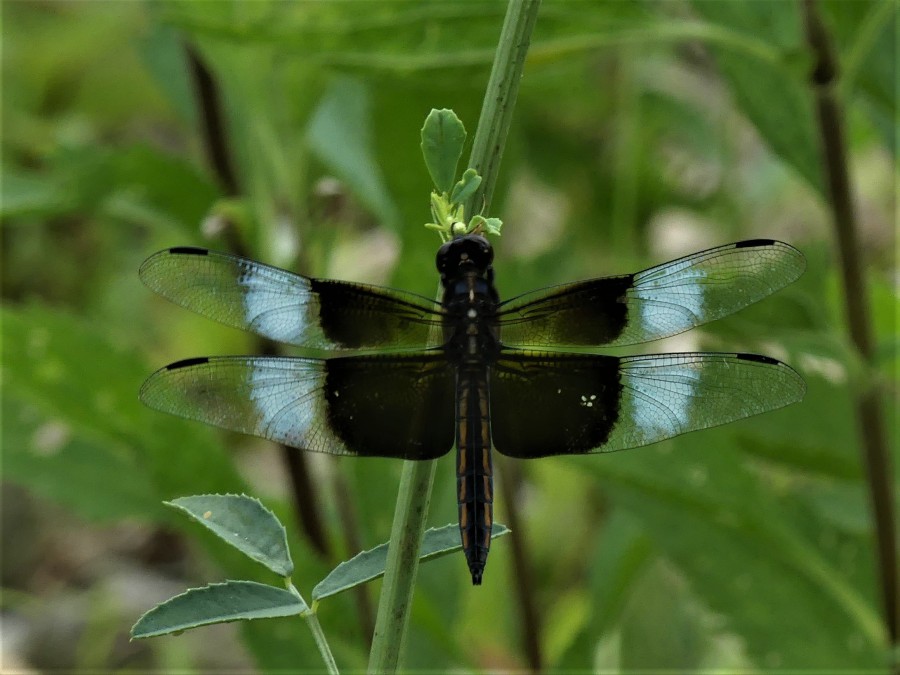
And finally one last dragonfly I always find beautiful, the male Widow skimmer. Dramatically beautiful.
MALE WIDOW SKIMMER DRAGONFLY
I would be quite remiss if I didn’t give you one last look at Chadwick Arboretum North and encourage you to go for a visit. It’s a beautiful, peaceful area right in the middle of Columbus. And it always provides new nature wonders to explore.
As Covid continues to drag on with ever increasing numbers throughout the country, it’s cause for concern. It’s also a cause to find ways to give yourself a much-needed break from the news. Restoring your inner peace and balance is more important now than ever. I believe we need to fill our worlds with positive things – things that make you smile.
For me, that’s turning to nature and looking at the miraculous wonders that abound all around us. And asking questions, just like a three-year old, so we more fully see and understand what is right in front of us.
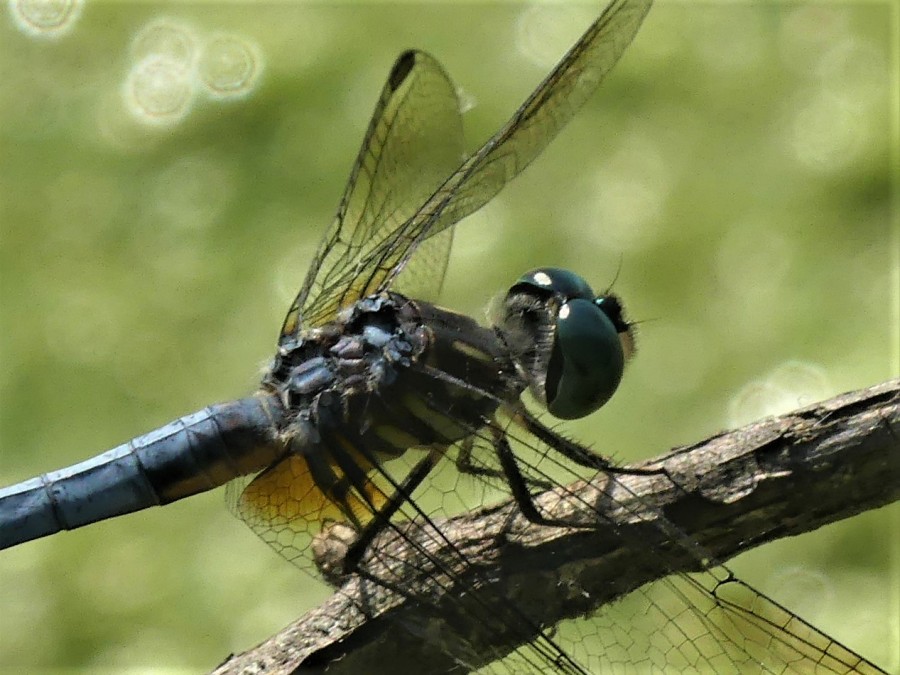
I visited a local pond not too long ago and came away with a new appreciation for dragonflies. Their colors are so amazing. Like the Blue Dasher (Pachydiplax longipennis) below. The exquisiteness of those delicate wings. And the amazing compound eyes!
Dragonflies have huge eyes that are multi-faceted and allows them to see in all directions at the same time (except directly behind them). They have the largest compound eyes of any insect. And their legs have small spines which keep prey from struggling free once caught. And they’re very strong flyers with speeds some say up to 30 mph.
Dragonflies come in a multitude of colors, blue, green brown, orange, black and more. Here are a few more colorful ones. There’s a Calico Pennant (Celithemis elisa) in the photo directly below. The green one is an Eastern Pondhawk (Erythemis simplicicollis). The orange and black one is a Halloween Pennant (Celithemis eponina). The black and white one is a male Widow Skimmer (Libellula luctuosa) and the brown one is a female Widow Skimmer. As in nature, the females tend to have more muted colors.
Calico Pennant (Celithemis elisa) dragonfly
Dragonflies aren’t the only things found hanging around ponds. Frogs have been pretty prolific this year. Here’s a big guy (who seemed to think he was well hidden) that was hanging out at the pond by our house, and another one blending in with the pond. (Not sure if that’s duckweed on the pond surface.) Our little pond has hosted quite a number of Northern Green frogs (Rana clamitans melanota), Eastern Gray Tree frogs (Hyla versicolor) and American Bullfrogs (Rana catesbeiana) this year so far. It’s quite a chorus at night.
Preserves are great places to spot nature at its best. There’s a terrific little one that’s called Boyer Nature Preserve in Westerville. It’s surrounded by houses and you wouldn’t know it’s there unless you look for it. It has three parking spots and a small gravel path leading to it. It’s more like a bog rather than a lake, but it does offer a bit of a boardwalk to get closer to the water. If you’re lucky to live nearby, it’s worth the visit.
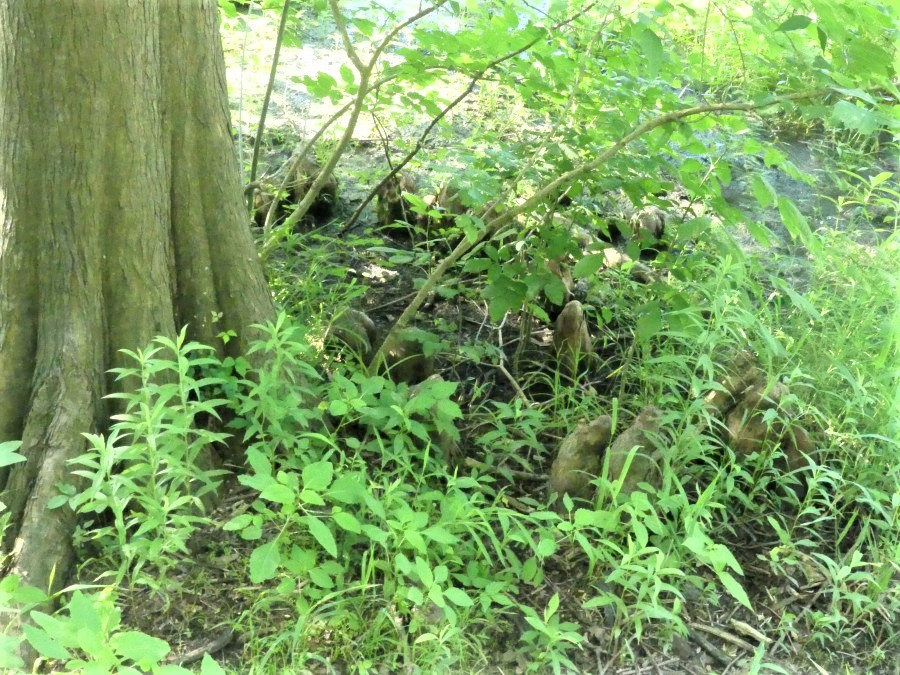
Something totally unexpected here was the Bald cypress (Taxodium distichum) tree. It’s near the back of the park, and easily identified (at least for me) by the cypress “knees” around it’s base. I always thought those were to help the tree get more oxygen when in water, but I’ve read that may not be the case. Some conjecture it could be for better stabilization in water, but it’s true purpose is unknown.
The Bald cypress tree is a deciduous conifer and loses its needle-like leaves in the fall, thus the “bald” name. It can live up to 600 years or more.
This was the first time I’ve ever seen the nut-like female cones of the tree. Each of the scales have four to five seeds. They do rather look like ornaments on a Christmas tree. Like I mentioned earlier, you never quite know what you’ll see when you’re hanging around a pond.







 Nature Views